Two Jobs, One Protein
Read the transcript of “Two Jobs, One Protein”
Film transcript: Two Jobs, One Protein
One protein has two jobs. Which job did the cell miss when losing it slowed division? Chapter one's rule can help: a result chooses only where the twins disagree. Its last test put the protein back, and division recovered.
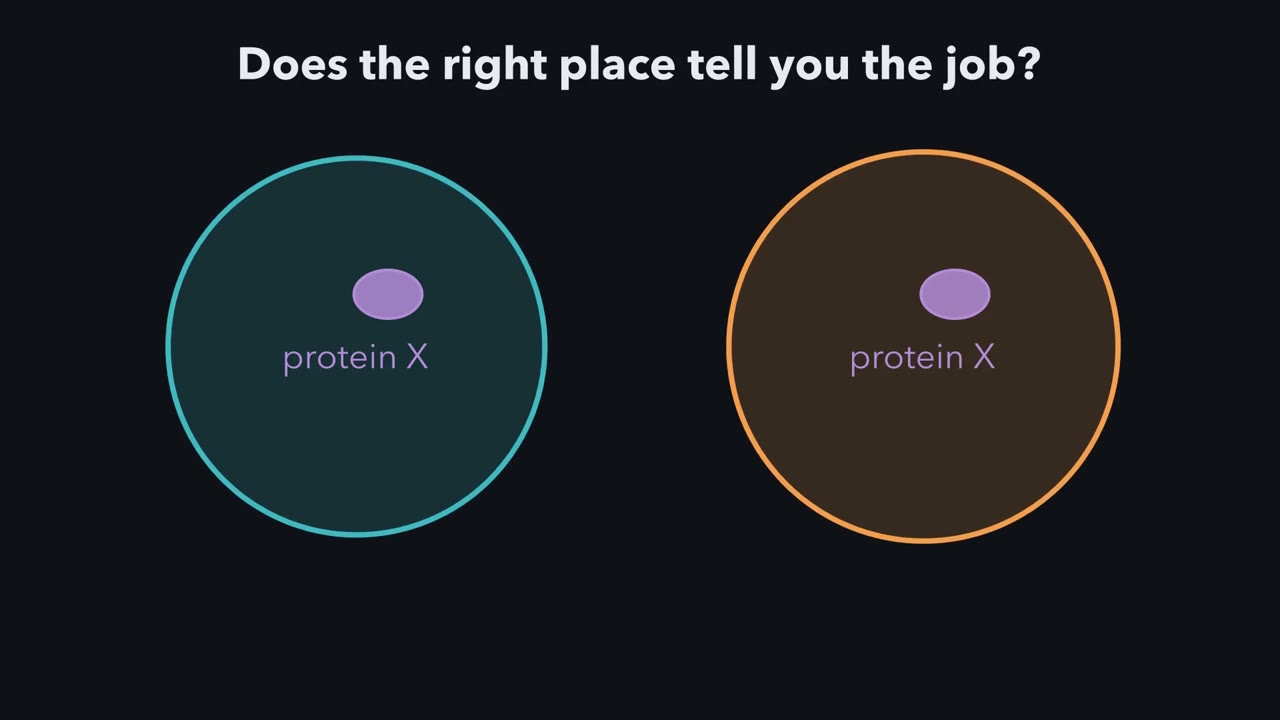
The protein is clathrin. One protein can do more than one task in a cell. Clathrin's best-known job is endocytosis. Clathrin coats small pockets of the cell's surface membrane, which pinch inward and carry material into the cell. In 2005, Stephen Royle and colleagues silenced clathrin in human cells in a dish. Mitosis, the division of one cell into two, took longer. So clathrin matters for division. But how? Here are the twins again. In the teal twin, clathrin works in mitosis itself. In the orange twin, it helps only through endocytosis, and division suffers indirectly. Interference works over a few days, so an indirect route would have time to build.
Now the rescue from chapter one. Silence clathrin in both twins, then put back the whole protein, in a form the interference cannot touch. If mitosis returns to normal, does that choose between the twins? It cannot. The whole protein brings back both jobs, so both twins predict rescue. And in the experiment, full-length clathrin did rescue mitosis. That strongly ties the defect to clathrin loss. Which job, rescue cannot say. They also put back only the front part of clathrin. It did not rescue. But a failed rescue is hard to read. The piece might be made at the wrong level, fold badly, or sit in the wrong place. To make the twins disagree, change the protein itself.
Build a resistant copy that keeps one job and loses the other. This is a separation-of-function mutant. First show that one job still works and the other does not. Then check its amount, folding and location. Royle and Leon Lagnado built such a copy the next year. What does each twin predict for it? That is a question for you in the text below. Work it out before you read on. So rescue answers one question: did losing the protein cause the defect? To ask which job, use a copy that keeps one and loses the other. Before you test it, write down what each twin predicts.
Rescue supports the protein's role; split its jobs to learn which.
Where does a protein live, in what order does it travel, and does it cause the defect you see? Each question is best answered by a different experiment, and a pellet named 'mitochondria' is never only mitochondria.
Continue in the lesson: Experiments That Distinguish Mechanisms →
3:08 · Free, with captions and a transcript. The lesson has the full text, the questions and the sources.
More films from this lesson
How this film was made. Narration: an AI narrator voice (Kokoro, af_heart) reading narration written from this lesson's text. Animation: AI-generated in code (Manim) by Claude, a schematic with no drawn molecular structures. Captions come from the narration script. See something wrong? Report it.