Putting the Switch on Trial
Read the transcript of “Putting the Switch on Trial”
Film transcript: Putting the Switch on Trial
The hybrid test pinned the fault on the lake copy's own DNA. Pitx1 RNA is missing where the pelvis forms. So which stretch of DNA is the broken pelvic switch? And how would you prove it? The colours are the same: blue for marine, orange for Paxton, gold for Pitx1 RNA. Here is the suspect, a stretch of noncoding DNA just upstream of the gene. It was first called Pel. A second switch was found later, so this one became PelA. Three tests put it on trial. First test: a reporter. Cut out the suspect DNA. Join it to a short start signal and a gene for a visible marker. Put that into fish embryos, and watch where the marker turns on.
The marine version of PelA drove the marker in the developing pelvis. The Paxton version carries a deletion. It gave pelvic expression in none of the fish tested, as the counter shows. So the Paxton switch drives no pelvic glow. Does that prove the fish's own pelvis needs PelA?
Not yet. A reporter shows what a sequence can drive, inside a construct. It does not show that the body depends on it. For that, you change the fish itself. Each test answers its own question. A reporter asks what a sequence can drive. Adding the switch back asks whether that can restore form. Removing it from the animal asks whether form depends on it. Rescue comes closer.
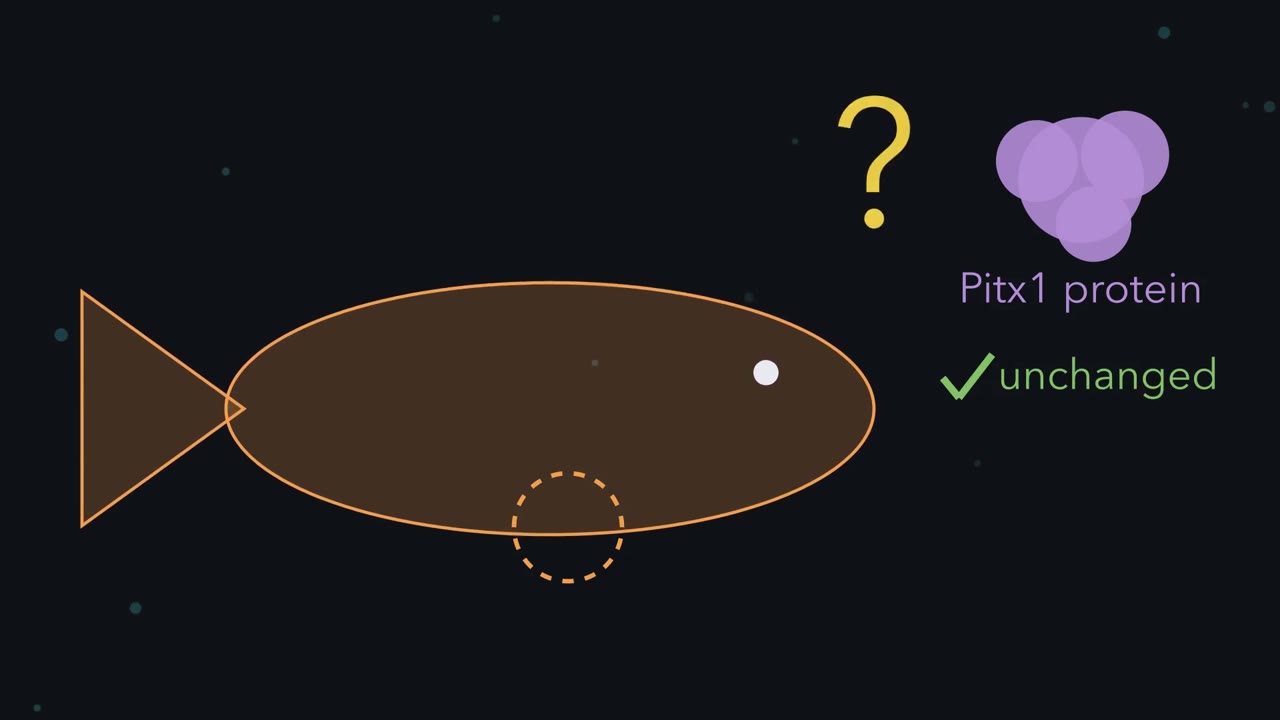
Marine PelA, driving Pitx1, was put into fertilized eggs from another pelvic-reduced lake. Those fish normally grow no pelvic spine. Compared with uninjected siblings, pelvic spine growth was variably enhanced. Now the wild fish. Many pelvic-reduced populations carry deletions at PelA. The deletions differ in where they start and stop. So the same switch was lost more than once. In one survey, deletions turned up in most pelvic-reduced populations, as the tally shows. None of the pelvis-complete populations had them. Common, then, but not universal. Most of the others showed signs of another route. Different deletions, same switch. Pelvic reduction evolved again and again by losing one enhancer, in many lakes but not all. The deletions hit the switch, not the Pitx1 protein.
Some lake sticklebacks have almost no pelvis, yet their Pitx1 protein is unchanged. If the protein did not break, what did?
Continue in the lesson: Evolution of Development →
3:07 · Free, with captions and a transcript. The lesson has the full text, the questions and the sources.
More films from this lesson
How this film was made. Narration: an AI narrator voice (Kokoro, af_heart) reading narration written from this lesson's text. Animation: AI-generated in code (Manim) by Claude, a schematic with no drawn molecular structures. Captions come from the narration script. See something wrong? Report it.