Films · Genetics and Molecular Biology
Rebuilding the Memory
Read the transcript of “Rebuilding the Memory”
Film transcript: Rebuilding the Memory
After DNA is copied, why do daughter cells not simply forget which genes were silent? The first film showed that access and regulators shape output. Now follow one regulatory state through replication and division. The sequence survives, but the state still needs maintenance.
Replication copies the DNA sequence. It does not automatically place every chemical mark on both new molecules. Look at a methylated CpG site, where a C is followed by a G. Each daughter duplex first has one old marked strand. Its partner is a new unmarked strand. The two strands now differ at each marked site. One carries inherited positional information. The other carries freshly copied sequence. A maintenance system must distinguish them before both daughter molecules can regain a similar pattern. Now predict. Which strand can guide restoration of the methylation pattern: the old marked strand or the new unmarked strand? Hold both possibilities beside the same CpG positions.
The old marked strand supplies the template. Guided to these half-marked sites, DNMT1 copies the old pattern onto the new strand. It is the main maintenance enzyme here. Other methyltransferases lay down new patterns. In mammals, dense methylation of a promoter CpG island goes with a silent gene, within promoter-specific limits. A restored pattern can therefore help keep that promoter quiet in both daughters. When the pattern is restored after replication, both daughters can inherit a similar regulatory state. That does not guarantee identical expression. It helps preserve the conditions under which the gene remains hard to read.
Similar does not mean perfectly fixed. An epigenetic change is inherited across cell divisions without changing DNA sequence. Mitotic inheritance is well established through DNMT1 and more. X inactivation and imprinting can keep one gene copy silent through many divisions. Inheritance through a whole animal's germline is a different claim. It is documented in plants and in C. elegans. In mammals, most DNA methylation is erased and rewritten in developing germ cells and in the early embryo. That is one reason transgenerational claims remain limited and contested. So chemical marks are not permanent ink.
Maintenance machinery must restore a state after replication, and other regulators can oppose it. Cellular memory is an active process. Replication creates the need again each time. It is not evidence that every acquired state crosses generations.
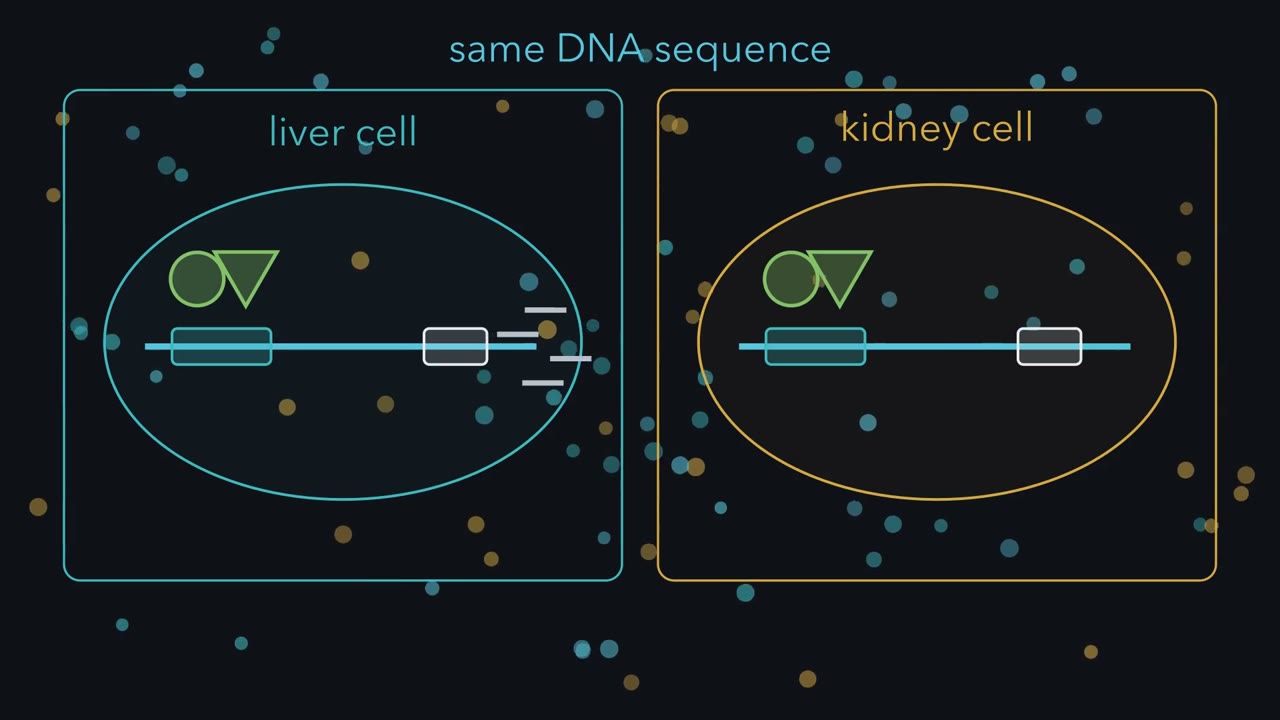
A liver cell and a kidney cell share one genome. How does each read a different part of it, and remember which part after it divides?
Continue in the lesson: Eukaryotic Gene Regulation and Epigenetics →
3:29 · Free, with captions and a transcript. The lesson has the full text, the questions and the sources.
More films from this lesson
How this film was made. Narration: an AI narrator voice (Kokoro, af_heart) reading narration written from this lesson's text. Animation: AI-generated in code (Manim) by Claude, a schematic with no drawn molecular structures. Captions come from the narration script. See something wrong? Report it.