Two Faces and a Seal
Read the transcript of “Two Faces and a Seal”
Film transcript: Two Faces and a Seal
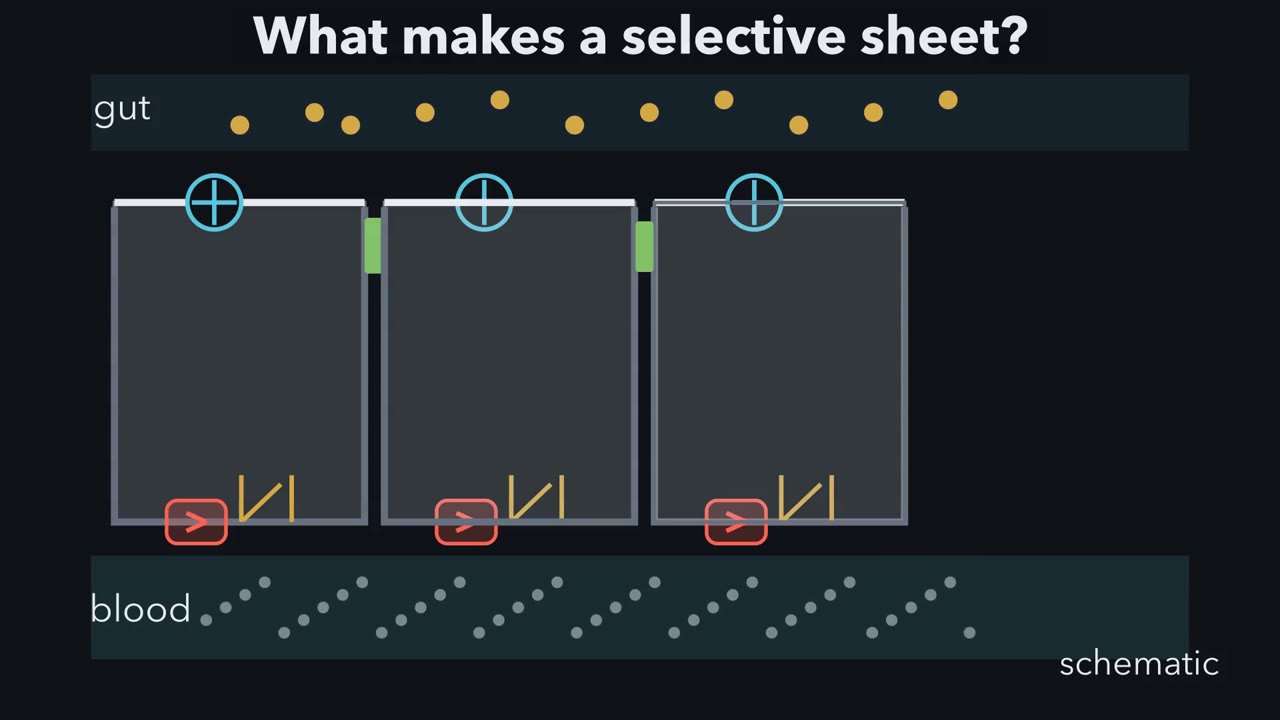
Your gut lining is a sheet just one cell thick. How does it keep pulling glucose into your blood, even when the gut holds less than the blood? Its top, the apical face, looks into the gut. Its sides and base, the basolateral face, look toward its neighbours and the blood. Each face carries different proteins. On the apical face sits a carrier called SGLT1, a sodium-glucose carrier. Think of it as a turnstile. Two sodium ions and one glucose pass through it together. Sodium is crowded outside the cell and sparse inside, and the inside is negative. So sodium falls inward, downhill. That fall, not the turnstile itself, pays the fare for glucose to climb.
Inside, glucose piles up a little. It leaves through a free exit door on the basolateral face. That door is a passive carrier: it spends no energy, and glucose runs out downhill. It is GLUT2 in the standard account. Each glucose brought two sodium ions in. The sodium pump, also on the basolateral face, spends ATP to throw sodium back out. That keeps the slope steep. Now run the clock. The gut's glucose gauge falls to the blood's level, then keeps falling below it. Glucose is moving uphill.
What sets the direction? Under these gut gradients, the carriers' places do. A sodium-paid turnstile on top and a free exit door underneath bias glucose from gut to blood. Now look between the cells. Neighbours are joined near the top by a seal. Try a thought experiment: loosen that seal enough to let glucose slip through. Would the gut still take up glucose?
It depends on the gut. Between the cells, glucose just follows its own gradient. Early in a meal, the gut holds more than the blood, so the open seal adds to absorption. Late in the meal, the gut holds less than the blood. Now the leak runs backwards.
Glucose slides back out between the cells, and the gut level stalls at a floor it cannot sink below. Tighten the seal, and the floor drops. In this thought experiment, what the sheet absorbs is what it carries through the cells, minus what leaks back between them. Here is the one idea. Under the usual gut gradients, where the carriers sit biases glucose flow from gut to blood. The seal does not orient that pathway. It decides what can slip between the cells, and so what can leak back. Our glucose leak was a thought experiment. What the real seal lets through, and how it is measured, is in the text below.
The gut lining is one cell thick. How does it keep pulling glucose into the blood, even when the gut holds less than the blood does?
Continue in the lesson: Epithelia and Tissue Organization →
3:20 · Free, with captions and a transcript. The lesson has the full text, the questions and the sources.
More films from this lesson
How this film was made. Narration: written from this lesson's text and read by an AI narrator voice (Kokoro, af_heart). Animation: AI-generated in code (Manim) by Claude, a schematic with no drawn molecular structures. Captions come from the narration script. See something wrong? Report it.