Energy Flows, Matter Returns
Read the transcript of “Energy Flows, Matter Returns”
Film transcript: Energy Flows, Matter Returns
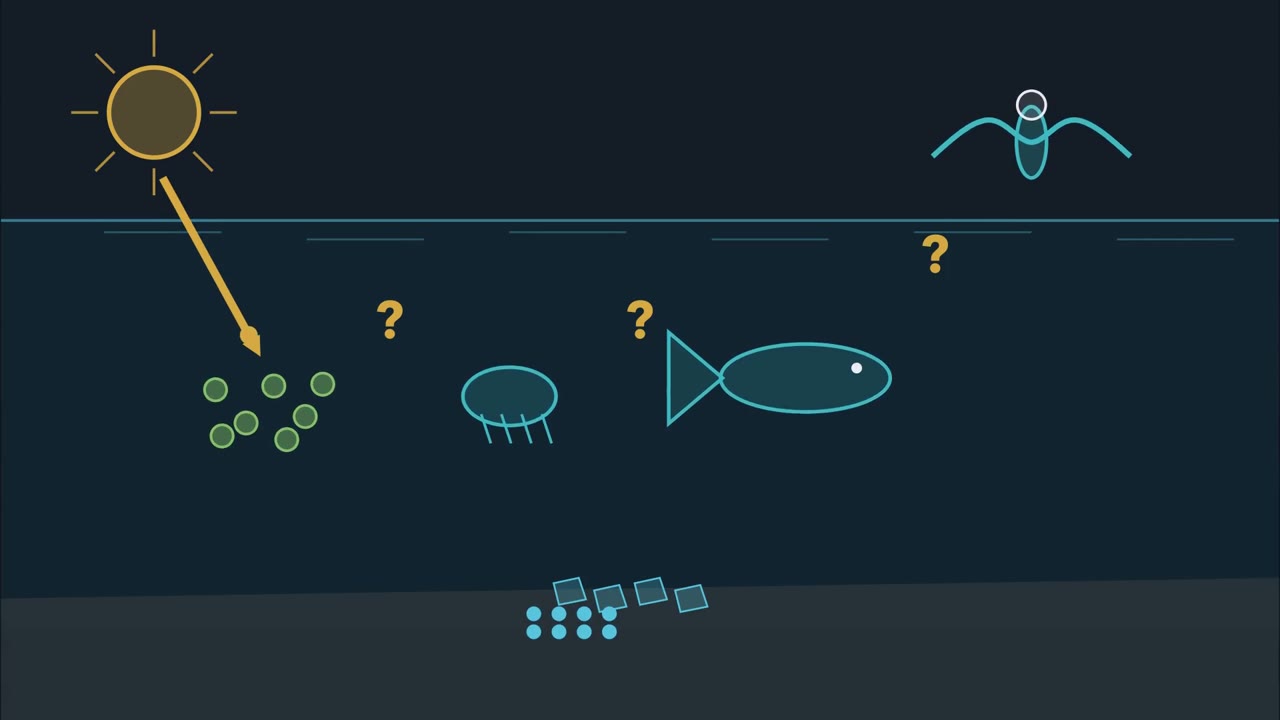
The energy pyramid followed only the tissue branch. What happens to energy that never becomes tissue for the next level? Return to the same Bay. Gold energy and green carbon now travel together, then separate. Sunlight enters the Bay as radiant energy. Phytoplankton change some into chemical energy in food.
Consumers change food energy into movement, new tissue, and red heat. Energy is never made or destroyed. It changes form as organisms live. Heat spreads through water and air. No living thing can capture that dispersed heat to build food again. The gold path moves forward and fades outward as red ripples.
Nearly every ecosystem needs a continuing energy supply. In the Bay, that supply is sunlight. A menhaden dies, and blue decomposers break it down. Can they return both its carbon and its usable food energy to phytoplankton? Hold both paths in mind.
Decomposers release much of the menhaden's green carbon as carbon dioxide. Phytoplankton can take that carbon up again. The green path closes into a loop. Energy does not. Decomposers also respire, so more chemical energy becomes heat and leaves the usable food pathway. Compare the maps. Carbon atoms pass through organisms, air, and water, and can be reused. Some may be buried or carried away. Energy enters, changes form, and disperses as heat.
Matter mostly cycles. Energy moves forward through this sunlit ecosystem. Not every ecosystem starts with sunlight. Some deep-sea vent communities begin with chemical energy. That changes the entrance, but energy still disperses as heat. The Bay picture has a clear scope, not a universal starting source. Ecologists test the picture with energy budgets. They compare neighboring feeding levels using matching measurements over the same area and time. Intake, new tissue production, and standing biomass are different measures. Mixing them makes a false transfer percentage. Transfer percentages vary among ecosystems and feeding steps.
Temperature, what gets eaten, digestion, and respiration can change the share reaching new tissue. That variation does not turn energy into a cycle. It changes how wide the next gold band becomes before the remaining energy disperses. Return to the osprey's fish. Its carbon may later enter decomposers, carbon dioxide, and phytoplankton again. Its energy can power movement or growth only before becoming dispersed heat. The same organism belongs to a matter loop and a forward energy path. Keep paths separate when reading any food web. Energy flows through ecosystems, while matter cycles and can be reused.
An osprey on the Chesapeake Bay eats fish, and the fish eat plankton, so how much of the sunlight the plankton caught ever reaches the osprey?
Continue in the lesson: Energy in Ecosystems →
3:41 · Free, with captions and a transcript. The lesson has the full text, the questions and the sources.
More films from this lesson
How this film was made. Narration: an AI narrator voice (Kokoro, af_heart) reading narration written from this lesson's text. Animation: AI-generated in code (Manim) by Claude, a schematic with no drawn molecular structures. Captions come from the narration script. See something wrong? Report it.