Where the Marsh Grass Goes
Read the transcript of “Where the Marsh Grass Goes”
Film transcript: Where the Marsh Grass Goes
In the made-up budget, decomposers respired far more than the grazers and predators. Most plant production was never eaten by a grazer at all. Was that just a quirk of invented numbers? In a real ecosystem, where does the plants' production actually end up each year? John Teal asked this on the coast of Georgia. He built an energy budget for a salt marsh, and published it in 1962. One grass dominates these marshes, smooth cordgrass It grows in the tidal mud and makes a great deal of plant matter each year. A grazing-chain picture of ecology predicts the obvious route.
Grass feeds the herbivores, and then the herbivores feed the predators. Teal did not assume the route. He assembled the budget from measurements of the grass and the algae on the mud. It also drew on measurements of the animals and bacteria living there.
Insects and other animals graze on the living grass. Will they take most of its production, or only a small part? Only a small part. In Teal's budget, the purple pipe to the grazers was thin. The grazing chain was a side channel. Much of the grass died instead, and broke into fragments. Bacteria used those fragments, and so did animals that feed on detritus. Those detritus feeders are themselves eaten. So detritus is not a dead end for animals. It is a second route into the food web. Every organism on this route respires. Each one releases heat through a grey door. The energy never returns to the grass. Only matter cycles. Nutrients return to the grass through its roots.
Carbon returns as carbon dioxide, which the leaves fix again. The energy comes from fresh sunlight. Teal's budget also left a remainder. After the respiration of bacteria and animals, about 45% percent of net production was left over. He took it as available to leave the marsh with the tides. But it was a remainder, not a measured export. Even so, the study changed the picture. With others' work on decomposing marsh grass, it moved detritus from a footnote to the centre of coastal budgets.
So keep the brown door in every budget. In this marsh, most grass production went that way rather than to grazers, and respiration released its energy as heat.
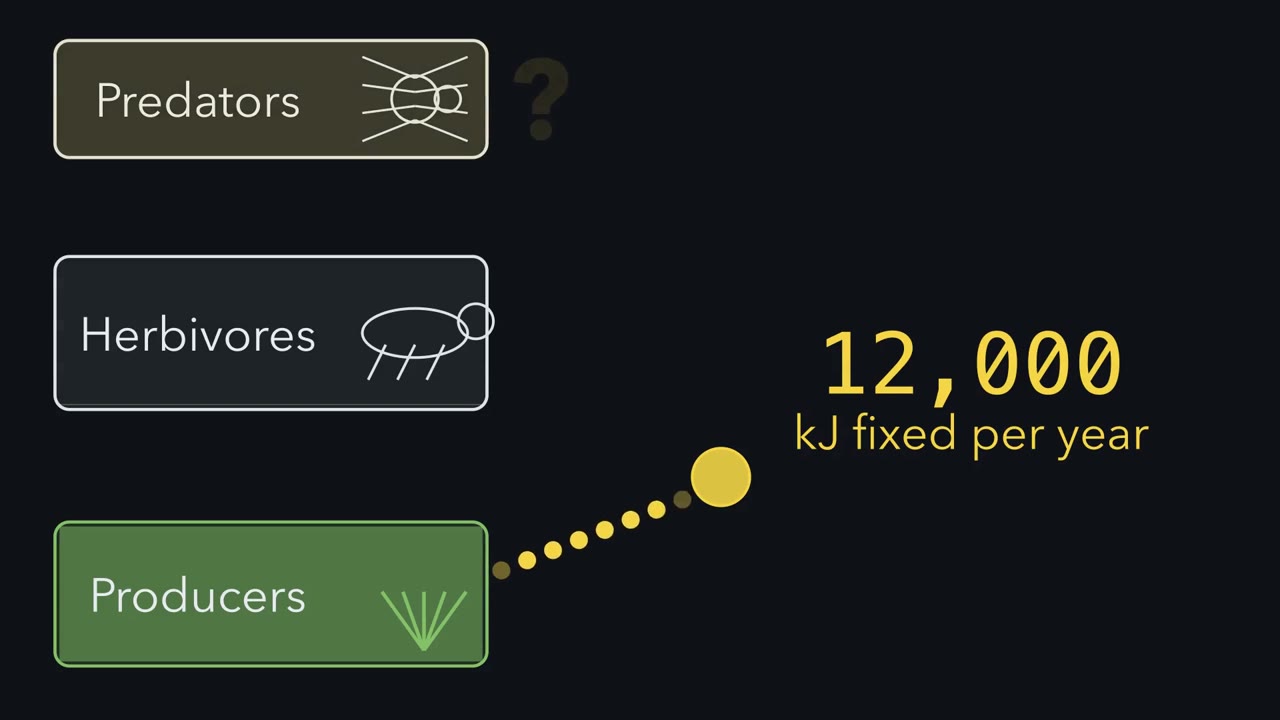
In a made-up budget, plants on one square metre fix 12,000 kilojoules a year and the top predators make 40. Where did the rest go?
Continue in the lesson: Energy Flow and Productivity →
3:08 · Free, with captions and a transcript. The lesson has the full text, the questions and the sources.
More films from this lesson
How this film was made. Narration: an AI narrator voice (Kokoro, af_heart) reading narration written from this lesson's text. Animation: AI-generated in code (Manim) by Claude, a schematic with no drawn molecular structures. Captions come from the narration script. See something wrong? Report it.