Cutting One Route at a Time
Read the transcript of “Cutting One Route at a Time”
Film transcript: Cutting One Route at a Time
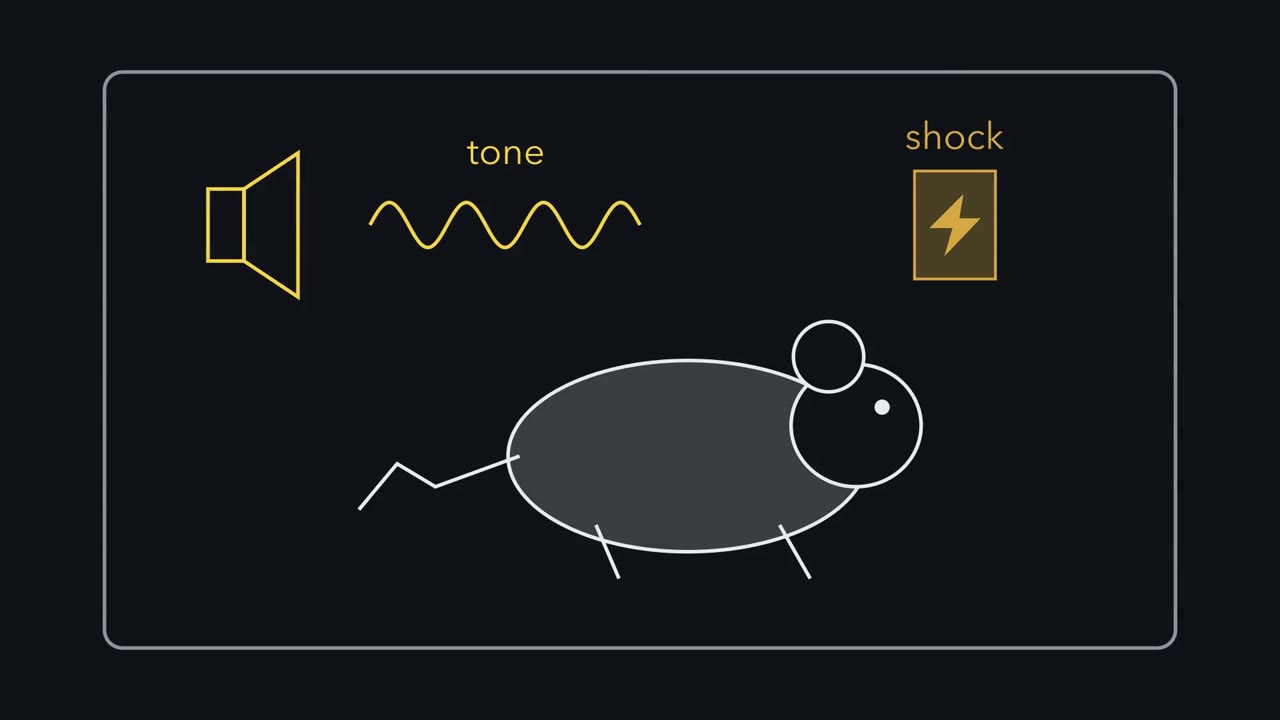
Freezing and the pressure rise arrive together. Do they travel one route out of the amygdala, or two? In 1988, Joseph LeDoux and his colleagues asked exactly that, in rats. First they damaged one target of the central amygdala. Two weeks later they trained the rats, and the next day played the tone alone. In the same rats, they measured both responses: freezing, and the rise in blood pressure. Picture two bars for each group. Intact rats that had the pairing show two tall bars. Intact rats without the pairing show two short bars. That short pair is our baseline. For these invented numbers, we assume the damage leaves the baseline alone, and that each score is the baseline plus a learned part.
So the excess over the baseline estimates the learned response. Suppose both responses need the same route through these lateral hypothalamus neurons. What should damage there do to freezing? If both responses needed those neurons, both would fall. They do not. The pressure rise falls almost to the baseline. Freezing stays almost at the top. So freezing does not need the lateral hypothalamus, but the pressure rise does. Now damage the caudal, or rear, periaqueductal gray instead. What do you expect this time?
The reverse. Freezing drops almost to the baseline, and the pressure rise survives. Each kind of damage impairs one response and spares the other. That pattern is called a double dissociation. It means different targets below one amygdala node contribute to different responses. In the worked problem, damage to the central amygdala itself leaves neither learned response above the baseline, as a shared source predicts. One detail matters. The caudal midbrain damage used ibotenic acid, a toxin that kills cell bodies but spares passing axons. So the freezing loss points to neurons in the periaqueductal gray, not to cut fibres. The same toxin in the lateral hypothalamus impaired the pressure rise while sparing freezing.
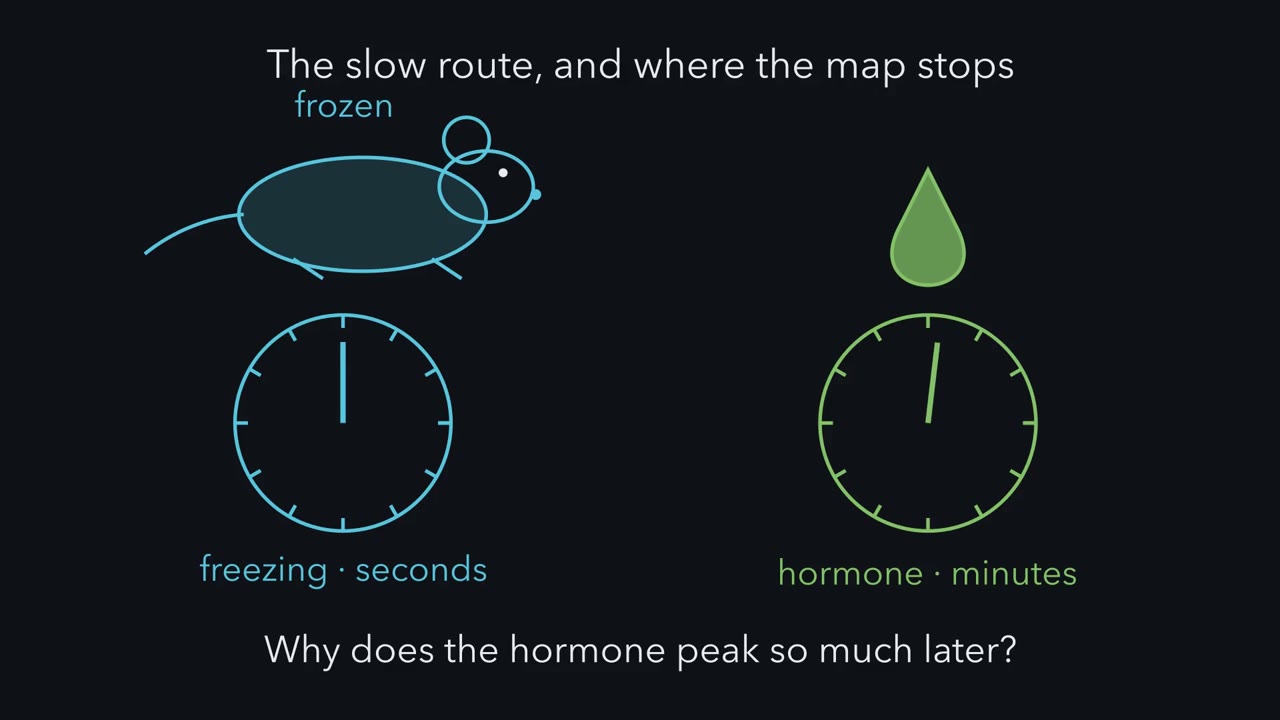
This experiment finds the routes out of the amygdala. It says nothing yet about a feeling.
A rat freezes to a tone that once came before a shock. Damage one region of its hypothalamus and it still freezes, but its learned rise in blood pressure is impaired.
Continue in the lesson: Emotion and Stress →
2:48 · Free, with captions and a transcript. The lesson has the full text, the questions and the sources.
More films from this lesson
How this film was made. Narration: an AI narrator voice (Kokoro, af_heart) reading narration written from this lesson's text. Animation: AI-generated in code (Manim) by Claude, a schematic with no drawn molecular structures. Captions come from the narration script. See something wrong? Report it.