One Signal, Three Routes
Read the transcript of “One Signal, Three Routes”
Film transcript: One Signal, Three Routes
A rat hears a tone that once came just before a mild shock. What does its brain do with that tone? Two things happen at once. The rat stops moving, and its blood pressure rises. Neither one is the feeling of fear. But both can be measured, and that lets us trace them in the brain. First, is the response learned? One group of rats hears tones that end in a shock. A second group gets the same tones and the same shocks, but kept apart in time. Later, the paired rats freeze far more to the tone alone. That difference is our estimate of what was learned. Where is it learned? The tone travels to the amygdala, a cluster of nuclei deep in the brain. The lateral amygdala is the input stage.
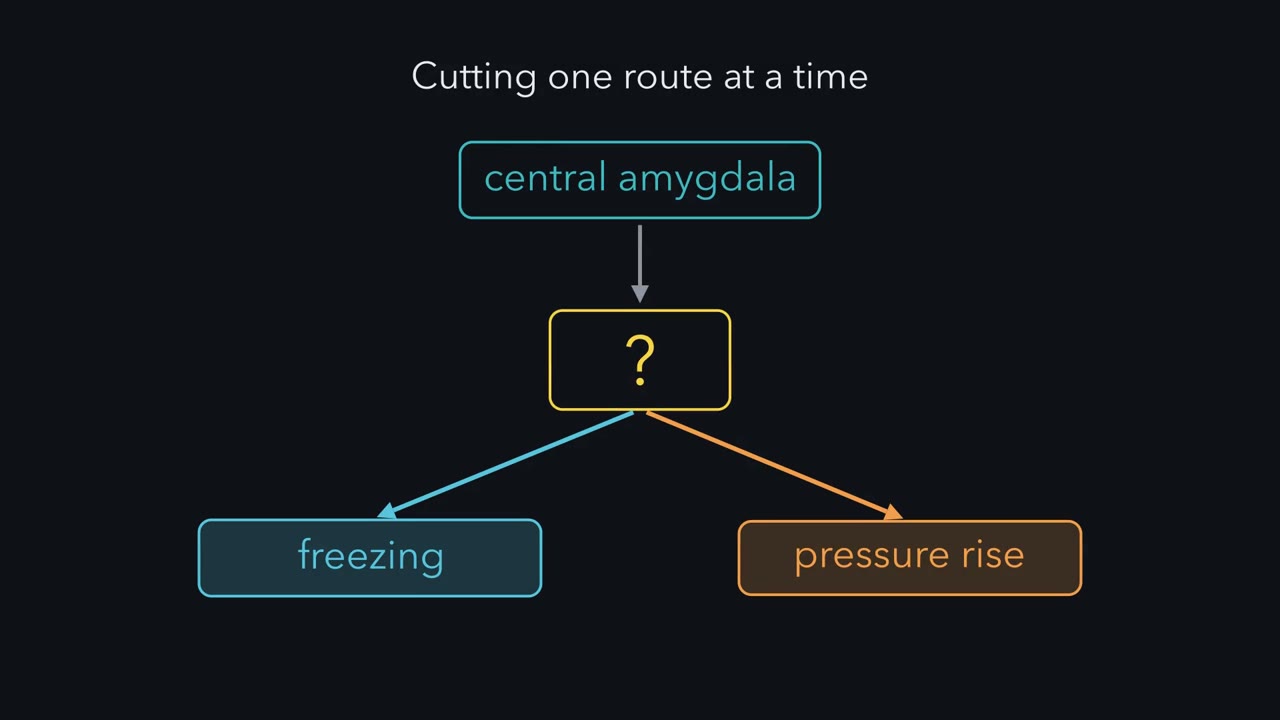
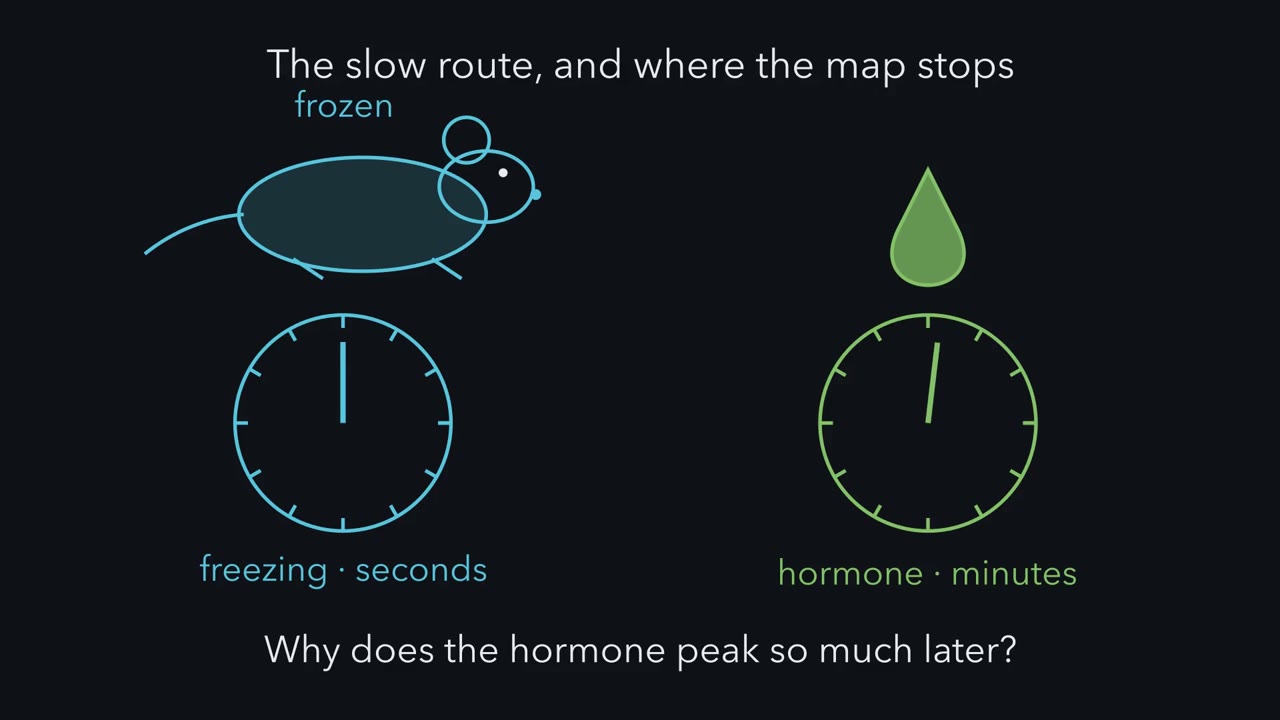
The central amygdala sends the signal out. Three routes leave it. One runs to the periaqueductal gray, in the midbrain. It drives freezing. A second runs to the lateral hypothalamus. It drives the rise in blood pressure. A third, mostly indirect, reaches a hormone chain: hypothalamus, pituitary, adrenal. In people, its hormone is cortisol. Two of these routes are fast. Freezing and the pressure rise appear while the tone is still playing. The hormone route is slow. The adrenal must make its hormone, so levels peak tens of minutes later. Feedback then turns further release down. So here is the rule. A learned threat cue reaches the amygdala, then leaves by separate routes.
In this rat task, damaging neurons in one target impaired mainly its own response. Damage to the amygdala can impair both. This map is for learned responses to a cue outside the body, measured in rats. It does not say what the rat feels. Later chapters show where the map stops. The amygdala is needed to learn the threat. Separate routes carry out the response, two fast and one slow.
A rat freezes to a tone that once came before a shock. Damage one region of its hypothalamus and it still freezes, but its learned rise in blood pressure is impaired.
Continue in the lesson: Emotion and Stress →
2:15 · Free, with captions and a transcript. The lesson has the full text, the questions and the sources.
More films from this lesson
How this film was made. Narration: an AI narrator voice (Kokoro, af_heart) reading narration written from this lesson's text. Animation: AI-generated in code (Manim) by Claude, a schematic with no drawn molecular structures. Captions come from the narration script. See something wrong? Report it.