Does More DNA Mean More Complex?
Read the transcript of “Does More DNA Mean More Complex?”
Film transcript: Does More DNA Mean More Complex?
The first film followed DNA sequence to proteins and traits. Does more DNA have to mean a more complex organism? To test that idea, we need counts from real chromosome sets, not guesses. DNA amount means total base pairs in a full chromosome set. A base pair is a ladder rung. Scientists sequenced some living things and estimated others. These methods count DNA; they do not score complexity. Watch each ladder become a counter, then a bar. Each bar shows published data for an organism. Every estimated value keeps its estimate label on screen. The rows include a bacterium and fungus, then plant and animal examples. Every group represented here has DNA.
That supports a careful claim about this table. It does not let this small set represent every living thing everywhere. If amount ranked complexity, where should the human bar end compared with the onion bar? Make your prediction before either bar grows. Remember, this test compares a full chromosome set with a full chromosome set.
The human bar grows, but the onion bar continues far beyond it. The table's division appears on screen. The onion chromosome set has several times the human amount. A larger DNA total does not rank organism complexity. Now reveal every bar in data order.
Rice extends beyond fruit fly, and onion extends beyond human. The pattern does not march from simpler to more complex. Total base count and organism complexity are different questions. Amount counts all base pairs, not only genes carrying protein instructions. It also does not tell which genes a cell uses.
Sequence and gene use help explain traits. A total length cannot replace that information. Now both halves meet. DNA sequence helps shape traits; DNA amount does not rank organism complexity. The rule has scope. Amount here means base pairs in one chromosome set.
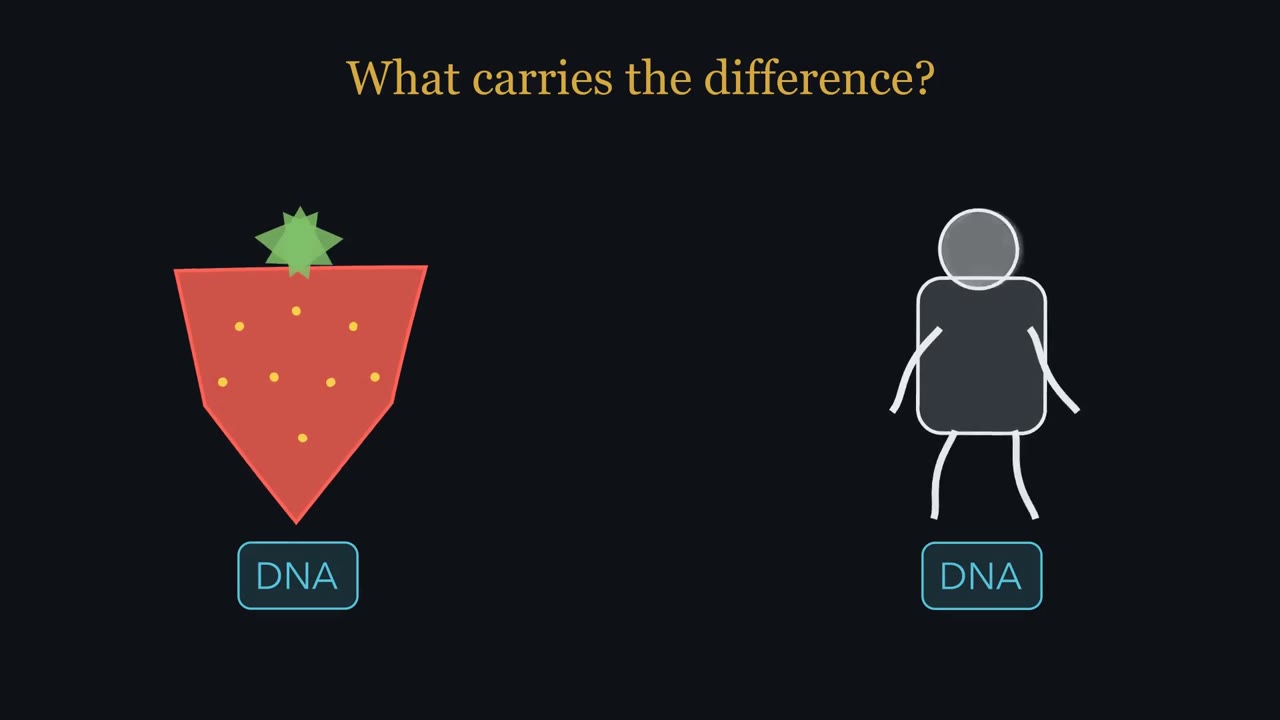
Sequence helps through genes, proteins and gene use, and many traits also depend on the surroundings. These bars come from published lab studies, not field samples. Most rows come from one strain or sample. Several values are estimates. The human row is a set without Y, and onion uses an earlier estimate. Good evidence keeps limits attached. The films began with a strawberry and person sharing DNA parts. The answer is not a bigger ladder. Different base orders and different gene use can guide different proteins.
DNA amount does not rank organism complexity.
If strawberries, mushrooms, bacteria and people all have DNA, why are they so different?
Continue in the lesson: DNA: The Code of Life →
3:27 · Free, with captions and a transcript. The lesson has the full text, the questions and the sources.
More films from this lesson
How this film was made. Narration: an AI narrator voice (Kokoro, af_heart) reading narration written from this lesson's text. Animation: AI-generated in code (Manim) by Claude, a schematic with no drawn molecular structures. Captions come from the narration script. See something wrong? Report it.