Inside the Fork
Read the transcript of “Inside the Fork”
Film transcript: Inside the Fork
In the first film, each old strand fixed its new partner. But how does a cell actually build those two new strands, one letter at a time? A real cell does not open the whole molecule at once. It opens the DNA at a moving Y, called the fork. The fork moves along, opening fresh template as it goes. Both old strands carry arrowheads, and they point opposite ways. The enzyme that builds new DNA is DNA polymerase. At each base, it picks the nucleotide that pairs with it. A wrong one almost never gets in. Then it joins that nucleotide to the growing strand with a covalent bond. Polymerase has one strict habit. It adds nucleotides only at the arrowhead end of a new strand.
So every new strand grows arrowhead first, pointing the opposite way to its template. On the upper template, the new strand's arrowhead points the way the fork moves. So polymerase simply follows the fork, adding nucleotide after nucleotide in one long run. Now look at the lower template. Its new strand must point the other way, back away from the fork. If polymerase only adds at the arrowhead, how can it copy this strand?
It builds in short pieces, because the fork opens only a little template at a time. Each piece starts near the fork and grows away from it. When the fork opens more template, a fresh piece starts near the fork and grows back toward the last one. Another enzyme joins the pieces into one strand. Now zoom in on one step, because copying must also be accurate. Polymerase tests each incoming nucleotide against the template. A nucleotide that does not pair is usually turned away. Sometimes a wrong base slips in anyway. Polymerase checks each new base and removes most wrong ones. This step is called proofreading.
Repair enzymes then catch many of the mistakes that slip past. Put the checks together: the matching check, proofreading, then repair. Each later check catches many mistakes the earlier ones missed. A textbook estimate is about one uncorrected mistake for every billion bases copied. So copying has two jobs. Pairing makes the copy possible, because it tells polymerase which base goes where. Checking makes the copy accurate, because it removes almost every slip.
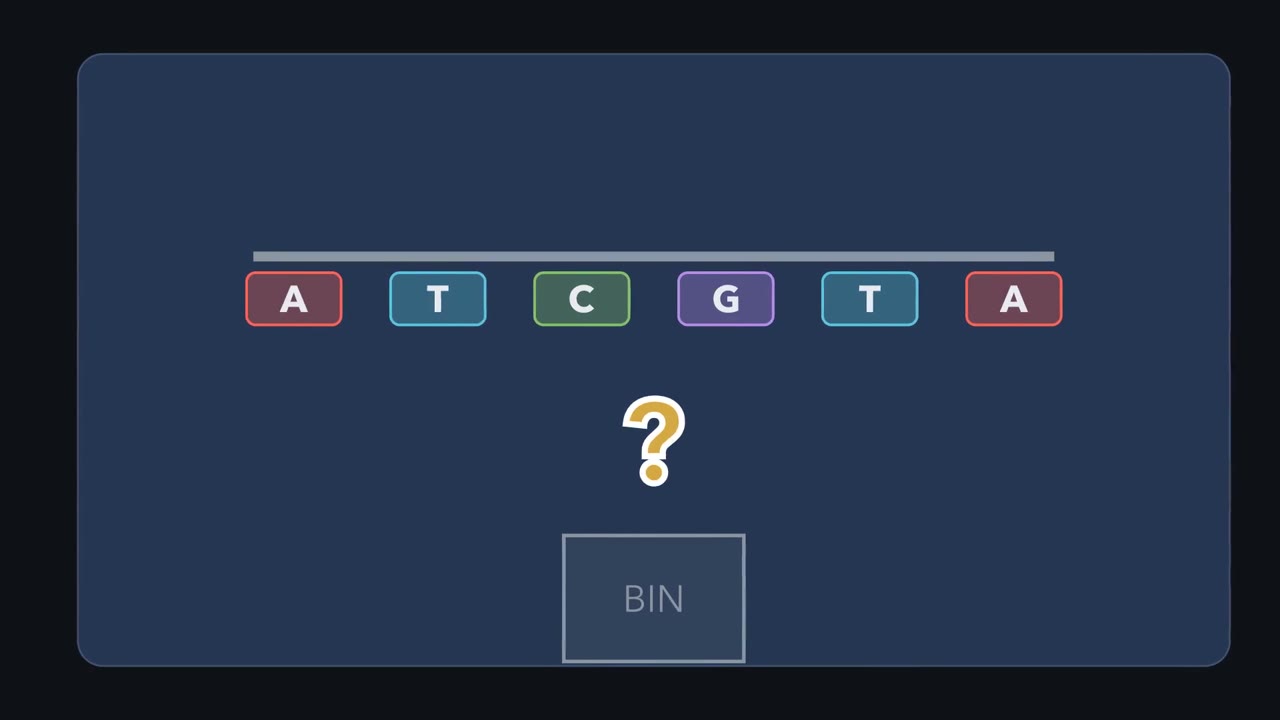
If you kept only one strand of a DNA molecule and threw the other away, could you rebuild the whole thing, letter for letter?
Continue in the lesson: DNA: Structure and Copying →
3:02 · Free, with captions and a transcript. The lesson has the full text, the questions and the sources.
More films from this lesson
How this film was made. Narration: an AI narrator voice (Kokoro, af_heart) reading narration written from this lesson's text. Animation: AI-generated in code (Manim) by Claude, a schematic with no drawn molecular structures. Captions come from the narration script. See something wrong? Report it.