Films · Genetics and Molecular Biology
Why One Strand Is Built in Pieces
Read the transcript of “Why One Strand Is Built in Pieces”
Film transcript: Why One Strand Is Built in Pieces
Each daughter molecule keeps one old strand and builds one new strand. But the two old strands point opposite ways. How can one fork build both new partners? Keep the first film's colour map. Purple marks parental templates, and cyan marks new DNA. The parental duplex opens into a moving Y-shaped replication fork. Each purple strand must guide a cyan partner, but the two templates run in opposite directions. Every DNA polymerase adds a nucleotide only to a 3' end. New DNA therefore grows 5' to 3'. A copying polymerase also needs that end paired to its template. Replicative polymerases cannot start a chain. Primase must first supply a short paired primer.
The fork moves right, exposing more purple template. Which cyan strand can grow with that fork while its polymerase extends a 3' end? On one template, the growing 3' end faces the fork. Polymerase follows the opening helix and lengthens one continuous leading strand. Its direction of synthesis stays 5' to 3'. On the other template, the usable 3' end faces away from the fork. Polymerase cannot reverse its chemistry. Primase starts near the fork, then polymerase extends back toward the previous piece. As more template opens, the cycle starts again. These pieces are Okazaki fragments. The pieces must become one strand. In E. coli, DNA polymerase I removes each RNA primer while replacing it with DNA.
DNA ligase seals the remaining nick. The finished lagging strand is continuous, although it was built discontinuously. Several proteins keep the fork moving. DnaB helicase unwinds the parental duplex. Single-strand binding protein holds the templates apart, and gyrase relieves overwinding ahead.
DnaG primase places primers. DNA polymerase III, held by its β clamp, performs most synthesis. Eukaryotes keep the same geometry with different parts and many origins. CMG is the helicase. Pol α-primase starts chains. The usual summary assigns most leading synthesis to Pol ε. It assigns most lagging synthesis to Pol δ on PCNA. Names change, but the constraint does not. Every fork needs a way to open DNA, start new chains, extend them, replace starter material, and seal the products. The text compares these jobs and the evidence behind them. Polymerases extend a 3' end, so one strand is built in pieces. Both strands still obey the same chemistry.
The enzyme never changes synthesis direction to solve the geometry. This constraint turns opposite templates into different building patterns.
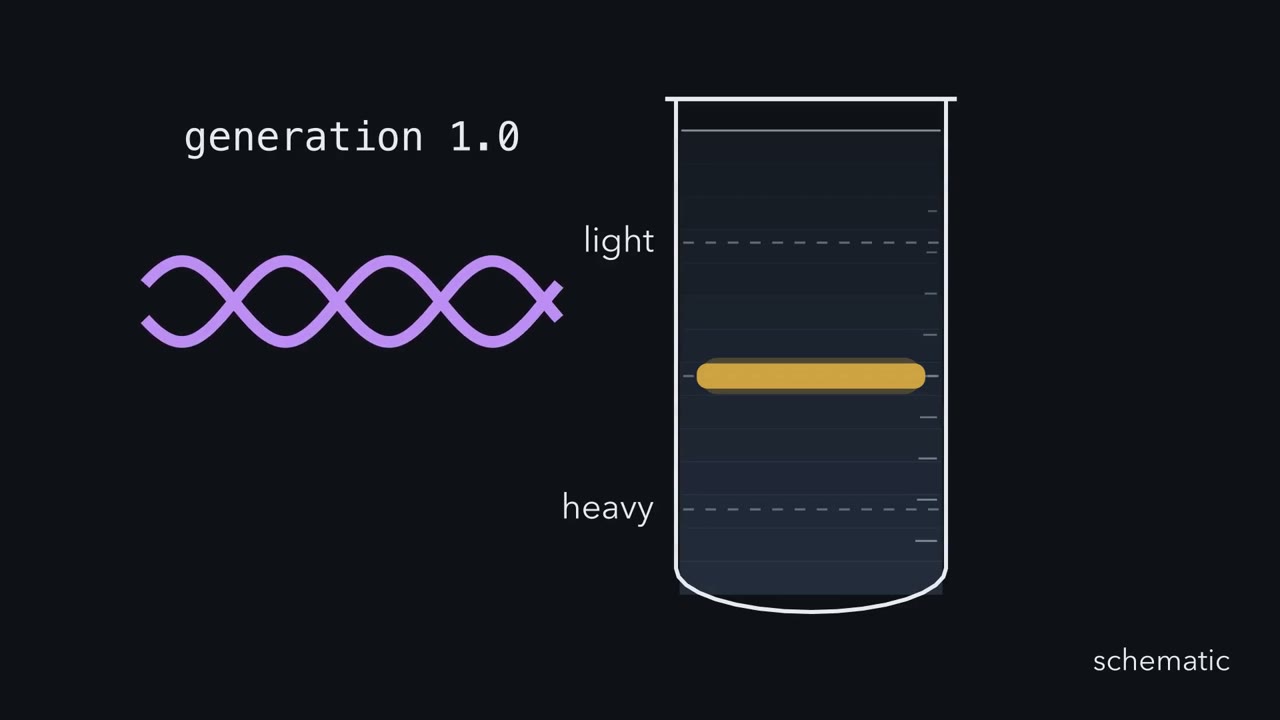
One generation after a switch from heavy to ordinary nitrogen, all of E. coli's DNA sat halfway between heavy and light. Why halfway?
Continue in the lesson: DNA Replication: Semiconservative Copying and Its Machinery →
3:41 · Free, with captions and a transcript. The lesson has the full text, the questions and the sources.
More films from this lesson
How this film was made. Narration: an AI narrator voice (Kokoro, af_heart) reading narration written from this lesson's text. Animation: AI-generated in code (Manim) by Claude, a schematic with no drawn molecular structures. Captions come from the narration script. See something wrong? Report it.