Films · Genetics and Molecular Biology
What the Halfway Band Means
Read the transcript of “What the Halfway Band Means”
Film transcript: What the Halfway Band Means
One generation after heavy-labelled E. coli switched to ordinary nitrogen, all of its DNA formed one band. That band sat halfway between heavy and light. Why did none remain fully heavy? To follow old DNA, Meselson and Stahl grew cells with heavy nitrogen. Old strands appear purple; strands built after the switch appear cyan. In a caesium chloride gradient, heavy DNA settles lower than light DNA.
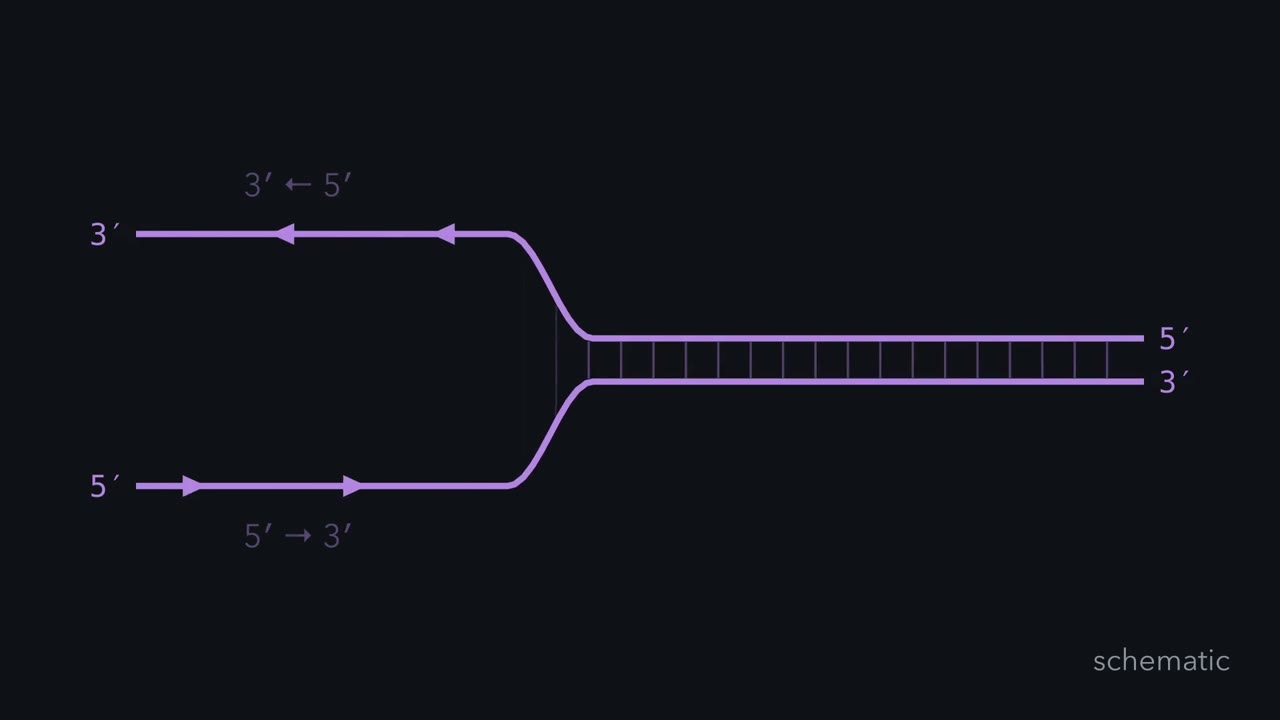
Hybrid DNA settles between them. Three models start from the same purple duplex. Conservative copying keeps both old strands together and builds a separate cyan duplex. Semiconservative copying separates the old strands, then gives each a new partner. Uniform dispersive copying breaks the old material into segments and mixes those segments through both daughters. A band is not a picture of a helix. It marks many DNA molecules with the same buoyant density. One intermediate band could mean every molecule is half old. It cannot reveal whether that half is one intact strand or many segments until another generation separates their predictions. Watch each model make its initial daughters.
Which models can put every molecule at the hybrid position, with no heavy or light band? Conservative copying makes one heavy duplex and one light duplex. A single hybrid band after one generation rules out conservative copying. Semiconservative copying makes two purple-cyan hybrids.
Uniform dispersive copying can also put equal old and new material in every molecule. Both survive the initial test. Now let the survivors copy again in ordinary nitrogen. Semiconservative copying keeps each purple strand in one hybrid. The other daughters are fully cyan. Its tube gains separate hybrid and light bands. Uniform dispersive copying halves the old fraction inside every molecule again. Its single band shifts toward light. Semiconservative copying After two generations, the extracted DNA formed hybrid and light bands in equal amounts. That matches the semiconservative distribution, not one uniformly mixed band. Hybrid and light bands after two generations rule out uniform dispersive copying. The old material never disappears.
It only spreads among more molecules, and where it sits is decisive. The experiment tracked inherited material, not enzymes. Heating the hybrid DNA separated heavy and light subunits, consistent with old and new strands. Meselson and Stahl still stated their limit carefully. Their bands did not alone show that each conserved subunit was one polynucleotide chain. Each daughter molecule keeps one old strand and builds one new strand. That logic predicts later band patterns and gives replication its name: semiconservative. Keep the rule for chromosome replication in this lesson.
One generation after a switch from heavy to ordinary nitrogen, all of E. coli's DNA sat halfway between heavy and light. Why halfway?
Continue in the lesson: DNA Replication: Semiconservative Copying and Its Machinery →
3:46 · Free, with captions and a transcript. The lesson has the full text, the questions and the sources.
More films from this lesson
How this film was made. Narration: written from this lesson's text and read by an AI narrator voice (Kokoro, af_heart). Animation: AI-generated in code (Manim) by Claude, a schematic with no drawn molecular structures. Captions come from the narration script. See something wrong? Report it.