How Does the Stomach Know Food Is Coming?
Read the transcript of “How Does the Stomach Know Food Is Coming?”
Film transcript: How Does the Stomach Know Food Is Coming?
How does a stomach know a meal is coming? Can it start work before any food arrives? The first film showed the gut as a one-way line, with several stretches working at once. Some signals ready a stretch before food arrives. Others answer once it is there. Ivan Pavlov's laboratory, in Saint Petersburg, asked this of dogs. The dogs had recovered from surgery, and were awake and eating. So one gland at a time could be studied in a whole, living animal. In one dog, the esophagus was opened at the neck. Food the dog swallowed fell out into a dish. It never reached the stomach. A second opening, called a fistula, let the workers collect juice straight from the stomach into a flask.
Suppose stomach juice flows only when food touches the stomach. What should the flask collect while this dog eats? After a delay of some minutes, acid juice flowed. It came from the stomach, through the fistula. The dog was eating, but no food had reached its stomach. Then both vagus nerves were cut. These nerves run from the brainstem to the stomach. Now the dog ate, and the flask stayed empty. So in the dog, nerves start the stomach early. This is the cephalic phase, set off by the sight, smell, taste and chewing of food. This rules in a nerve-driven start. It does not rule out later steps, once food is inside the gut. Here are two later steps.
Chyme, the stomach's acid soup of food, moves on into the duodenum, the first part of the small intestine. These steps use hormones. A hormone is a substance released into the blood, which acts on distant target cells. The blood carries the message to the next gland. Acid arriving there makes the duodenal lining release a hormone, secretin, into the blood. The pancreas answers with fluid rich in bicarbonate, which neutralizes the acid. Fat and protein arriving release a second hormone, cholecystokinin, called CCK. The pancreas sends enzymes, and the gallbladder squeezes out bile. So nerves start the stomach before food arrives. And a stretch that food has just reached signals the glands that serve it.
The duodenum reports acid, fat and protein, and the right glands answer.
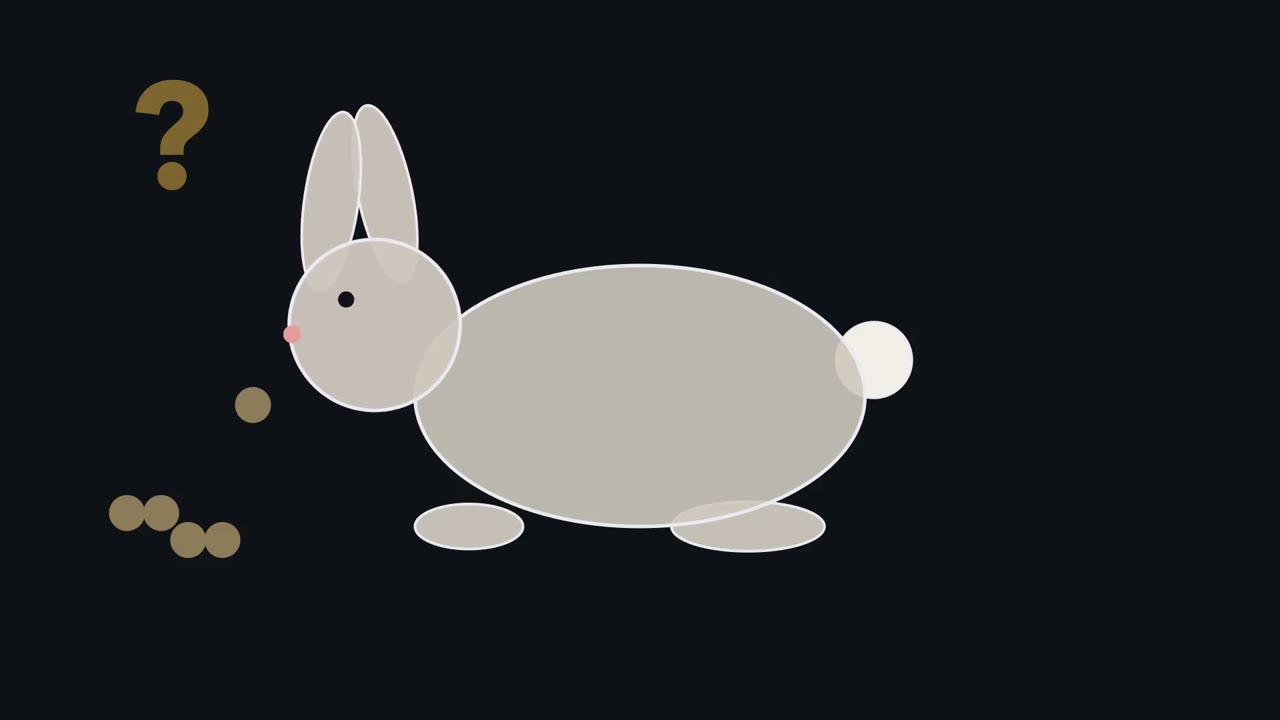
Why would a rabbit eat some of its own droppings?
Continue in the lesson: Digestive Systems and Nutrition →
2:56 · Free, with captions and a transcript. The lesson has the full text, the questions and the sources.
More films from this lesson
How this film was made. Narration: an AI narrator voice (Kokoro, af_heart) reading narration written from this lesson's text. Animation: AI-generated in code (Manim) by Claude, a schematic with no drawn molecular structures. Captions come from the narration script. See something wrong? Report it.