When a Drug Becomes a Test
Read the transcript of “When a Drug Becomes a Test”
Film transcript: When a Drug Becomes a Test
Chapter one linked free subunits, ends, and their lattice. How can a drug turn that rule into a clean test? A drug is informative only when three labels stay attached: its target, dose, and test system. Remove any label, and the same drug name can support the wrong conclusion. Keep the moving parts on screen. Free subunits feed an end; the end adds to or removes from a lattice. A perturbation can act at any of those three places. Latrunculin A binds actin monomers one to one, holding them so they cannot join. The available pool falls, so less actin enters polymer. Yet it can also speed loss at the ends of freshly built filaments. Sequestration is not the whole story.
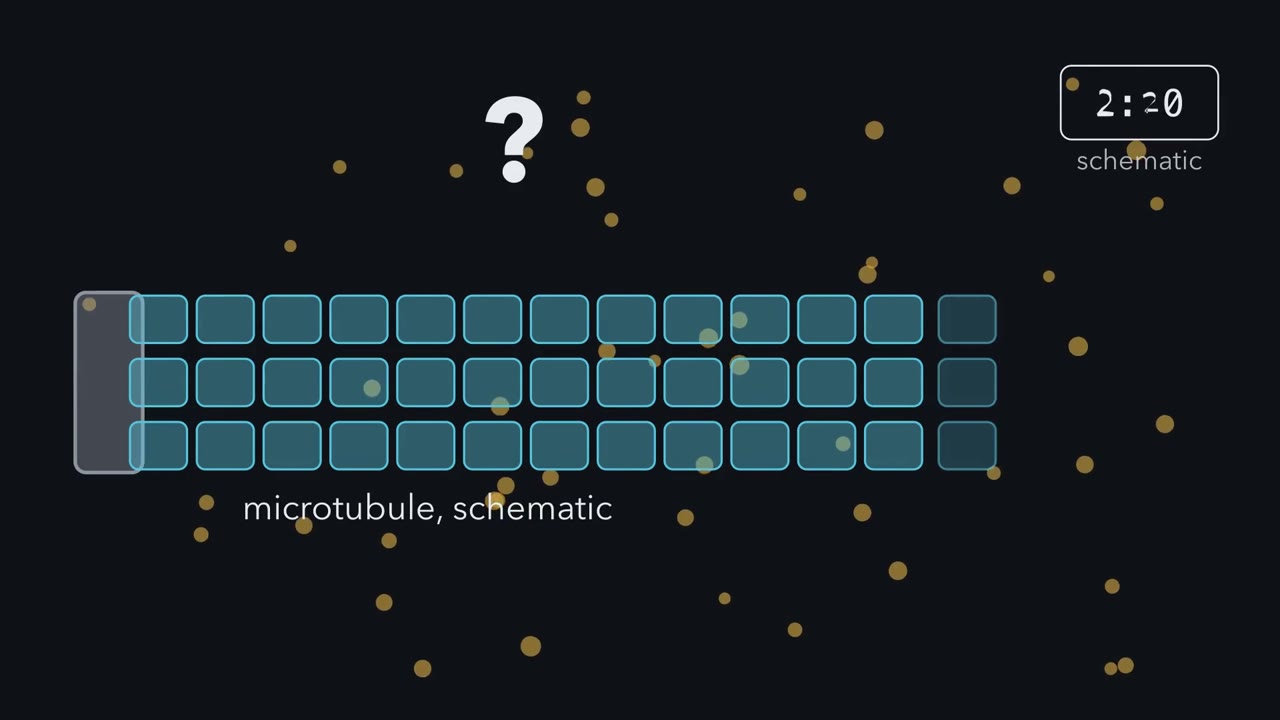
Cytochalasin B acts elsewhere. Its binding follows filament-end number, not total actin, and it inhibits addition at barbed ends. Phalloidin instead binds along actin filaments. With purified muscle actin, it slows disassembly. Now predict. A drug lowers the amount of polymer. Does that observation alone reveal whether it trapped subunits, blocked ends, or changed the lattice?
No. The same amount change can begin at different sites. Add a second measurement that separates them. Holding total actin constant while changing end number can reveal binding that follows ends. That is the difference between an effect and a mechanism.
Polymer amount reports the outcome. A measurement tied to the proposed target tests how that outcome arose. Target is still not enough; dose changes the experiment. In tested cultured cells, nanomolar nocodazole can pause microtubules and slow growth and shortening. Micromolar doses commonly used on cultured mammalian cells remove most microtubules. The system can change a switching result too. With nocodazole, catastrophe became more frequent in cultured newt lung cells. In BSC-1 monkey kidney cells after an hour, catastrophe became less frequent. Phalloidin shows another system boundary. It slows disassembly with purified muscle actin, but enters living cells poorly.
Fluorescent phalloidin therefore mainly stains filaments after cells are fixed. Sometimes the drug is not selective enough. Withaferin A redistributes vimentin in human fibroblasts, but did not alter purified vimentin assembly. Removing vimentin genetically, then adding it back, is the cleaner test. Read every result as a complete sentence: this target, at this dose, in this system, changed this measurement. Then compare another perturbation aimed at a different step. Chapter one supplied the moving parts behind cytoskeletal turnover. This chapter adds the rule for testing them experimentally. If target, dose, or system changes, the conclusion may change too.
A microtubule in a dish of pure tubulin grows for minutes, then collapses many times faster. Why would a polymer be built to fail? Because a polymer that switches by itself lets a cell explore space, rebuild its scaffolding and organize division.
Continue in the lesson: Cytoskeletal Polymers and Dynamics →
3:43 · Free, with captions and a transcript. The lesson has the full text, the questions and the sources.
More films from this lesson
How this film was made. Narration: an AI narrator voice (Kokoro, af_heart) reading narration written from this lesson's text. Animation: AI-generated in code (Manim) by Claude, a schematic with no drawn molecular structures. Captions come from the narration script. See something wrong? Report it.