Chance or Control
Read the transcript of “Chance or Control”
Film transcript: Chance or Control
In chapter 1, the microtubules placed the band, and the cut fell between the two sets of chromosomes. But the cut splits everything else too. Does the cell count its organelles out, or is chance good enough? Start with the simplest model: no control at all. Each copy of an organelle goes to either daughter by a coin toss, on its own.
With a hundred copies, the count in one daughter averages fifty, give or take about five. Most daughters get forty to sixty. The chance that either daughter gets none is about 1 .6 times 10 to the minus 30. In practice, that never happens.
Now shrink the stock to just two copies, tossed the same way. How often does one daughter end up with none? Half the time. Both copies can land left, or both right; each happens one time in four. Either daughter can be the empty one, so together they make one in two. The chance of an empty daughter is two times one half to the power n. Each added copy halves the risk. At ten copies it is about one in five hundred. At twenty-one copies it drops below one in a million.
So chance is safe only for many independent units. But some organelles are one connected structure, like a mammalian cell's Golgi ribbon, or a tubular mitochondrial network. To the coin, each is a single copy. Such a structure must be broken up first, or moved actively. In PtK1 cells, a rat-kangaroo kidney line, the Golgi ribbon comes apart during mitosis. Its membranes cluster around the spindle poles. After division, the ribbon reforms. Mitochondria in HeLa cells, a human cell line, broke into fragments early in mitosis. Without Drp1, a protein that drives mitochondrial fission, they stayed tubular. That is one cell line, so treat it as a strong lead.
Some things are not left to chance. The two centrosomes sit at the spindle poles, and the spindle carries one to each pole. So microtubules return: they place the cut, and carry part of the inheritance. One caution. Moving an organelle is not the same as changing its share. Each claim needs its own test.
So the cell need not count every unit. Chance can share many small units, often with some control alongside. Chance is safe only for many units; one connected unit needs control.
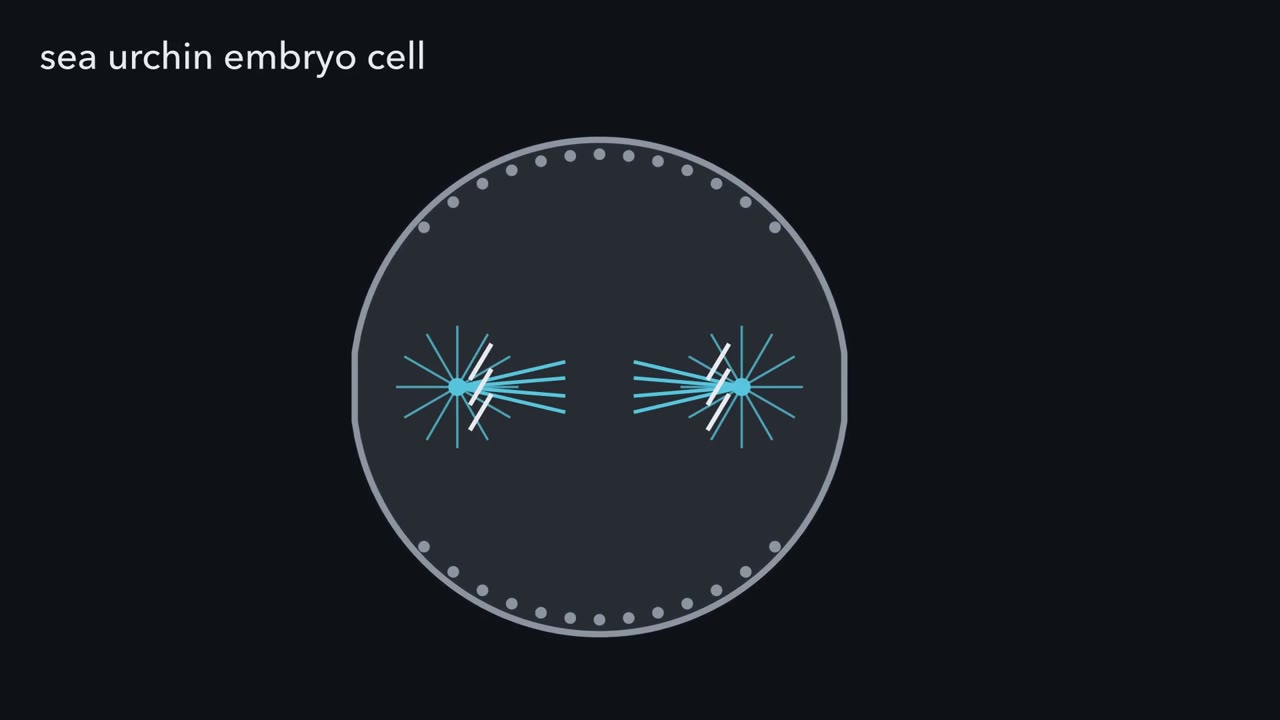
Push the spindle off-centre in a sea urchin embryo cell, and the signal for the furrow follows it before the furrow does.
Continue in the lesson: Cytokinesis and Organelle Inheritance →
3:28 · Free, with captions and a transcript. The lesson has the full text, the questions and the sources.
More films from this lesson
How this film was made. Narration: an AI narrator voice (Kokoro, af_heart) reading narration written from this lesson's text. Animation: AI-generated in code (Manim) by Claude, a schematic with no drawn molecular structures. Captions come from the narration script. See something wrong? Report it.