Trend and Chance
Read the transcript of “Trend and Chance”
Film transcript: Trend and Chance
Which population is in more danger? One shrinks a little on average each year. The other grows a little, but its numbers swing wildly. Both start with fifty animals. Put one population on a chart. Each blue line is one possible run of its numbers. The red dashed line is the floor, a number too low to recover from. Two things move the line. The gold arrow is the trend, the average yearly change on a log scale.
Around it the line jitters up and down. Those are the swings, the good years and bad. Now run the same population two hundred times. The runs fan out. Some touch the floor. The fraction that touches it is the risk. That is the idea behind a population viability analysis A real one runs a fuller model many times, and counts the runs that fall. Turn two dials, one at a time. Widen the swings, and more runs touch the floor. Raise the start, and fewer runs do. Now tilt the gold arrow down, so the population shrinks on average. Will starting with ten times as many animals save it?
Over one century, the bigger start helps a lot. Far fewer runs touch the floor. But keep the clock running. Over a thousand years, nearly every run reaches it. The bigger population bought time, not safety. With the arrow pointing down, every start reaches the floor in the end. How soon depends on the trend, the start and the swings together. Tilt it up to plus point oh two, and most runs stay clear. With few animals, one unlucky litter can decide the outcome. So chance in single births and deaths weighs most near the floor.
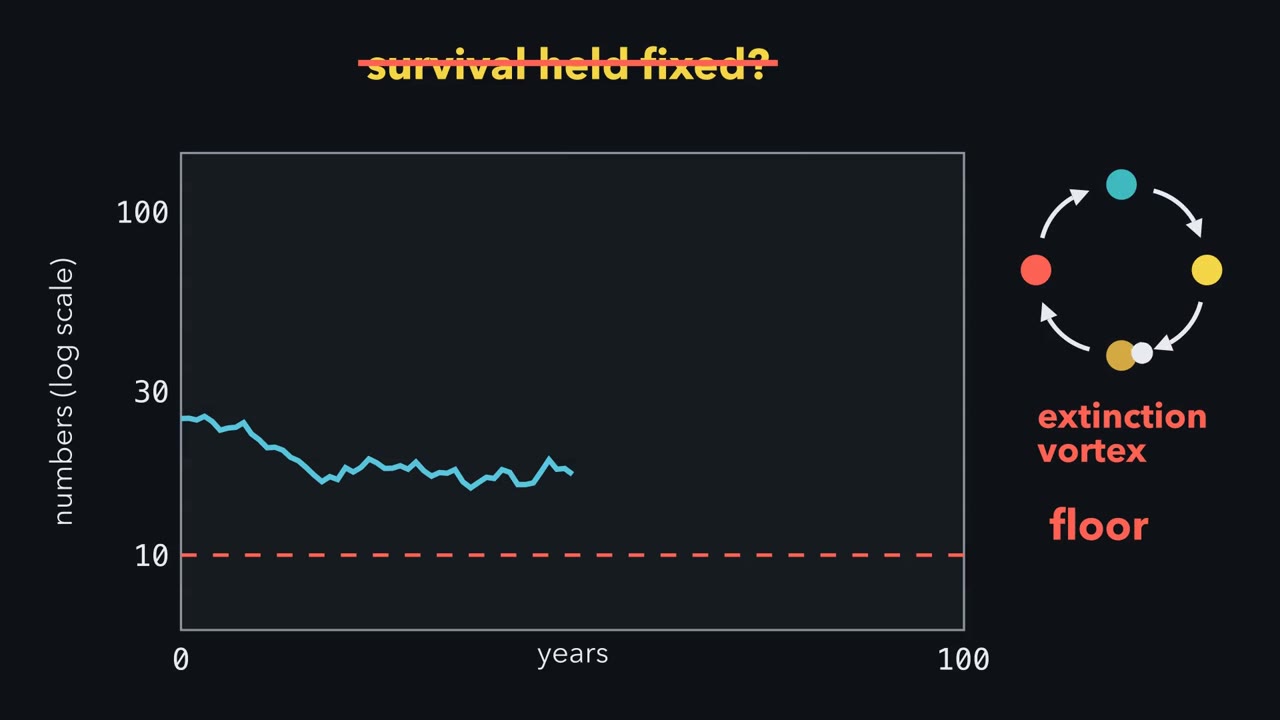
Genes can tilt the arrow too. Fewer animals means more mating among relatives. Inbreeding can lower survival and fertility, so the trend tilts down and numbers fall further. This loop is called the extinction vortex. Back to the two populations. The shrinking one will reach the floor in time, however big it starts. The growing one can escape. Its risk still depends on trend, size and swings together. This gives managers a target, for one population in one habitat. A minimum viable population is the smallest start that keeps the risk below a chosen level, over a chosen time. So conservation starts by removing the cause of decline. Alongside it, numbers, connections and genes can lift the trend or cut the risk.
But in this model, without a trend above zero, size only buys time.
In 1995, eight female pumas from Texas were released into the Florida panther population. What did that change, and how would you know?
Continue in the lesson: Conservation and Restoration →
3:23 · Free, with captions and a transcript. The lesson has the full text, the questions and the sources.
More films from this lesson
How this film was made. Narration: written from this lesson's text and read by an AI narrator voice (Kokoro, af_heart). Animation: AI-generated in code (Manim) by Claude, a schematic with no drawn molecular structures. Captions come from the narration script. See something wrong? Report it.