Films · Genetics and Molecular Biology
Reading a Pathway Backward
Read the transcript of “Reading a Pathway Backward”
Film transcript: Reading a Pathway Backward
The first film used one genome to supply what another lacked. Can a supplied compound reveal where a pathway is blocked? Watch one cell build a needed product through a chain of steps. Each arrow needs a gene-controlled function. A damaging mutation can remove one function and stop the flow. The cell then lacks the final product, even though every step after the block may still work. A nutritional screen makes that hidden block visible. Keep each mutant alive on complete medium, then test minimal medium. Adding candidate compounds separately asks which supplied material can restore the missing synthesis and growth. Add an upstream intermediate.
It enters before the broken arrow and reaches the same barrier. Nothing arrives downstream. The growth gauge stays dark. Failure to rescue tells us only that this supply did not bypass the block. Now add a downstream intermediate. It enters beyond the broken arrow. The later functions convert it into the needed product, and growth returns.
Rescue places the block somewhere before that entry point. A new mutant blocks the last arrow. Which supply can restore growth: the early intermediate, or the final product? Trace each route before choosing. The early intermediate still meets the last block, so it cannot rescue. The final product needs no remaining conversion. Supplying it restores growth. The useful supply entered after every blocked step. Compare several mutants. An early block is rescued by many later supplies. A middle block has fewer options. A late block may accept only the product. Nested rescue patterns let us read pathway order backward. This reading needs assumptions.
The supplied compound must enter the cell and join the pathway. The pathway must behave like the tested chain. A rescue class can contain several genes, because different functions may act between the same supplies. A strain can carry more than one block. An early supply may bypass the first barrier yet stop at a later one.
Growth returns only when the supplied material enters after every remaining block. Complementation and feeding experiments ask related rescue questions, but their groups differ. Complementation groups sort mutations by shared function. Rescue classes sort blocks by pathway position. Keeping those readouts separate prepares us to compare function with recombination. Rescue narrows the possibilities; it does not expose the broken reaction directly. Measure accumulated compounds or test more intermediates when neighboring steps remain possible.
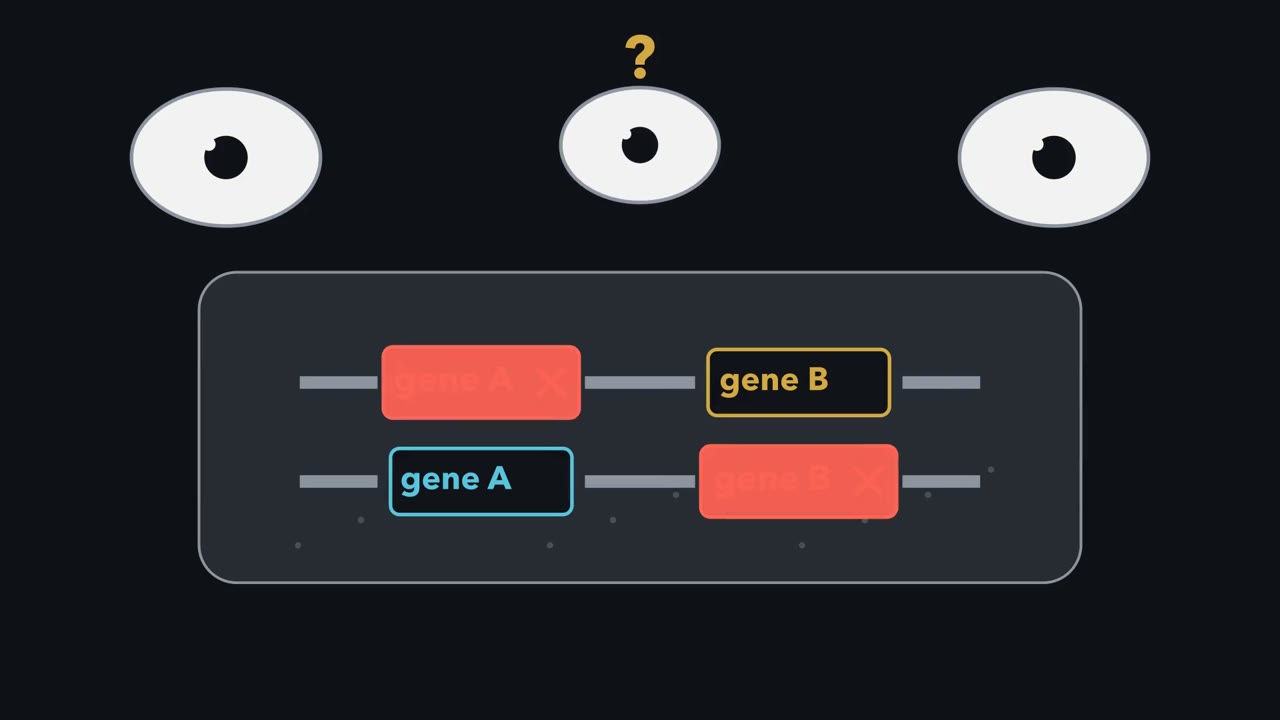
Two pure-breeding white-eyed flies can have red-eyed offspring. What does that tell you about their genes?
Continue in the lesson: Complementation and Gene Function: From Beadle and Tatum to Benzer →
3:26 · Free, with captions and a transcript. The lesson has the full text, the questions and the sources.
More films from this lesson
How this film was made. Narration: an AI narrator voice (Kokoro, af_heart) reading narration written from this lesson's text. Animation: AI-generated in code (Manim) by Claude, a schematic with no drawn molecular structures. Captions come from the narration script. See something wrong? Report it.