Films · Genetics and Molecular Biology
When Two Mutants Rescue Each Other
Read the transcript of “When Two Mutants Rescue Each Other”
Film transcript: When Two Mutants Rescue Each Other
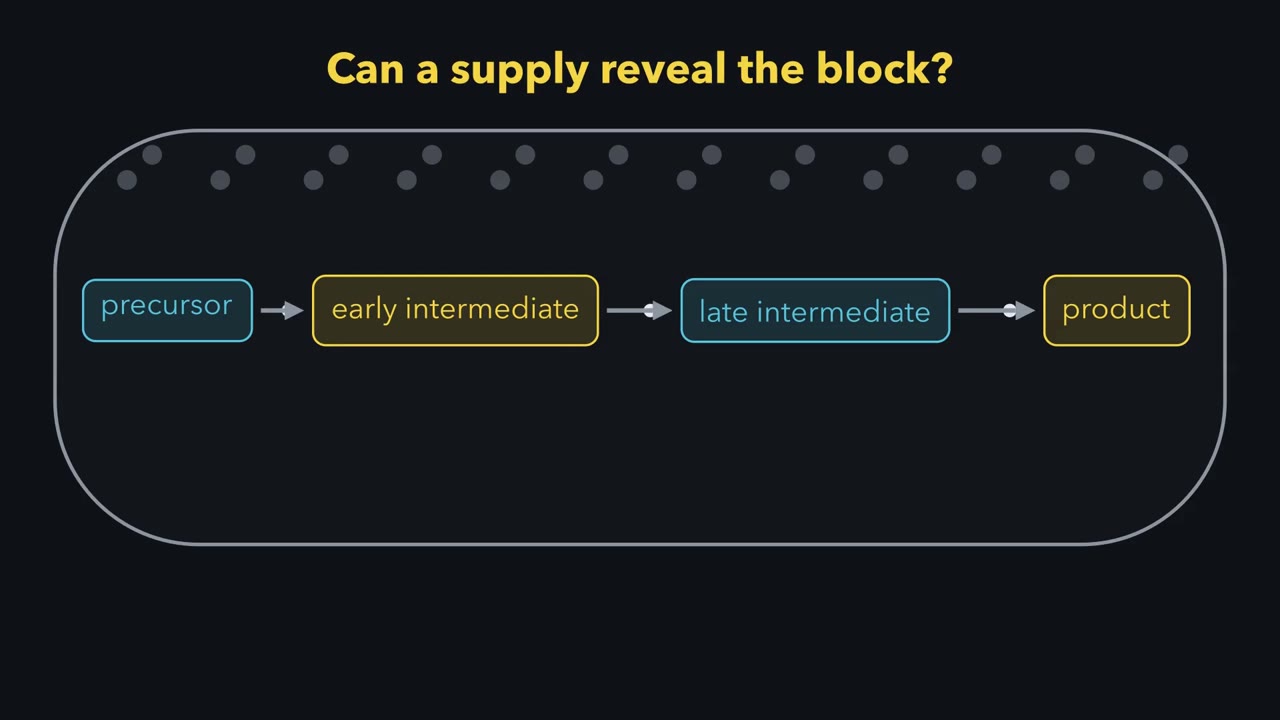
How can two pure-breeding white-eyed flies have red-eyed offspring? Watch their chromosome copies enter one shared cell. Each parent carries a different hidden loss. The offspring eye begins white, waiting to see whether normal function returns. A red eye needs several genes working together. Some genes make pigments. Others move pigments into granules. A missing shared transporter leaves the eye white. So does blocking both pigment pathways.
Appearance alone cannot tell which gene broke. An allele is one version of a gene. A diploid cell carries paired chromosome copies, so it can carry paired alleles. For a recessive loss, one working allele usually makes enough product. That product works at its normal place in the cell. First check each mutation against wild type. If a working copy restores the ordinary phenotype, the mutation is recessive. That check matters because complementation reads rescue. A dominant mutation can keep the cell mutant beside any partner. Now combine the checked recessive mutations on opposite chromosome copies in one diploid cell. This arrangement is trans.
One chromosome has broken gene A and working gene B. The other has working A and broken B. Will this cell recover its red eye, or stay white? Follow the working copies, not the broken ones. Decide whether the shared cell now has every function it needs.
The working A copy supplies the blue function. The working B copy supplies the gold function. With both functions present in the cell, red pigment appears. Normal function returns, so the mutations complement. Reset the cell. Now both chromosomes carry broken alleles of gene A, while gene B works. No working A product appears. The eye stays white, so these mutations fail to complement under the simple model. Mutations that fail with one another form a complementation group. In the simple model, a group usually marks one gene. Testing many pairs turns one shared phenotype into groups, revealing how many functions the screen happened to hit. The rule has boundaries.
Intragenic complementation can rescue different alleles of one gene. Mutations in different genes can sometimes fail together. Those exceptions refine the test. They do not change what a clean recessive result usually means. Always name what the test measured. A red eye is observed rescue, not direct proof of chromosome position. Mapping asks where mutations sit. Complementation asks whether their functions can supply each other in one cell.
Two pure-breeding white-eyed flies can have red-eyed offspring. What does that tell you about their genes?
Continue in the lesson: Complementation and Gene Function: From Beadle and Tatum to Benzer →
3:28 · Free, with captions and a transcript. The lesson has the full text, the questions and the sources.
More films from this lesson
How this film was made. Narration: written from this lesson's text and read by an AI narrator voice (Kokoro, af_heart). Animation: AI-generated in code (Manim) by Claude, a schematic with no drawn molecular structures. Captions come from the narration script. See something wrong? Report it.