What Keeps Chthamalus High?
Read the transcript of “What Keeps Chthamalus High?”
Film transcript: What Keeps Chthamalus High?
The first film built a test on paper: can a species grow beside its competitor? On a rocky Scottish shore, what keeps one barnacle out of the band just below it? At Millport, adults of the barnacle Chthamalus, in teal, live high on the rock. Another barnacle, Balanus, in orange, covers the rock below. A pattern like that has rival explanations.
Lower down, Chthamalus might not tolerate the longer time underwater. Its predators might be worse there, such as the whelk Thais. Or Balanus might be crowding it out. Joseph Connell tested the crowding explanation by changing it. He mapped patches of Chthamalus and split each map in two. A coin toss chose one half for removal. On that half, he removed every Balanus touching or surrounding a Chthamalus. The other half stayed untouched, with its Balanus in place, at the same height and in the same weather. Then he came back at intervals and recounted the marked barnacles on both halves. The difference he intended between the halves was whether Balanus was there.
Suppose longer time underwater was what killed Chthamalus low on the shore, and Balanus did nothing. What would the cleared half show, compared with the untouched half? If immersion were the cause, both halves would do the same, since both spend the same time underwater. That is not what Connell found. Chthamalus kept free of Balanus survived well, at the shore levels he studied. He also watched how Chthamalus died.
Growing Balanus smothered it, undercut it and crushed it. That is interference competition, one barnacle acting directly on another, much of it for space on the rock. So at Millport, Balanus set the lower limit of Chthamalus. The band where Chthamalus could live reaches lower than the band where it does live. Those are its fundamental and realized niches. Keep the scope. This is one shore, one pair of species and one set of years. It does not say what sets barnacle limits on every coast. Its strength is the design, not the generality.
For a neighbour that stays put, like a barnacle, the design gives a field test. Remove it from a random half, and leave a matched half alone. If survival improves, and proper controls rule out other differences, the neighbour was limiting.
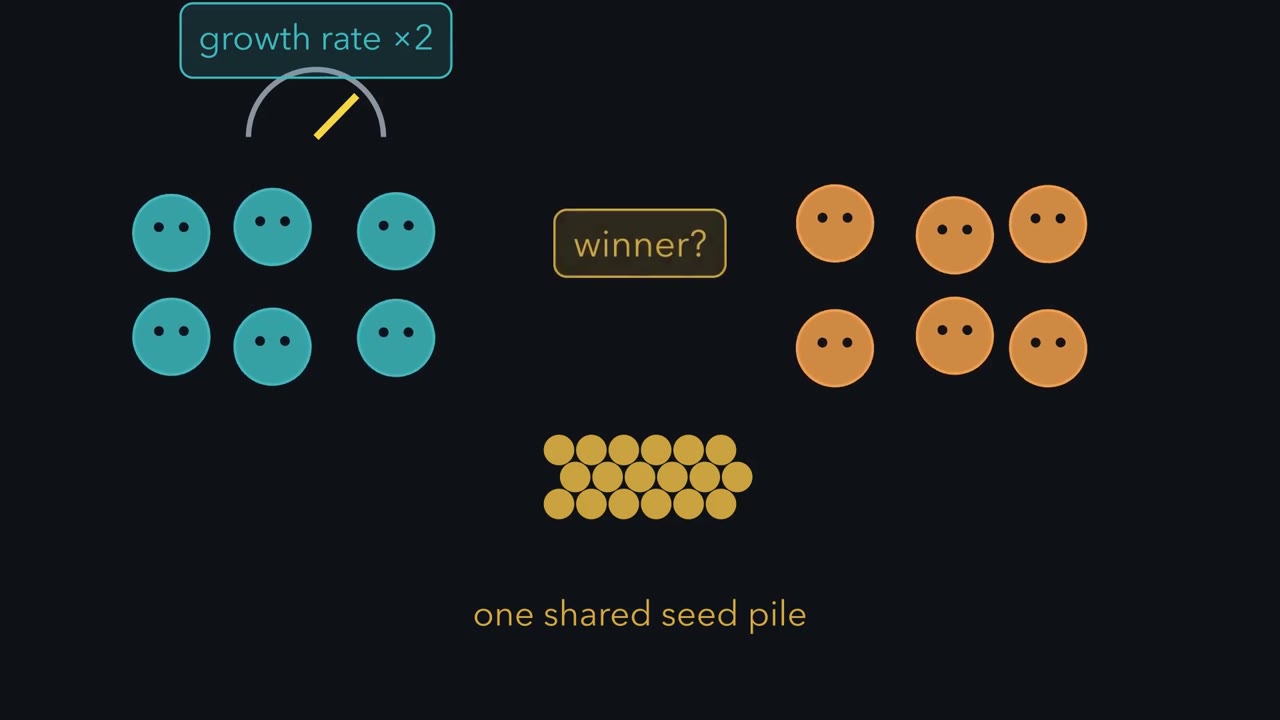
One competitor grows twice as fast as the other. Why does it not always win?
Continue in the lesson: Competition →
3:03 · Free, with captions and a transcript. The lesson has the full text, the questions and the sources.
More films from this lesson
How this film was made. Narration: an AI narrator voice (Kokoro, af_heart) reading narration written from this lesson's text. Animation: AI-generated in code (Manim) by Claude, a schematic with no drawn molecular structures. Captions come from the narration script. See something wrong? Report it.