Can It Grow When Rare?
Read the transcript of “Can It Grow When Rare?”
Film transcript: Can It Grow When Rare?
Two species eat the same limited food, and one grows twice as fast. Must the faster one win? This film builds the test that decides. Start with the teal species alone. Its numbers rise toward its carrying capacity, Big K, the size it settles at alone. Picture that capacity as a bar of room that fills up. As the room fills, growth per individual slows. That is the per-capita growth rate, and it reaches zero when the bar is full. Now bring back orange. Each orange individual takes some of teal's room too. A number called alpha says how much, counted in teal individuals. Read the two numbers after alpha as on, then from. alpha12 is the effect on species 1, from species 2.
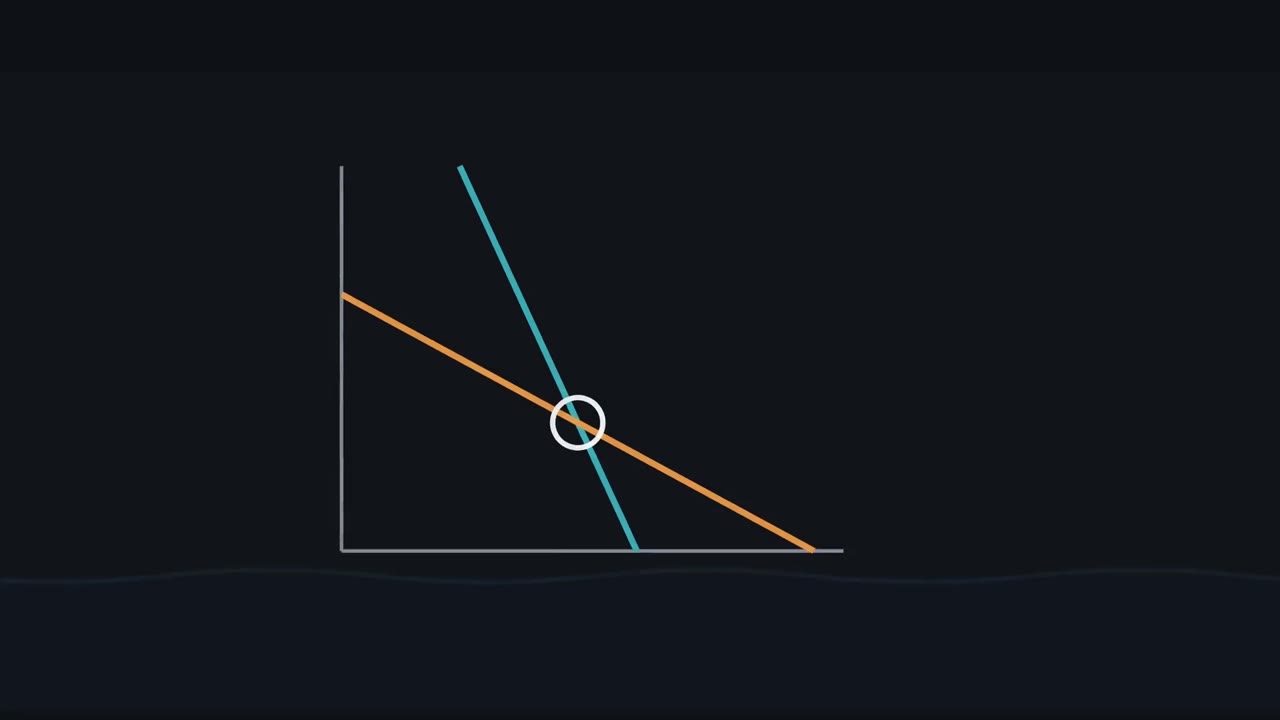
Orange has its own room bar, filled the same way. Now plot both species at once. Teal numbers run across, and orange numbers run up. The teal line marks every mix where teal stops growing. On one side teal grows; on the other it shrinks. That line is teal's isocline, its zero-growth line. Orange gets one too. Where the two isoclines cross, neither species changes. Is that crossing where they end up? Here is the test. Shrink teal to a few individuals, and let orange sit at its own carrying capacity.
Can teal grow? This is the invasion test. Here teal's arrow points away from zero, so rare teal grows. Swap roles, and rare orange grows too. Both pass. Every path that starts with both species present flows into the crossing. They coexist stably. Now make teal hurt orange more, so orange's line tilts. Rare orange, among a full teal population, now shrinks. Teal passes, orange fails, and orange slides to zero. Teal excludes it from this place. Cross the lines the other way, and neither passes. Each species wins from some starts, so the starting numbers decide. Back to the pair that coexist. Now double orange's growth rate, and change nothing else.
Does the ending change? The ending stays put. Orange moves faster and the paths bend, but they still finish at the same crossing. Here, growth rate changes the route, not the outcome. So in this model, the faster grower need not win. In words, each species must limit itself more than it limits the other.
Limits means the share of each room that one individual fills. So the whole verdict comes from one question, asked of each species. Can it grow when rare, beside a competitor at full strength?
One competitor grows twice as fast as the other. Why does it not always win?
Continue in the lesson: Competition →
3:26 · Free, with captions and a transcript. The lesson has the full text, the questions and the sources.
More films from this lesson
How this film was made. Narration: written from this lesson's text and read by an AI narrator voice (Kokoro, af_heart). Animation: AI-generated in code (Manim) by Claude, a schematic with no drawn molecular structures. Captions come from the narration script. See something wrong? Report it.