Same Warmth, Two Answers
Read the transcript of “Same Warmth, Two Answers”
Film transcript: Same Warmth, Two Answers
The first film built a rule. Rain falls where moist air rises, and warmer months need more rain to count as humid. Now test it on two made-up stations. Both average about 26 °C. What grows at each? Station A is the one you just worked. Its blue rain line rides above the red in every month. No month is dry. Its class is Af: tropical, with no dry month. That is a tropical rainforest climate. Station B has the same average warmth, though its months run from about 24 to 30 °C. But it gets about two thirds as much rain, and most of it falls from April to October. From November to March, the blue line drops below the red. Those five months fill with gold.
They are the dry season. Its class is Aw: tropical, with a marked dry season. That is a tropical savanna climate. The rule's first guess is grass with scattered trees. So far the rule gives two first guesses. Similar warmth, different rain, different climate classes. Now look at station B's rain once more. Staver, Archibald and Levin analysed tree cover across the tropics. They looked at places with about 1,000 to 2 ,000 and a half -thousand millimeters of rain a year. Those places also had a dry season shorter than seven months, by the study's own measure. There, tree cover was rarely in between. Places were mostly savanna, or mostly forest.
Station B's rain total falls in that range, and its diagram points to savanna. Would every place with a climate like that be savanna? No. In that window, savanna and forest were both found under similar climates. And fire was associated with keeping areas open. Where grass is open, fire can keep it open. A closed canopy can hold fire back. So each state may help keep itself going.
This is a pattern, not proof. Savanna and forest may be alternative states under similar climates. Whether those states are truly stable is still debated. So climate gives a first guess at the biome. Fire, soils, the timing of rain and microclimate can change the answer. A savanna climate does not guarantee a savanna.
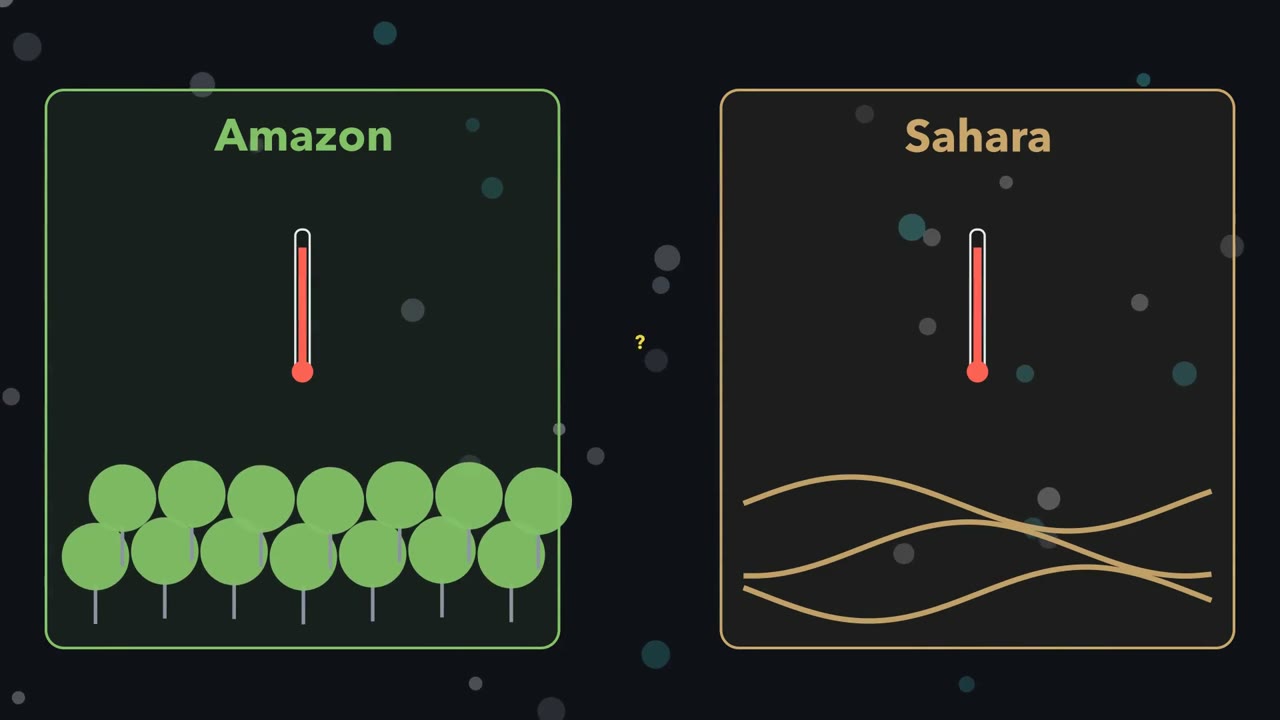
The Amazon and the Sahara are both hot. Why is one a rainforest and the other a desert?
Continue in the lesson: Climate, Biomes and Environmental Variation →
3:02 · Free, with captions and a transcript. The lesson has the full text, the questions and the sources.
More films from this lesson
How this film was made. Narration: an AI narrator voice (Kokoro, af_heart) reading narration written from this lesson's text. Animation: AI-generated in code (Manim) by Claude, a schematic with no drawn molecular structures. Captions come from the narration script. See something wrong? Report it.