Where the Rain Falls
Read the transcript of “Where the Rain Falls”
Film transcript: Where the Rain Falls
The Amazon and the Sahara are both hot. So why is one a rainforest, and the other a desert? Each is a biome, a large region with similar climate and similar plants and animals. To guess a biome, ask two things of every month. How warm is it? How wet? Start with warmth. Shine a torch straight down at a table, and you get a small bright spot. Tilt it, and the same light spreads into a larger, dimmer oval. Sunlight does the same on a round Earth. Averaged over a year, it strikes the equator most directly, and the poles at a slant. So the tropics get the most energy per square metre, and the poles the least. But the Amazon and the Sahara get similar average warmth.
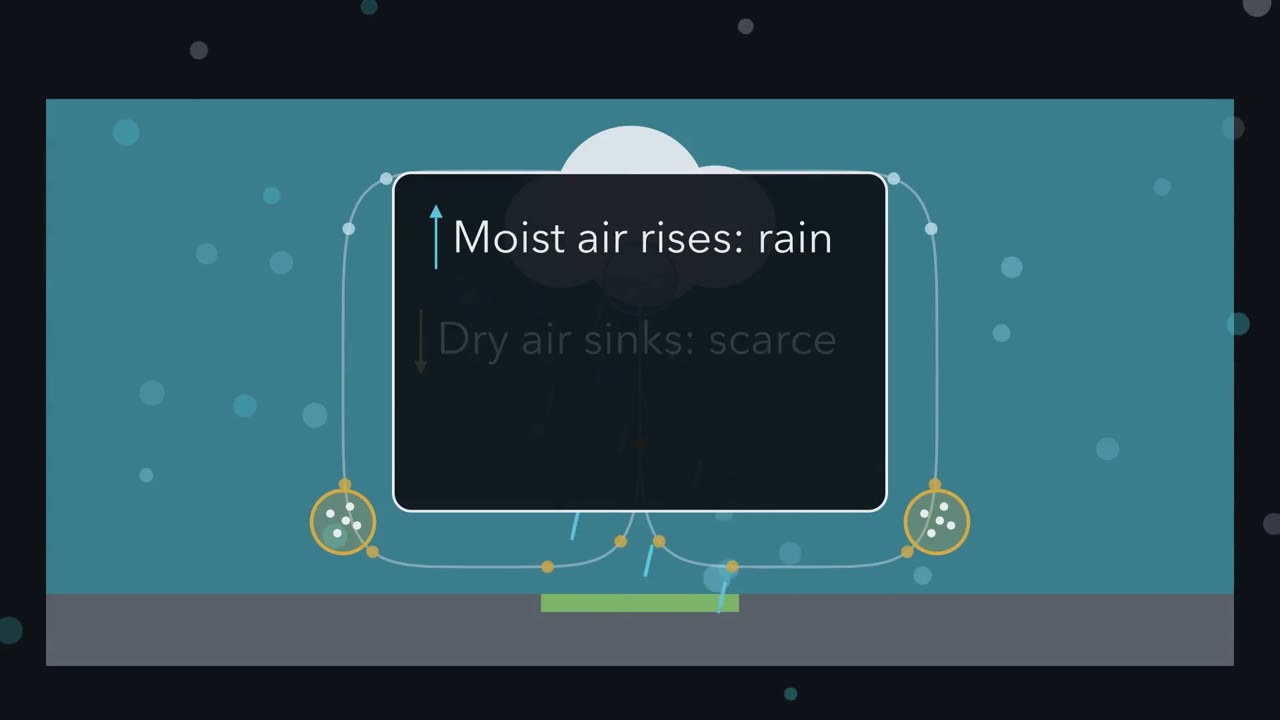
What differs is water, and moving air decides where it falls. Over the warm equator, moist air rises. As it rises, it expands and cools. Its water vapour condenses into cloud, and it rains. This is the equatorial rain belt. The air, now dry, flows toward the poles high up. Near 30° degrees north and south, it sinks back down. Sinking air is squeezed, and it warms. Warming takes it further from the point where its vapour condenses. So sinking air stays clear, and rain is rare. Many great deserts lie beneath it, the Sahara among them. So here is the first half of the rule. Rain falls where moist air rises and cools. It is scarce where air sinks and warms.
The rain belt does not stay put. Through the year, it shifts north and south. It roughly follows the overhead Sun, but lags behind it. Picture a town some way north of the equator, near the edge of that swing. Does it get rain all year, or only part of it?
Only part of it. The town is wet while the rain belt is overhead, and dry when the belt moves away. A wet season, then a dry one. Ecologists draw that on a climate diagram. Months run along the bottom. A red line shows temperature. A blue line shows rain. The scales are linked, so 10 °C sits level with 20 mm. When the blue line drops below the red, the month is read as dry. That is the second half of the rule. The warmer a month, the more rain it needs to count as humid. Read month by month, warmth and water give a first guess at the biome. A guess, not a final answer.
The Amazon and the Sahara are both hot. Why is one a rainforest and the other a desert?
Continue in the lesson: Climate, Biomes and Environmental Variation →
3:10 · Free, with captions and a transcript. The lesson has the full text, the questions and the sources.
More films from this lesson
How this film was made. Narration: written from this lesson's text and read by an AI narrator voice (Kokoro, af_heart). Animation: AI-generated in code (Manim) by Claude, a schematic with no drawn molecular structures. Captions come from the narration script. See something wrong? Report it.