Harvey's Arithmetic
Read the transcript of “Harvey's Arithmetic”
Film transcript: Harvey's Arithmetic
The first film compared two circuits carrying the same flow. How big is that flow, and what did measuring it first prove? For centuries, the standard account came from Galen. Blood was made continually from food in the liver. The tissues it reached used it up. William Harvey, a London physician, tested this on the human arm. He tied a band round the upper arm. Tied tight, it stopped the pulse below it. Tied more loosely, it let the arteries drive blood in, but stopped its return. The veins below the band swelled. So blood enters a limb by arteries, and leaves by veins. Then Harvey asked a question of quantity. He made small guesses, on purpose, for how much blood leaves the heart at each beat.
He multiplied by the number of beats in half an hour. Even that low product was more blood than the whole body contains, and far more than food could replace. Now test the argument. Suppose his guess per beat was still too big, by a full half. Does his conclusion fall?
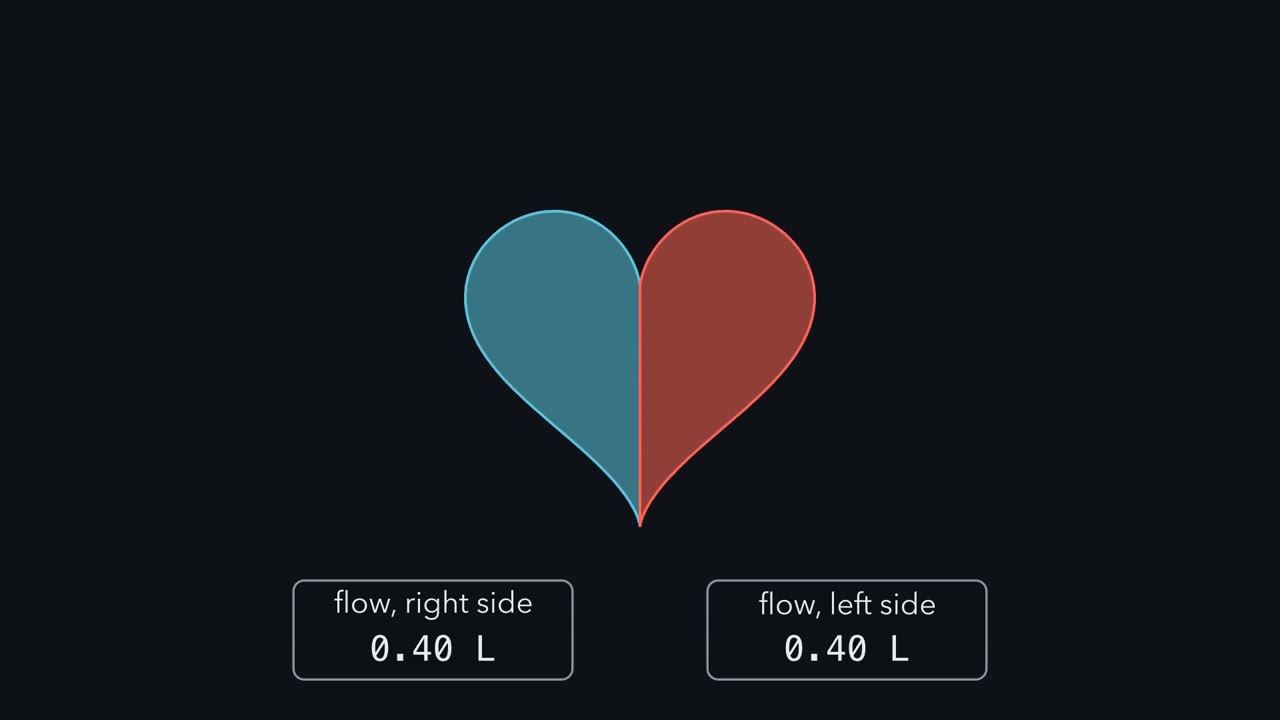
It stands. Even with half the scoop, half an hour still overflows the body many times. The heart moves far more than the body holds. So the same blood must go round. It leaves the heart by the arteries and comes back by the veins, again and again. Blood circulates. Harvey's product now has a modern name. Cardiac output is one ventricle's heart rate times its stroke volume, the blood it ejects per beat. So the heart has two dials on its flow. One dial sets the rate of beating. The other sets how much blood each beat ejects.
In a healthy mammal, the rate dial is the sinoatrial (SA) node. It is a patch of pacemaker muscle in the right atrium. Sympathetic nerves turn it up, and the vagus nerve turns it down. The stroke volume dial has three inputs of its own. They are how much the ventricle fills, how strongly it contracts, and the pressure it must push against. Over half an hour, rate times stroke volume adds up to far more blood than you hold. Food could never replace it. So the same few litres go round, again and again.
An adult human holds about 5 litres of blood, yet at rest each side of the heart pumps about that much every minute. Where does it all go?
Continue in the lesson: Circulation and the Heart →
2:49 · Free, with captions and a transcript. The lesson has the full text, the questions and the sources.
More films from this lesson
How this film was made. Narration: an AI narrator voice (Kokoro, af_heart) reading narration written from this lesson's text. Animation: AI-generated in code (Manim) by Claude, a schematic with no drawn molecular structures. Captions come from the narration script. See something wrong? Report it.