Films · Genetics and Molecular Biology
What Holds the Pair, and What Lets Go
Read the transcript of “What Holds the Pair, and What Lets Go”
Film transcript: What Holds the Pair, and What Lets Go
Why does the first division of meiosis part homologs, and not sisters? In mitosis, homologs do not synapse as a pair. Each chromosome lines up on its own, and its sisters part. In meiosis I, the sisters stay together, and the homologs part. So something must tie each pair, and let go in the right order. Start with the sisters. From S phase on, ring-shaped proteins called cohesin tie them together. The rings sit along the arms and around the centromere. In prophase I, the homologs pair along their length. A protein structure called the synaptonemal complex zips them together. While they are zipped, crossing over happens. Segments are exchanged between non-sister chromatids, one from each homolog.
It starts with a deliberate break in the DNA of one chromatid. The repair copies from the other homolog, and can end in a swap. Later in prophase I, the zipper comes apart. The homologs pull slightly away from each other. But they stay joined where the crossover was. That visible site is a chiasma. Now look at what ties the pair. The crossover, plus the cohesin on the arms beyond it, holds the two homologs together. In most organisms studied, that is the link the spindle pulls against.
So what must the cell cut, to let the homologs go at anaphase I? The cohesin on the arms. Once it is cut, the crossover no longer ties the pair. The homologs part, each still made of two sisters. Cohesin at the centromeres has to survive. A protein called shugoshin protects it until anaphase II. Shugoshin brings an enzyme, PP2A, to the centromeres. Removing phosphate there is thought to shield cohesin from being cut. So the sisters stay joined into meiosis II. At anaphase II, the centromere cohesin is cut as well, and the sisters part.
This two-step release is the pattern seen in yeast and mammals, as studied. One cut frees the homologs. A later cut frees the sisters. Each link is a point of failure. In mouse eggs, if centromere cohesin is lost too early, sisters reach meiosis II already apart. They can then go to either pole at random. Eggs can end up with too many or too few chromosomes. As studied in yeast and mammals, two links are cut in two steps. Arm cohesin goes at anaphase I, and the homologs part. Centromere cohesin goes at anaphase II, and the sisters part.
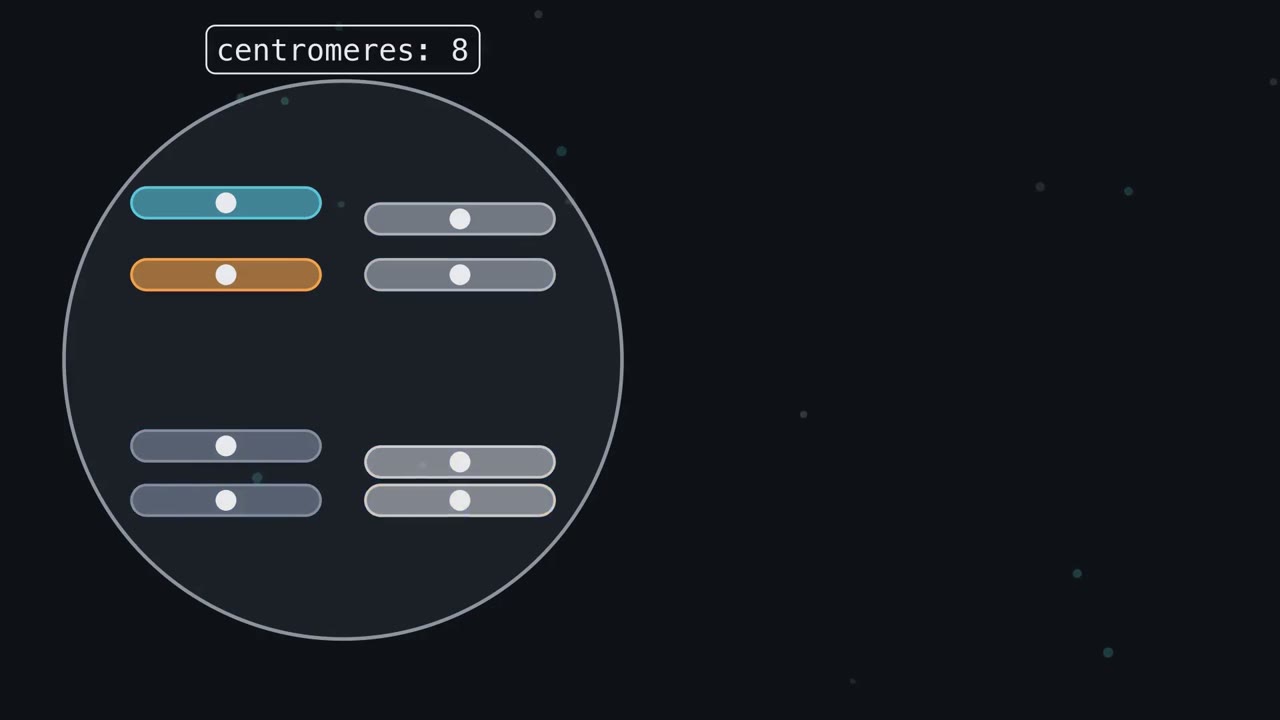
A fruit fly cell has eight chromosomes and its sperm have four. Which four does a sperm get, and what decides it?
Continue in the lesson: Chromosomes and Meiosis: The Physical Basis of Mendel's Laws →
3:18 · Free, with captions and a transcript. The lesson has the full text, the questions and the sources.
More films from this lesson
How this film was made. Narration: an AI narrator voice (Kokoro, af_heart) reading narration written from this lesson's text. Animation: AI-generated in code (Manim) by Claude, a schematic with no drawn molecular structures. Captions come from the narration script. See something wrong? Report it.