Films · Genetics and Molecular Biology
One of Each Pair, by Coin Toss
Read the transcript of “One of Each Pair, by Coin Toss”
Film transcript: One of Each Pair, by Coin Toss
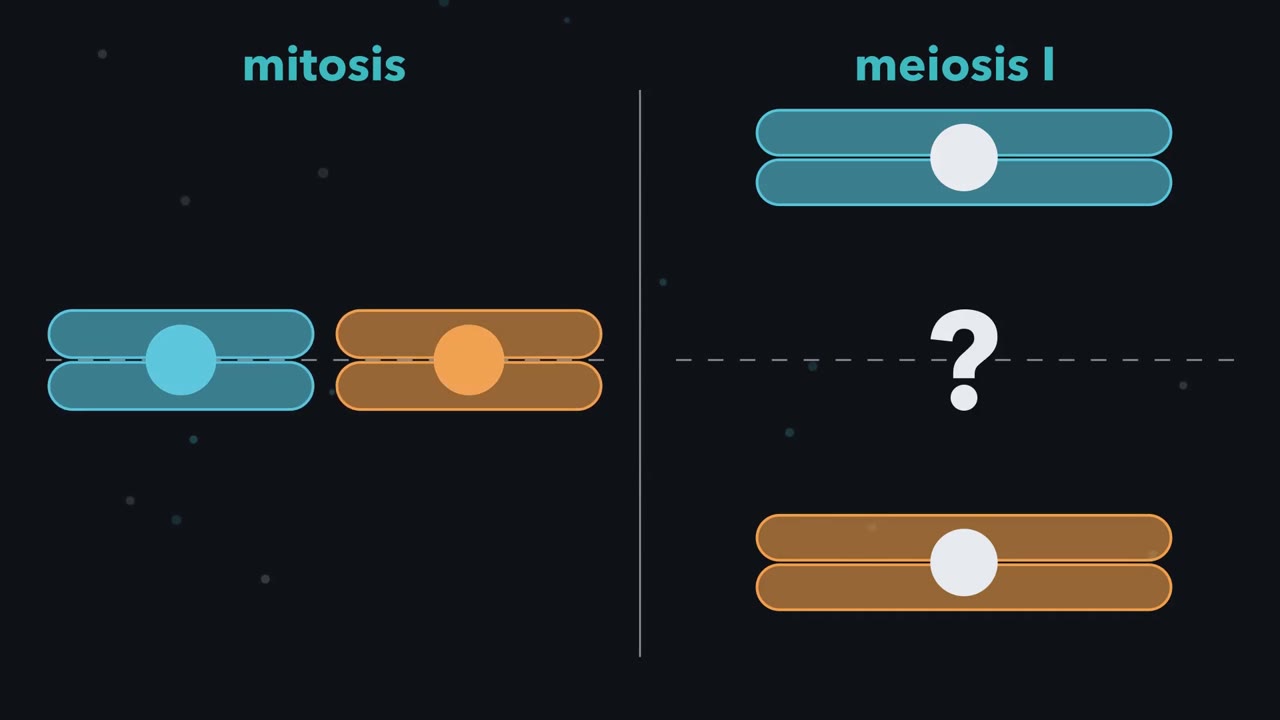
Which four chromosomes does a fruit fly sperm get? The fly's body cells hold eight. Its eggs and sperm hold four, one from each of four pairs. Mendel worked out his laws from counts of peas. He never saw what did the separating. These two chromosomes are homologs, one inherited from each parent. They carry the same genes at the same places. But they can carry different versions, called alleles. Blue carries one allele, and orange carries the other. Follow the colours. Before meiosis, in S phase, each chromosome is copied. The two copies are sister chromatids, joined at the centromere. Count centromeres, not arms. A copied chromosome is still one chromosome.
Meiosis is one round of copying, then two divisions. In the first, the homologs find each other and line up side by side. Then the pair sits across the middle of the cell, its homologs facing opposite poles. Anaphase I pulls the homologs apart. Each new cell gets one member of the pair. Count its centromeres: one. The cell is already haploid, with one homolog of this pair. That chromosome is still two sister chromatids. No DNA is copied in between. In the second division, the sisters part. That makes four products. Two carry blue's allele, and two carry orange's. That two-and-two split is what Mendel's model expects. It is his law of segregation, seen as chromosome movement.
Now add a second pair, green and purple, on a different chromosome, carrying a second gene. Here is the question. Does the way the blue pair faces the poles change the way the green pair faces? No. Each pair faces the spindle by its own coin toss. Blue may end up with green, or blue with purple.
Ignoring crossovers for now, one meiosis takes just one of these layouts. So one meiosis gives only two kinds of gamete, two of each. Independence shows only when you count many meioses. Both layouts are equally likely. So all four kinds of gamete appear, a quarter each. That is independent assortment. Each extra pair is one more coin toss. So the combinations climb fast, with two choices for every pair. This holds for genes on different chromosomes.
Genes close together on one chromosome tend to travel together. And something has to hold each pair together until it is dealt. That is chapter 2. So here is the idea, in the simple Mendelian model. Meiosis I deals one homolog of each pair to each cell. Each pair is dealt by its own fair coin toss. Meiosis II then splits sisters.
Segregation is the deal. Independent assortment is the coin tosses.
A fruit fly cell has eight chromosomes and its sperm have four. Which four does a sperm get, and what decides it?
Continue in the lesson: Chromosomes and Meiosis: The Physical Basis of Mendel's Laws →
3:41 · Free, with captions and a transcript. The lesson has the full text, the questions and the sources.
More films from this lesson
How this film was made. Narration: written from this lesson's text and read by an AI narrator voice (Kokoro, af_heart). Animation: AI-generated in code (Manim) by Claude, a schematic with no drawn molecular structures. Captions come from the narration script. See something wrong? Report it.