Films · Genetics and Molecular Biology
Break, Rejoin, Segregate
Read the transcript of “Break, Rejoin, Segregate”
Film transcript: Break, Rejoin, Segregate
The first film changed whole-chromosome dose. Can a chromosome rearrangement matter when no DNA seems missing? Follow the same coloured blocks through breakage and meiosis. A chromosome is more than a counted object. Its blocks carry genes, and their order provides context. For any rearrangement, ask what material changed dose, what breakpoint changed context, and what products meiosis can make. Remove one block and the chromosome has a deletion. Its genes now have lower dose. A missing segment cannot supply its genes. Copy one block and the chromosome has a duplication. Those genes now have higher dose. An extra segment supplies another copy.
The red gauge tracks both changes. Now cut out several blocks and return them in reverse order. That is an inversion. No block is lost, so dose can stay balanced. The chromosome count also stays unchanged. During meiosis, homologous blocks bend into a loop to align. A reciprocal translocation exchanges segments between nonhomologous chromosomes. Move a teal end segment from blue to a grey chromosome, and return a grey segment.
Total dose may stay balanced even though both chromosomes have new neighbours. Balanced dose does not guarantee no biological effect. A breakpoint can interrupt a gene block. It can also place pieces from different genes together. The result depends on which sequence meets the breakpoint. These are changes in gene context, not whole-chromosome count. The carrier still faces meiosis.
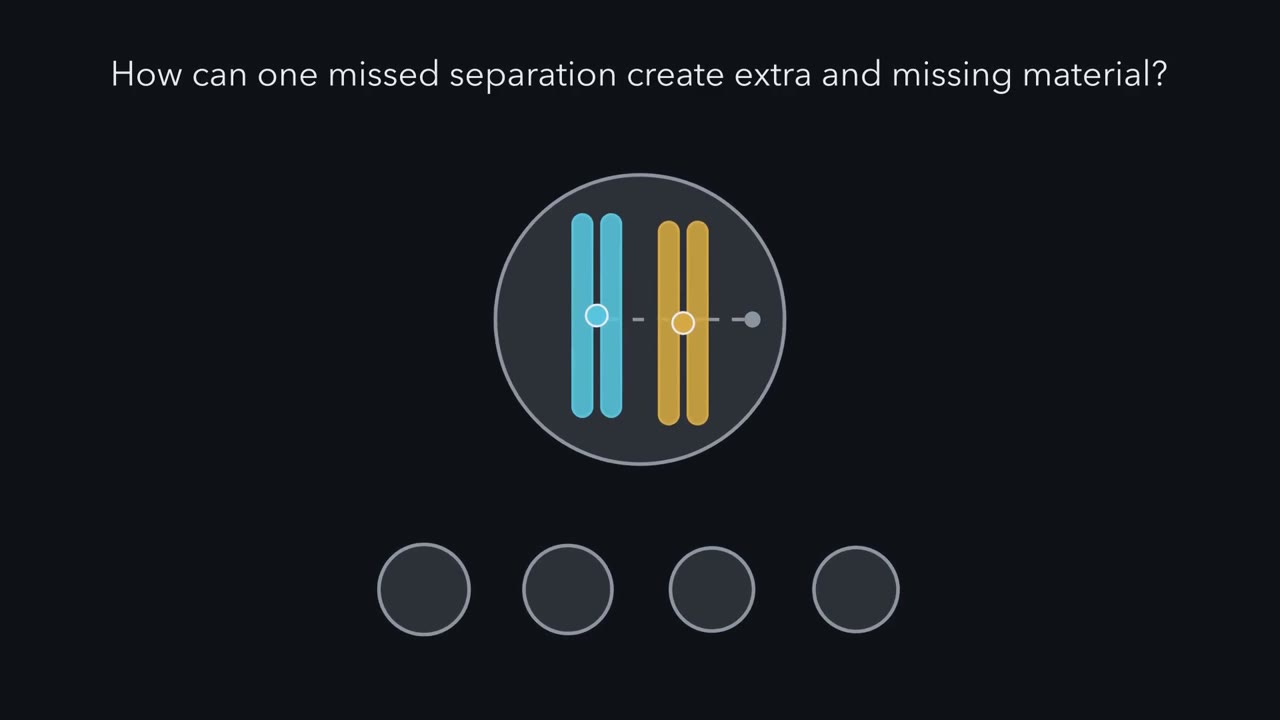
Normal and translocated partners must align matching blocks. All four chromosomes form a cross-shaped group. The way this cross separates decides whether each gamete receives one copy of every block. Which separation preserves one copy of every coloured block: opposite chromosomes moving together, or neighbouring chromosomes moving together? Look at the block ledgers.
Opposite partners preserve one copy of every block. This alternate segregation makes normal or balanced gametes. Neighbouring partners give each gamete an extra copy of one segment and no copy of another. This adjacent segregation makes unbalanced gametes. That explains a common puzzle. A carrier can be healthy because their chromosome set is balanced. Yet meiosis can produce unbalanced gametes. Balance must therefore be tested at both levels. The rearrangement's consequence depends on breakpoint context and segregation, not chromosome count alone. Trace three things after every break. Ask what material was gained or lost. Ask which genes were interrupted or newly joined.
Then ask which chromosome combinations can pass through meiosis. Rearrangements matter through DNA dose, gene context, and meiotic balance.
How can one missed separation give a cell an extra chromosome, and why can a balanced rearrangement still matter?
Continue in the lesson: Chromosome Number and Structure: Aneuploidy and Rearrangements →
3:43 · Free, with captions and a transcript. The lesson has the full text, the questions and the sources.
More films from this lesson
How this film was made. Narration: an AI narrator voice (Kokoro, af_heart) reading narration written from this lesson's text. Animation: AI-generated in code (Manim) by Claude, a schematic with no drawn molecular structures. Captions come from the narration script. See something wrong? Report it.