Films · Genetics and Molecular Biology
When Chromosomes Miss Their Turn
Read the transcript of “When Chromosomes Miss Their Turn”
Film transcript: When Chromosomes Miss Their Turn
How can one missed separation give one gamete extra chromosome material and another too little? Watch one replicated chromosome pair cross both meiotic divisions. Each homologue has joined sister chromatids. Blue marks one homologue, and gold marks the other. The centromeres remain visible as small circles. At meiosis I, homologues normally move apart. At meiosis II, sisters normally separate. The first division sorts homologues; the second sorts copies within each homologue. Nondisjunction means chromosomes fail to part during a division. The resulting gamete may carry an extra chromosome or none of that chromosome. This is aneuploidy, a gain or loss of individual chromosomes rather than a whole set.
First, let both homologues travel together at meiosis I. One daughter cell receives blue and gold. The other receives neither. Their sister chromatids remain joined, so the first division has already created a dose imbalance. Now suppose meiosis II runs normally. Can separating the sisters repair the chromosome dose, or is the final pattern already fixed?
The later division cannot replace a missing homologue. Normal sister separation produces matching outcomes within each branch. The products from one branch carry both homologues. The products from the other carry neither. The counts appear on screen. Reset to normal meiosis I. Blue and gold separate into different daughter cells. During meiosis II, blue sisters fail to part in only one cell. Gold sisters still separate normally in the other cell. This error makes three dose classes instead of two. One product has extra material, one is missing it, and the remaining products are normal. The stage of the missed separation sets the product pattern.
It also leaves a fingerprint that DNA markers in the child can read. A normal gamete contributes one copy at fertilization. A gamete with extra material can therefore make a trisomic zygote. A gamete missing that chromosome can make a monosomic zygote. That starting dose is copied as the zygote divides. Extra or missing chromosome material changes the copies of many genes together. That can alter development and survival. Most aneuploid human embryos do not survive pregnancy. Trisomy 21 is among the few autosomal trisomies seen regularly at birth. The division error explains the product pattern.
DNA dose explains why the pattern matters biologically. Keep those questions separate: where did separation fail, and what chromosome material became extra or missing? The same count can hide different routes to imbalance.
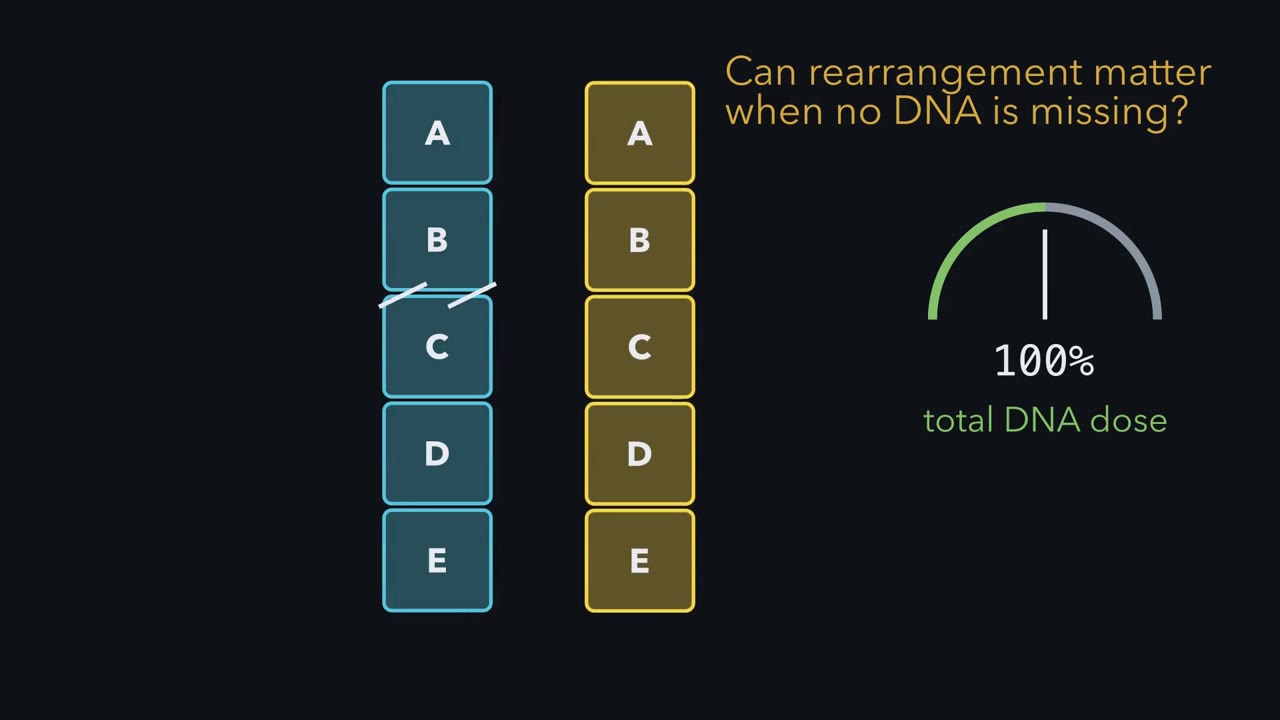
How can one missed separation give a cell an extra chromosome, and why can a balanced rearrangement still matter?
Continue in the lesson: Chromosome Number and Structure: Aneuploidy and Rearrangements →
3:35 · Free, with captions and a transcript. The lesson has the full text, the questions and the sources.
More films from this lesson
How this film was made. Narration: written from this lesson's text and read by an AI narrator voice (Kokoro, af_heart). Animation: AI-generated in code (Manim) by Claude, a schematic with no drawn molecular structures. Captions come from the narration script. See something wrong? Report it.