Design a Fix That Can Be Tested
Read the transcript of “Design a Fix That Can Be Tested”
Film transcript: Design a Fix That Can Be Tested
The first film followed nutrients from land to low oxygen. Where should a limited cleanup budget act? A useful plan cuts the cause first, rebuilds habitat, and works within real limits. Restoration means returning a damaged ecosystem toward health. Criteria say what a solution must achieve, such as lowering nitrogen or adding habitat. Constraints are limits, including money, land, and time. The budget bar is one constraint, so every choice has a trade-off. Start upstream. A forest buffer is a strip of trees and shrubs beside a stream. It slows runoff, traps soil, and can remove nitrate from water underground.
Winter cover crops hold soil and take up leftover nitrogen. Both act before nutrients reach the Bay. Wastewater upgrades remove more nitrogen at a treatment plant. Oyster reefs work differently. Oysters filter particles, and the reef shelters other animals. Reefs rebuild habitat, but they do not replace cutting nutrients. In this plan, underwater grass is a readout, not a tool. Cleaner water can let it return where conditions suit it. Place each tool beside the step it can change.
Land and treatment tools can reduce orange nutrient flow. Reefs add habitat directly, and cleaner water can let underwater grass return. So a plan cuts nutrients first, then adds habitat as its criteria and budget allow. No single readout tells the whole story. Nitrogen load, the total delivered over time, tracks a pressure entering the Bay.
Summer oxygen tracks a condition animals need. Underwater grass tracks habitat. A plan may improve one before another, so keep all three gauges beside the same map. Suppose nutrient flow drops after a new fix. Which change should appear first: less nutrient pressure, or a fully regrown grass bed?
Less nutrient pressure can appear first. Grass recovery often lags: the water must clear, and plants need time to spread back. Stored nitrogen can also keep leaking from soil for years, so even the nutrient drop can be slow.
Track each criterion over time instead of judging one sample. A strong plan states what evidence would count before work begins. Measure the pressure, the condition, and the habitat response. Repeat measurements across several years. Keep the comparison fair, and report when the evidence supports only part of the plan. Build the plan, measure the results, and compare them with a place that received no fix. If results are unclear, refine the design and test again. The causal chain tells you where to act. Measured criteria tell you whether the plan works.
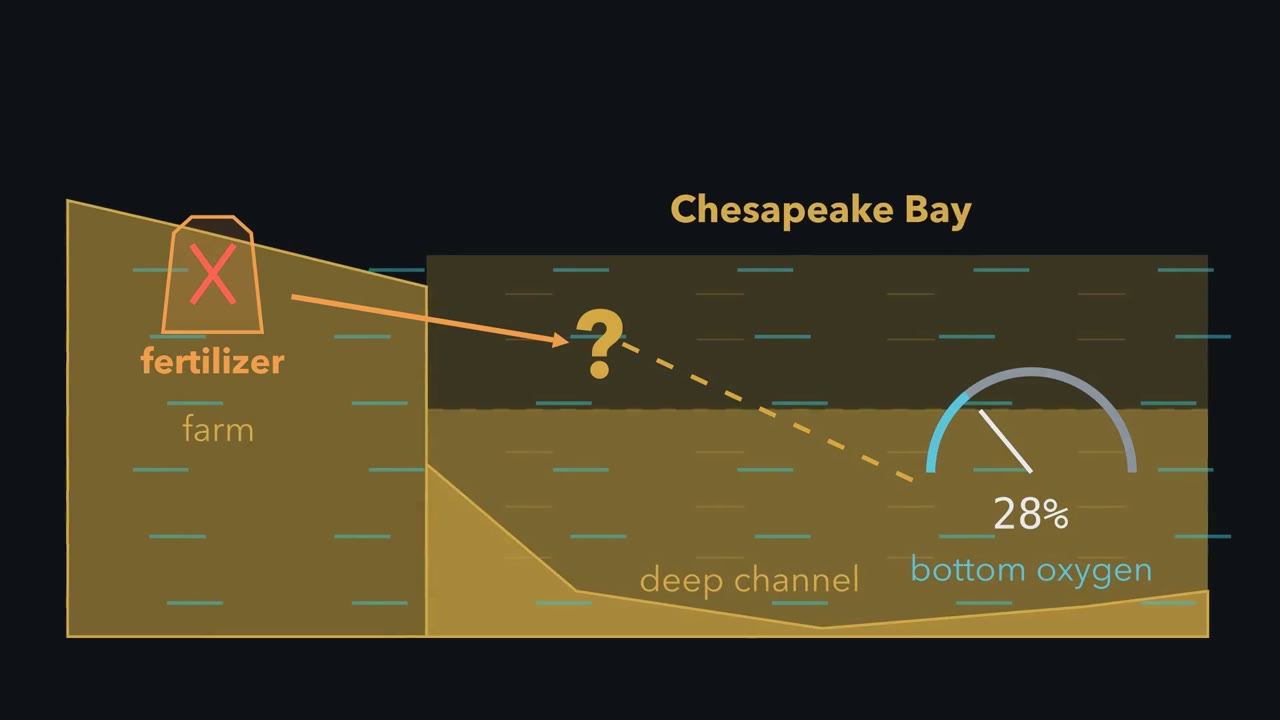
How can fertilizer spread on a field far upstream leave crabs and fish short of oxygen at the bottom of the Chesapeake Bay?
Continue in the lesson: The Chesapeake Under Pressure →
3:30 · Free, with captions and a transcript. The lesson has the full text, the questions and the sources.
More films from this lesson
How this film was made. Narration: an AI narrator voice (Kokoro, af_heart) reading narration written from this lesson's text. Animation: AI-generated in code (Manim) by Claude, a schematic with no drawn molecular structures. Captions come from the narration script. See something wrong? Report it.