Timing Securin's Destruction
Read the transcript of “Timing Securin's Destruction”
Film transcript: Timing Securin's Destruction
How fast can one living cell destroy a protein? Chapter 1 ended with the brake lifting. The APC/C tagged securin, and the proteasome destroyed it. Now, how can you read that speed? Tag securin with a fluorescent protein, and film a single cell. The glow tracks how much securin is left. In human HeLa cells, it starts to fall at metaphase, once the checkpoint is satisfied. Here are made-up numbers, for practice. At metaphase, 100 percent. Five minutes later, 71.
Ten minutes, 50. Fifteen minutes, 35. Treat this as exponential loss, with no new securin made. At 10 minutes, half is gone. That time is the half-life. For exponential loss, a half-life removes half of what remains. The loss is a steady fraction, not a steady amount. Here is a test for you. Ten minutes took the glow from 100 down to 50. What will it read at 20 minutes?
25 percent, not zero. Two half-lives halve it twice. The first 10 minutes lost 50 points; the next 10 lost only 25. The curve has a formula. f of t equals f zero times e to the minus k t. The rate constant k is ln 2 divided by the half-life. Here, k is about 0.069 per minute. Each securin the proteasome destroys is gone for good. While none is made, the curve can only fall. That fall is the one-way step from chapter 1, measured in minutes. So read this exponential destruction curve by its half-life. Every half-life halves what is left. From that one number you get the rate, and predict when any level is reached.
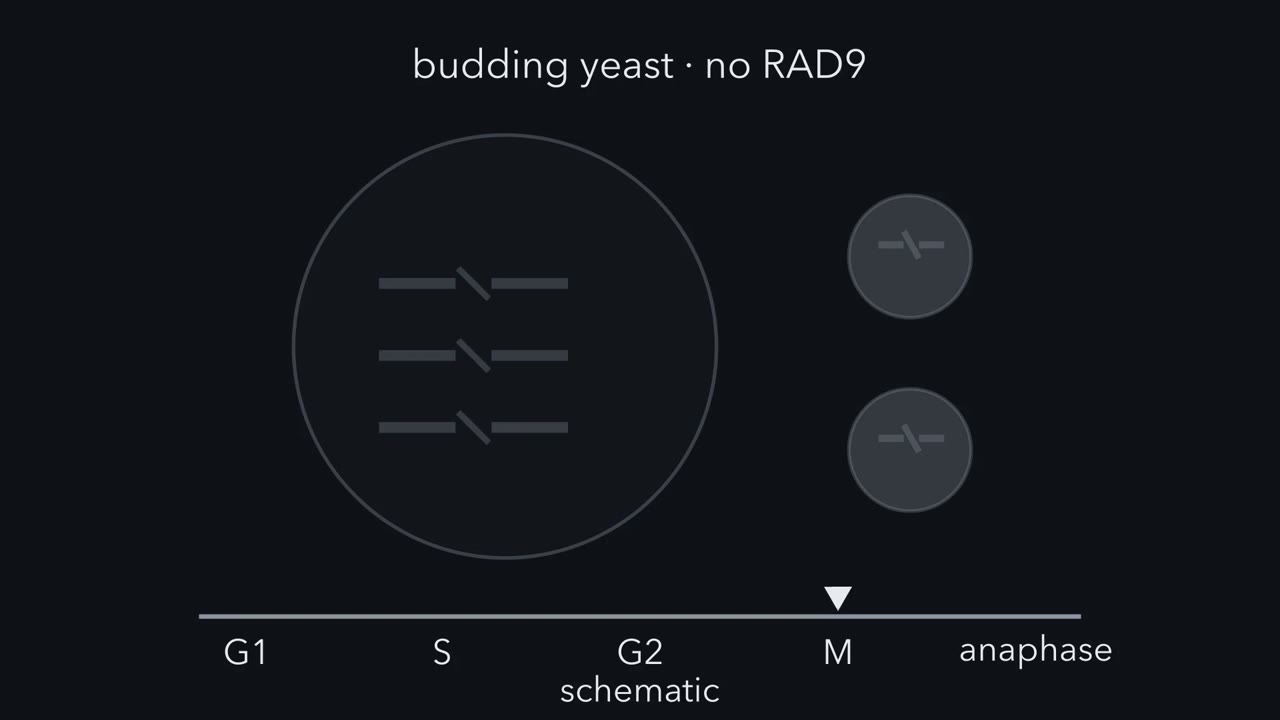
A yeast cell missing one gene keeps dividing after irradiation and dies. Hold it back with a drug, and it can repair the damage. What was the gene for?
Continue in the lesson: Checkpoints and Irreversible Transitions →
2:22 · Free, with captions and a transcript. The lesson has the full text, the questions and the sources.
More films from this lesson
How this film was made. Narration: an AI narrator voice (Kokoro, af_heart) reading narration written from this lesson's text. Animation: AI-generated in code (Manim) by Claude, a schematic with no drawn molecular structures. Captions come from the narration script. See something wrong? Report it.