Prisms: Learning You Can Watch
Read the transcript of “Prisms: Learning You Can Watch”
Film transcript: Prisms: Learning You Can Watch
Can you watch the cerebellum learn? Put on prism goggles, and throw. The goggles shift what you see to the right. So the first throws miss to the right. Each miss teaches a little. Throw by throw, the misses walk in toward the target. How much each error teaches sets how fast this curve falls. Call it k, the fraction of the error corrected per throw. Now take the goggles off. Where does the next throw land?
To the left. The learned correction is still being applied, to a world that has changed back. That opposite miss is the after-effect. It shows that the mapping between seeing and moving was recalibrated. Real after-effects are usually smaller, partly because people drop a deliberate aiming strategy once the goggles are off. In people with damage to the olivocerebellar system, adaptation at this task was impaired. In the model, a smaller k means smaller steps. The curve flattens, and after the same number of throws the after-effect is smaller too. The model does not say which part is damaged. One account: lose the cerebellum's prediction, and the arm leans on slow feedback.
Movements can overshoot and swing near the target. Now the side. A patient has a lesion in the left cerebellar hemisphere. Which arm is more likely to show tremor? The left arm. Cerebellar output crosses to the right thalamus, which relays to the right motor cortex. Then the corticospinal tract crosses back, to the left side of the spinal cord. Two crossings cancel. The takeaway: the cerebellum helps learn predictions from error. Damage can leave a limb leaning more on late feedback, one cause of clumsiness, on the same side.
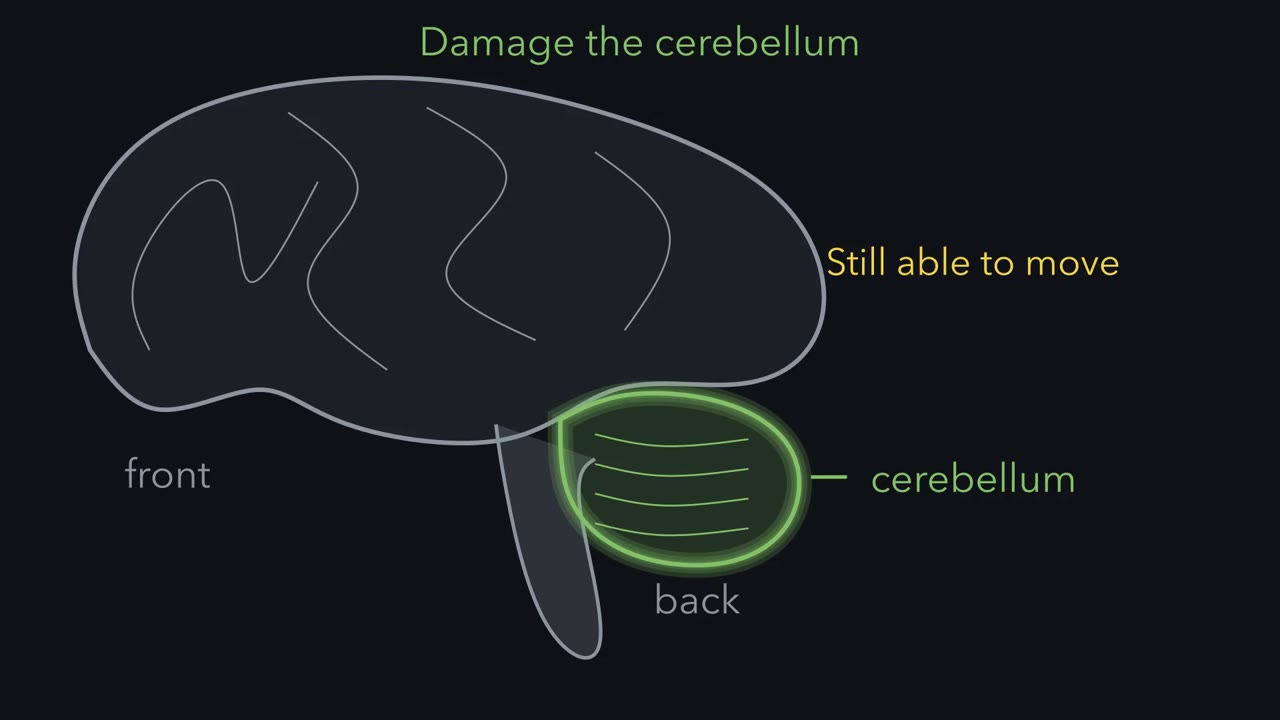
Most of the neurons in one count of the human brain sit in the cerebellum. Damage it and you can still move. What do you lose?
Continue in the lesson: The Cerebellum →
2:12 · Free, with captions and a transcript. The lesson has the full text, the questions and the sources.
More films from this lesson
How this film was made. Narration: an AI narrator voice (Kokoro, af_heart) reading narration written from this lesson's text. Animation: AI-generated in code (Manim) by Claude, a schematic with no drawn molecular structures. Captions come from the narration script. See something wrong? Report it.