Following the Sign
Read the transcript of “Following the Sign”
Film transcript: Following the Sign
How does one small change at a synapse become a correction that arrives on time? David Marr and James Albus proposed that the climbing fibre is a teacher. But which way would it change a synapse? Marr guessed stronger. Albus guessed weaker. In 1982, Masao Ito and Masanobu Kano tested it in rabbits. Compare three conditions. Parallel fibres alone. No lasting depression. Climbing fibre alone. No lasting depression either. The two together. Afterwards the parallel-fibre response is smaller, and it stays smaller for at least an hour. Under these conditions, only pairing weakened the synapse. This is cerebellar long-term depression, the sign Albus had chosen.
The input to a brake gets weaker. Does the nucleus fire more, or less? More, with other inputs unchanged. The foot presses the brake less, so the nucleus, already running, speeds up. Two negatives make a positive. But which parallel fibres are weakened? It depends on the region. In the flocculus, it is those active about a hundred and twenty milliseconds before the climbing fibre. That matters, because a visual error reaches the flocculus roughly a tenth of a second after the mistake. So the fibres active just before carry the context in which the mistake was made. Next time that context arrives, the learned change can act before the late visual error does. The correction need not wait for feedback.
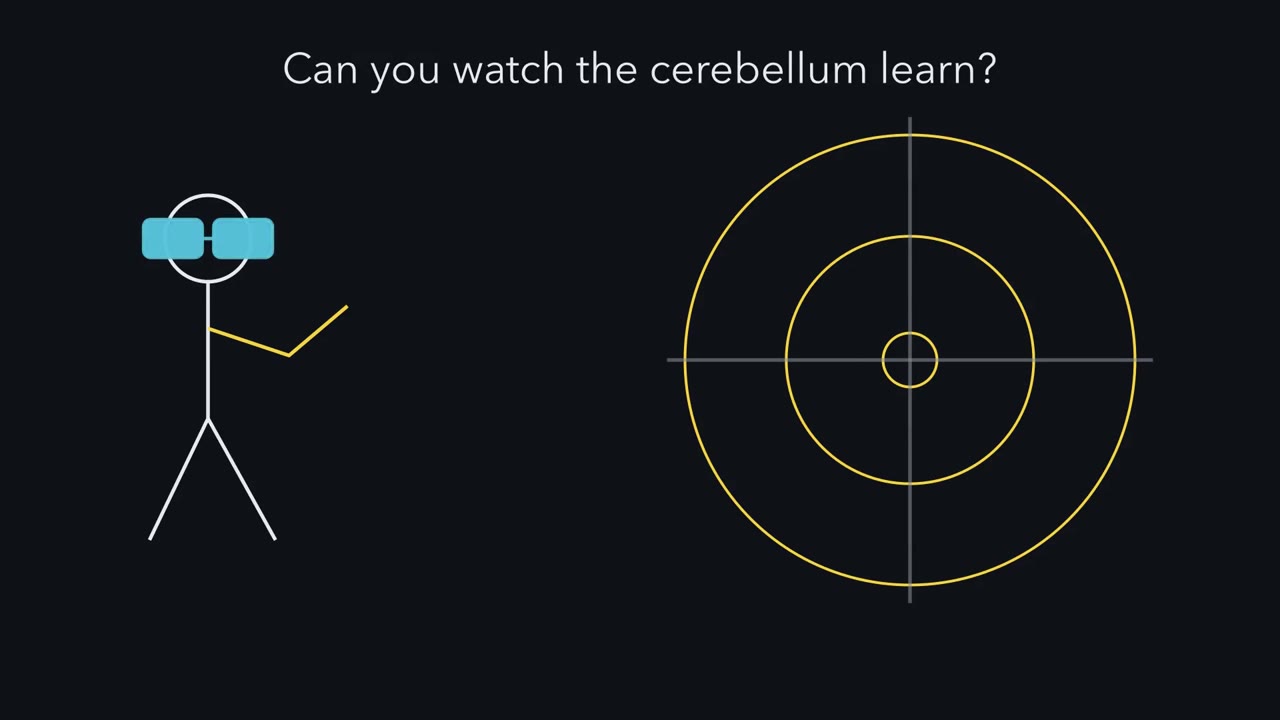
What does learning look like in a real cell? Monkeys returned a handle to a set position, and then the load changed. Climbing-fibre events show as big complex spikes; ordinary output spikes are simple spikes. In some recorded cells, complex spikes grew more frequent as the monkeys adapted. Simple-spike responses fell, and stayed lower. That pattern fits the rule, though it does not measure the synapse directly. But depression alone can only release the brake. What if the output needs to fall instead?
One way: strengthen the same synapses, so the brake presses harder. Parallel-fibre activity without a paired climbing fibre can do that. Other circuit changes can also lower output. In this one simplified channel, weakening alone can only raise the output, with other inputs fixed. Strengthening can reverse that change. The rule has limits. The teacher works in some tasks and not others. Mice without detectable depression still learned the tested tasks. Climbing fibres also signal reward. The takeaway: in this model, a well-timed error signal can weaken the eligible synapses. With other inputs fixed, less brake means more output, ready before the late feedback next time.
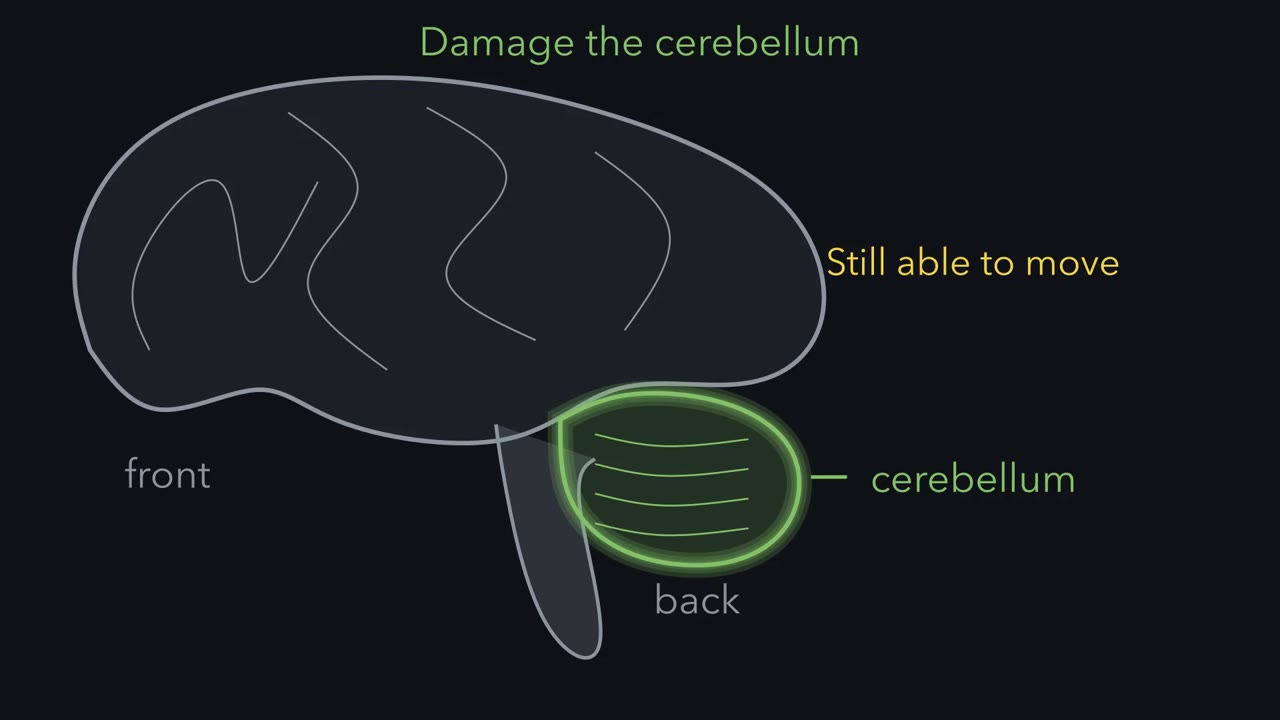
Most of the neurons in one count of the human brain sit in the cerebellum. Damage it and you can still move. What do you lose?
Continue in the lesson: The Cerebellum →
3:20 · Free, with captions and a transcript. The lesson has the full text, the questions and the sources.
More films from this lesson
How this film was made. Narration: an AI narrator voice (Kokoro, af_heart) reading narration written from this lesson's text. Animation: AI-generated in code (Manim) by Claude, a schematic with no drawn molecular structures. Captions come from the narration script. See something wrong? Report it.