Fate, Not Speed
Read the transcript of “Fate, Not Speed”
Film transcript: Fate, Not Speed
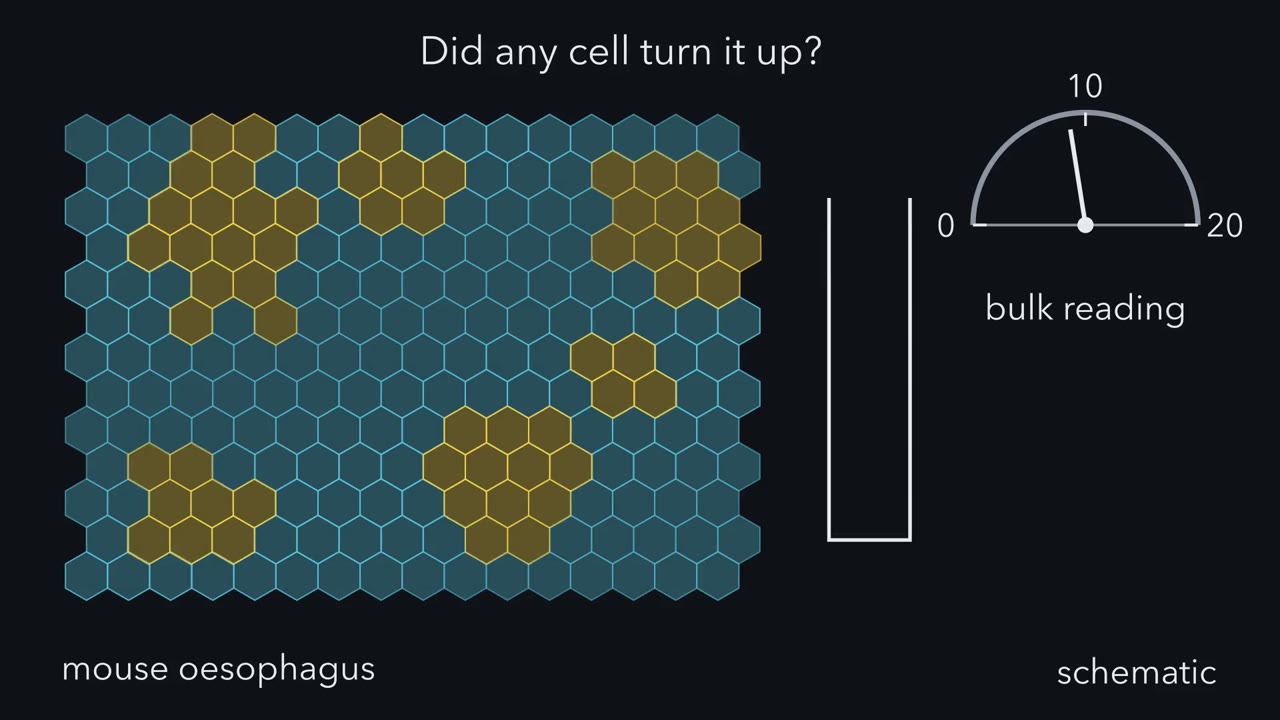
In middle-aged and elderly organ donors, much of the healthy oesophageal lining carried a mutation in one cancer gene, NOTCH1. How does one mutant cell's family come to fill a lining that is replaced all the time? Experiments in mouse oesophagus show how. Here is the lining, cut across. Only the bottom row of cells divides. That row is the basal layer, and its dividing cells are progenitors. Each daughter of a progenitor either stays in the bottom row or leaves it. Cells that leave differentiate, ride upward and are shed from the top. So the lining keeps its cell number steady only if, on average, it makes as many cells as it loses. Watch one progenitor divide.
Each division has three possible outcomes. Both daughters stay: call that PP. One stays and one leaves: PD. Or both leave: DD. In normal lining, these outcomes are balanced. PP comes up as often as DD. So on average, each division leaves one progenitor behind. One in, one out, and the bottom row holds steady. Now one basal cell loses Notch1, and we mark it gold. Every cell descended from it inherits the gold mark. That family of cells is a clone. Its clock runs no faster than its blue neighbours' clocks. The mouse data point to one difference. Its divisions give PP a little more often than DD. Before we run the clock forward, a question. On average, will the gold clone hold steady, die out, or spread along the row?
On average, it spreads. In this simplest picture, each division leaves a little more than one progenitor on average. Round after round, that small tilt compounds. Now watch the edges. Blue neighbours there differentiate and lift away. Each progenitor the gold clone keeps takes room a neighbour gives up. So the clone won by keeping more of its daughters as progenitors. Fate, not speed. Now look down on the lining from above. With time, gold patches spread among the blue. The lining changed because which cells are there changed. On average, the gold cells divided no faster. Is a lining full of these clones dangerous? And how could anyone tell fate from speed in a living tissue?
The text below picks up there.
Much of the lining of an older person's healthy oesophagus can carry mutations found in cancer. Why is it still healthy?
Continue in the lesson: Cell Identity, Cell State and Disease →
3:03 · Free, with captions and a transcript. The lesson has the full text, the questions and the sources.
More films from this lesson
How this film was made. Narration: written from this lesson's text and read by an AI narrator voice (Kokoro, af_heart). Animation: AI-generated in code (Manim) by Claude, a schematic with no drawn molecular structures. Captions come from the narration script. See something wrong? Report it.