A Snapshot Becomes a Clock
Read the transcript of “A Snapshot Becomes a Clock”
Film transcript: A Snapshot Becomes a Clock
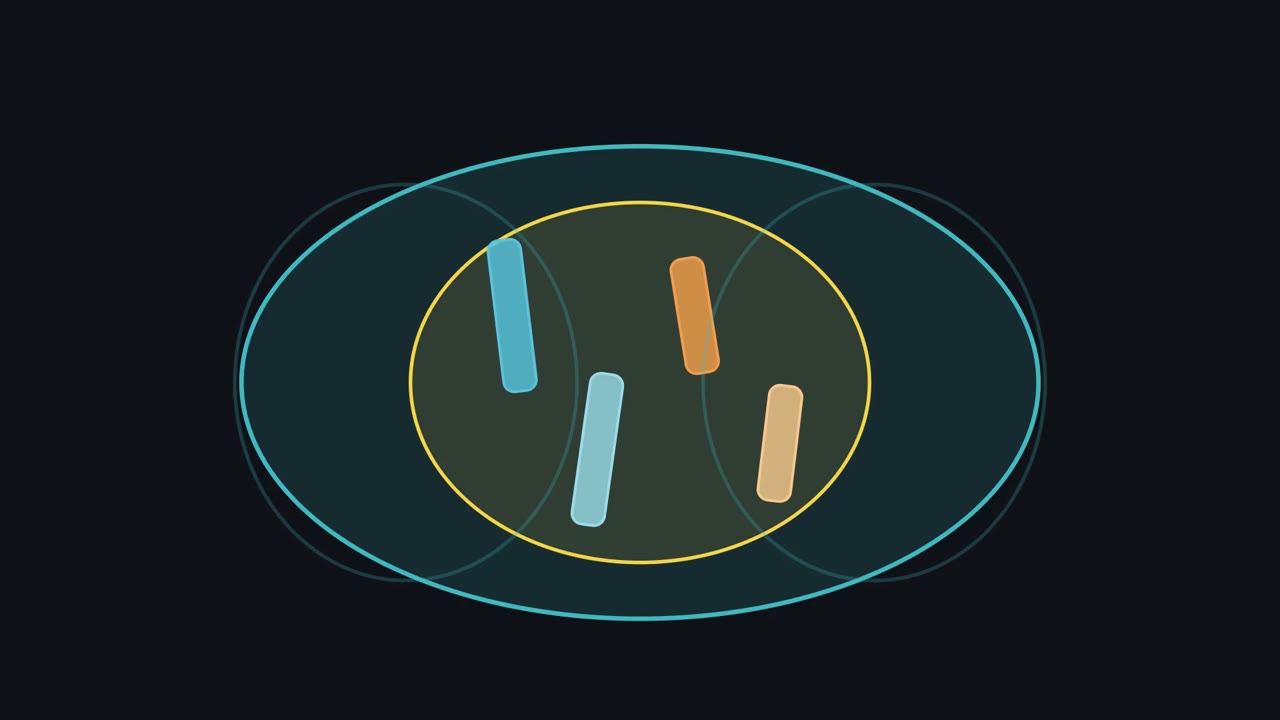
The first film showed how chromosome copies reach matching nuclei. How can a frozen onion root reveal which part of that cycle takes longest? The cells cannot answer, but their patterns can. A stained root tip is a snapshot. Each cell is caught at one moment of its cycle. Some show loose chromosomes inside a yellow nucleus. Others show chromosomes coiling, lining up, separating, or reaching opposite ends. Imagine many runners photographed at random points around a track. A slow section holds more runners because each runner stays there longer.
Cycling cells follow the same counting model. A longer phase should appear in more cells. Two phase lanes now contain different numbers of cells. Suppose every cycling cell moves steadily and the sample is fair. Which lane represents the longer-lasting phase? Hold your answer.
The fuller lane represents the longer phase. More cells were caught there because each one remains there longer. This gives a fraction, not a stopwatch reading. Divide the cells in one phase by all the cells counted, assuming every one is cycling. Now sort one teaching set by visible clues. Intact nuclei go to interphase. Coiled chromosomes go to prophase. A middle row marks metaphase. Separating groups mark anaphase. Two forming nuclei mark telophase. To estimate time, multiply a phase's fraction by the total cycle time. The teaching activity supplies a round total time rather than measuring it. Put that value on screen. The result is a model estimate for this set.
The model can fail if the pictures were chosen to display every stage. It also weakens if cells stopped cycling or changed pace. A random field, a clear sampling rule, and a measured total time would support stronger estimates. One more distinction matters. Mitosis separates chromosomes between nuclei, while cytokinesis separates the cell. Root-tip photographs can show both nearby, but the phase count sorts chromosome patterns. It does not directly time membrane or wall completion. The two processes overlap, so one snapshot can catch both. The count still teaches an important idea.
Cells spend time growing, copying DNA, and preparing before chromosomes visibly separate. That preparation serves the first film's rule. Copy each chromosome first; separate the copies so each nucleus gets one. And the counting rule is just as short. In a fair snapshot, a longer phase holds more cells.
When one cell becomes two, what keeps either new cell from receiving only half the chromosomes?
Continue in the lesson: The Cell Cycle and Mitosis →
3:23 · Free, with captions and a transcript. The lesson has the full text, the questions and the sources.
More films from this lesson
How this film was made. Narration: an AI narrator voice (Kokoro, af_heart) reading narration written from this lesson's text. Animation: AI-generated in code (Manim) by Claude, a schematic with no drawn molecular structures. Captions come from the narration script. See something wrong? Report it.