Did the Limit Move?
Read the transcript of “Did the Limit Move?”
Film transcript: Did the Limit Move?
The first film showed growth slowing near carrying capacity. But when a crab count falls, did the population move, did carrying capacity move, or both? Return to the same creek. This time, follow a pair of trackers: teal for population size and gold for carrying capacity.
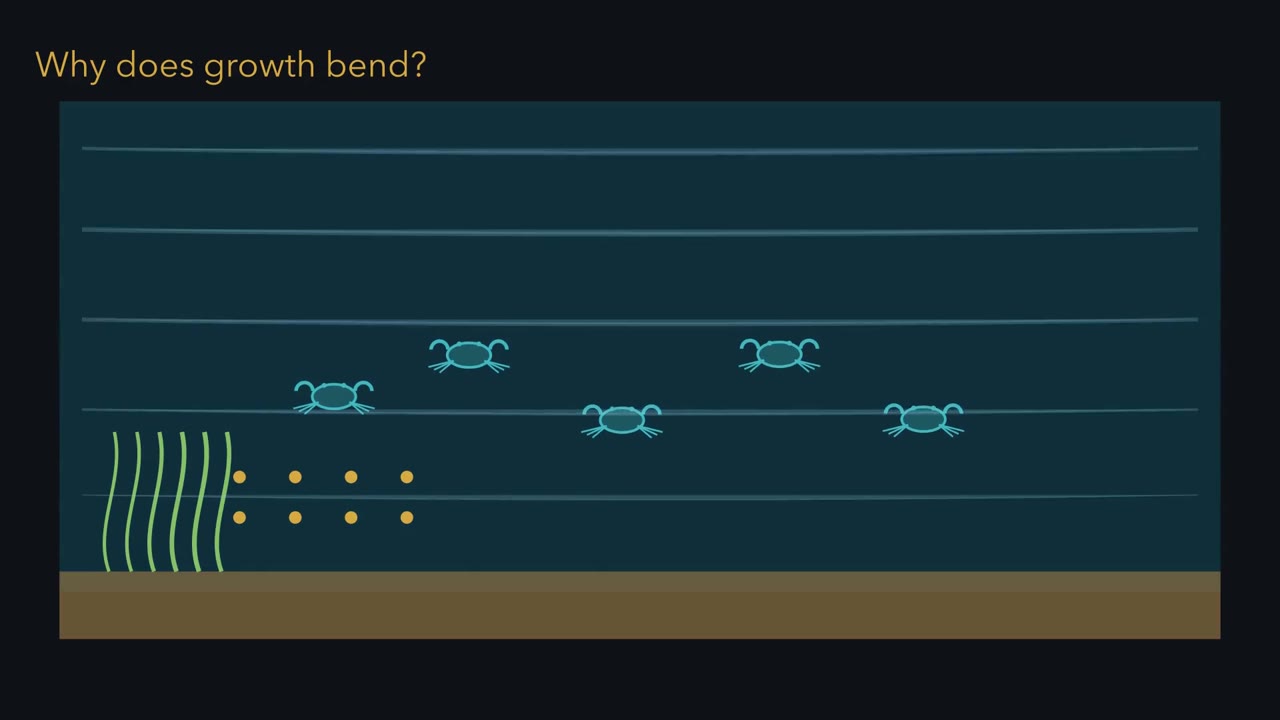
Population size means how many individuals are present now. Carrying capacity means the largest population the environment can support over time. The trackers can move together, but they are not the same measurement. A low population can sit below either a high or low capacity. Begin with a brief cold event in this schematic creek. Some teal crabs disappear, so population size falls. Food, space, and shelter remain. Under that assumption, the gold support level stays put. The population may grow back toward it after the event passes. Now change the creek for the long term. Remove much of the green shelter and keep it gone. Young crabs have fewer hiding places, so in this model the environment supports fewer crabs over time.
The gold carrying-capacity tracker moves down, and population growth now slows near that lower level. Here is the prediction. Both windows now show the same low crab count. The left followed a brief event. The right lost shelter for the long term. Can the count alone tell you whether carrying capacity moved? Hold your answer.
No. The same abundance can come from different paths. To tell them apart, scientists need evidence about food, habitat, predators, weather, and survival across time. The count shows population size. It does not measure carrying capacity or identify which limiting factor caused a change. That matters for the winter dredge survey.
Crews sample buried crabs across the Bay and build a Bay-wide estimate. The estimate is not an exact count. It can show whether reported groups rose or fell. By itself, it cannot show why they changed. A lasting gain in food or shelter can raise environmental support. Lasting habitat loss can lower it. People can affect both trackers too. Harvest removes individuals, while shoreline building can remove marsh. Removing individuals does not automatically prove that the support level changed. Return to the paired trackers. A brief shock moved the teal population while gold support stayed. Lasting shelter loss moved the gold level too. Keep the distinction whenever a graph rises or falls.
Ask what changed, how long it lasted, and what evidence measured it.
Why can the number of blue crabs in the Chesapeake Bay change by more than 100 million from one winter to the next?
Continue in the lesson: Populations and Carrying Capacity →
3:25 · Free, with captions and a transcript. The lesson has the full text, the questions and the sources.
More films from this lesson
How this film was made. Narration: an AI narrator voice (Kokoro, af_heart) reading narration written from this lesson's text. Animation: AI-generated in code (Manim) by Claude, a schematic with no drawn molecular structures. Captions come from the narration script. See something wrong? Report it.