Press play to start at .
The Tie That Holds
From the film
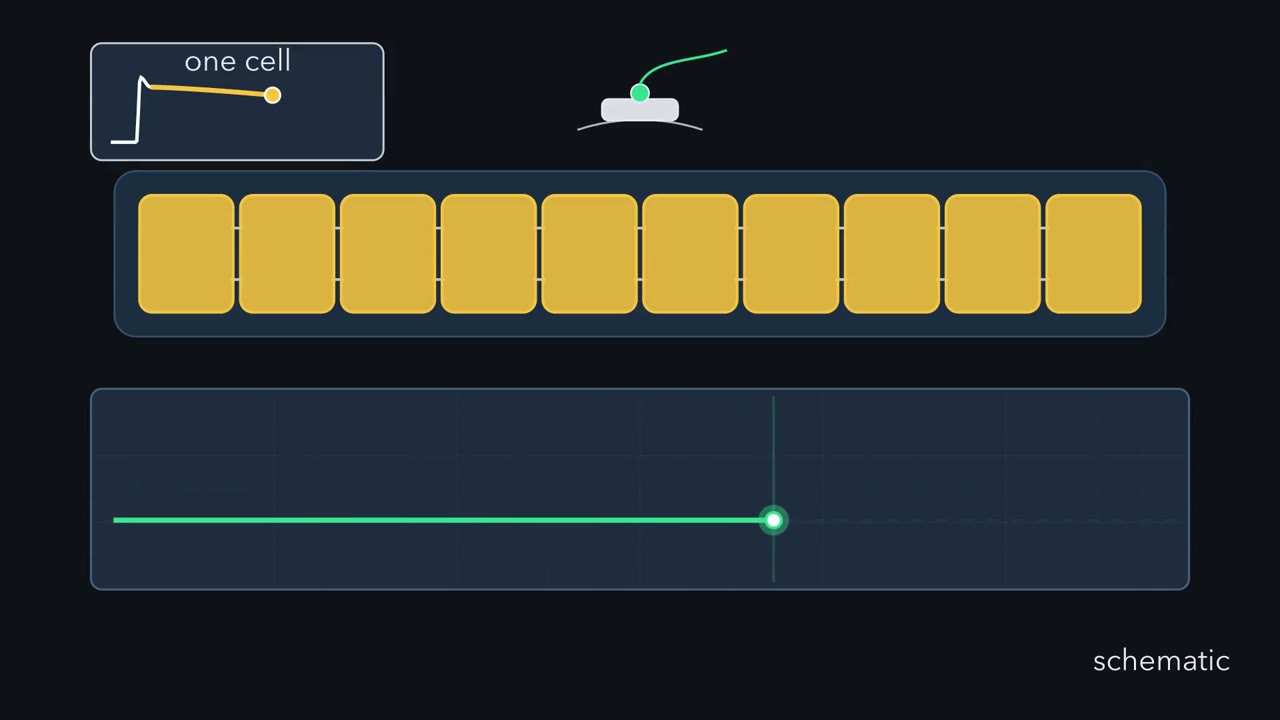
- A ventricular cell stays depolarized roughly a hundred times as long as a nerve spike.
- During the plateau, inward L-type calcium current and outward potassium currents nearly cancel.
- IK1 largely shuts at plateau voltages, so total conductance is low and small currents hold the voltage.
- Blocking one outward potassium current lengthens the plateau and the QT interval.
- The plateau ends as L-type channels inactivate and the potassium currents win.
Read the transcript of “The Tie That Holds”
Film transcript: The Tie That Holds
Tap a sentence to play from there.
- 0:00 A nerve spike is over almost at once.
- 0:04 Excite a ventricular heart cell, and it stays depolarized roughly a hundred times as long. What holds it up there?
- 0:15 Picture one ventricular cell from a human heart.
- 0:19 At rest its voltage sits flat, near minus ninety millivolts.
- 0:24 A potassium current called IK1 holds it there.
- 0:28 Now sodium channels open, and the voltage shoots up past zero.
- 0:33 Those channels inactivate within milliseconds, and a brief outward potassium current cuts a small notch.
- 0:45 Yet the voltage does not fall back.
- 0:48 It hangs near zero for about two hundred milliseconds.
- 0:52 This long stretch is the plateau.
- 0:55 Two sets of channels pull against each other.
- 0:59 L-type calcium channels let calcium flow in.
- 1:03 Delayed-rectifier potassium channels let potassium flow out.
- 1:12 Here is the one idea.
- 1:15 The plateau is a near tie.
- 1:18 Inward and outward currents almost cancel, so the voltage changes only slowly, drifting down as the outward currents gain.
- 1:30 But at rest, a large potassium conductance held this cell near minus ninety.
- 1:36 Why doesn't it drag the voltage straight back down?
- 1:40 Because IK1 is an inward rectifier.
- 1:44 It passes current well near rest, but largely shuts at plateau voltages.
- 1:50 So total conductance is low, and small currents hold the voltage.
- 1:59 So this balance is easy to disturb.
- 2:04 Block just one of the outward potassium currents.
- 2:07 What happens to the plateau?
- 2:14 It lengthens. Drugs that block the potassium channel called hERG do this.
- 2:22 The longer plateau reaches the skin too, as a longer QT interval on the ECG.
- 2:34 Losing one current is partly covered, though.
- 2:38 Several potassium currents can repolarize the cell.
- 2:42 That margin is called the repolarization reserve.
- 2:46 How does the tie finally break?
- 2:49 The L-type channels inactivate, shutting with time at depolarized voltages, and as calcium builds up inside.
- 2:58 Calcium's pull fades, and the potassium currents win.
- 3:02 As the voltage falls, IK1 conducts again and finishes repolarization.
- 3:08 The cell returns to where it started, flat near minus ninety millivolts.
- 3:19 So the long hold takes no huge current.
- 3:23 It takes opposing pulls, closely matched, while the resting potassium path is largely shut. When the match ends, the plateau ends.
The electrocardiogram: the same idea, other levels
A level is a place to start, not a rank. If this loses you, the rung below teaches the same idea, told more simply.
College, upper level · the level you chose
Cardiac Action Potentials and the ECG · this lesson
Why the trace is flat at the plateau: only boundaries between cells show.
Physiology · about 35 min · film 3:24 · 5 practice questions
Next door
- Nerve signals: The Spike and Its Puzzles · 2:20 Each wave on the trace is the sum of electrical pulses, as in nerves, spreading through heart muscle cells.
- The cardiac cycle: Where the Two Lines Meet · 2:44 The electrical waves match the steps of filling, squeezing and relaxing that a heartbeat goes through.
More films from this lesson
Continue in the lesson: Cardiac Action Potentials and the ECG →
Free, with captions and a transcript. The lesson has the full text, the questions and the sources.
How this film was made. Narration: written from this lesson's text and read by an AI narrator voice (Kokoro, af_heart). Animation: AI-generated in code (Manim) by Claude, a schematic with no drawn molecular structures. Captions come from the narration script. See something wrong? Report it.