One Door for Two Cycles
Read the transcript of “One Door for Two Cycles”
Film transcript: One Door for Two Cycles
Can a dry summer change the carbon dioxide in the air? To answer that, we have to follow water, not carbon. The first film showed the air as a tub of carbon. The oak's green arrow drained it every summer. Now follow the oak's water instead. Rain falls on the yard. That is precipitation. Some of it soaks into the ground, which is infiltration.
Some flows downhill to a stream. That is runoff. The oak's roots take water from the soil. It moves up the stem to the leaves. Then it leaves through tiny openings in the leaves, as water vapor. That is transpiration. Water also evaporates from the pond, and most of all from the ocean. High up, the vapor cools into tiny droplets that form clouds. That is condensation. Then rain falls again. Plants move a lot of this water. One study estimated that nearly two thirds of the water moving from land into the air goes through plants. The estimate has a wide range. Now zoom into one leaf.
Carbon dioxide comes in through the same tiny openings that water vapor goes out of. One door serves both cycles. Inside the leaf, photosynthesis uses water and carbon dioxide together to make sugar. The water came up from the roots. The carbon dioxide came in through the door. Now a hot, dry summer. The soil dries out, and the oak closes its tiny openings to save water. What happens to the green arrow on the air tub? Pause and predict.
It gets thinner. With the openings nearly closed, less carbon dioxide gets in. So the oak takes less carbon out of the air. This happens in real forests. In 2003, Europe had a very hot, dry summer. One study estimated that plants there took in about 30 percent less carbon than usual. One thing in this picture does not cycle.
Carbon and water go around and around, used again and again. Energy does not. It comes in as sunlight and leaves as heat, so plants need new sunlight every day. The two cycles are linked at the leaf. Water going out and carbon dioxide coming in pass through the same tiny openings. So a change in one cycle can change the other.
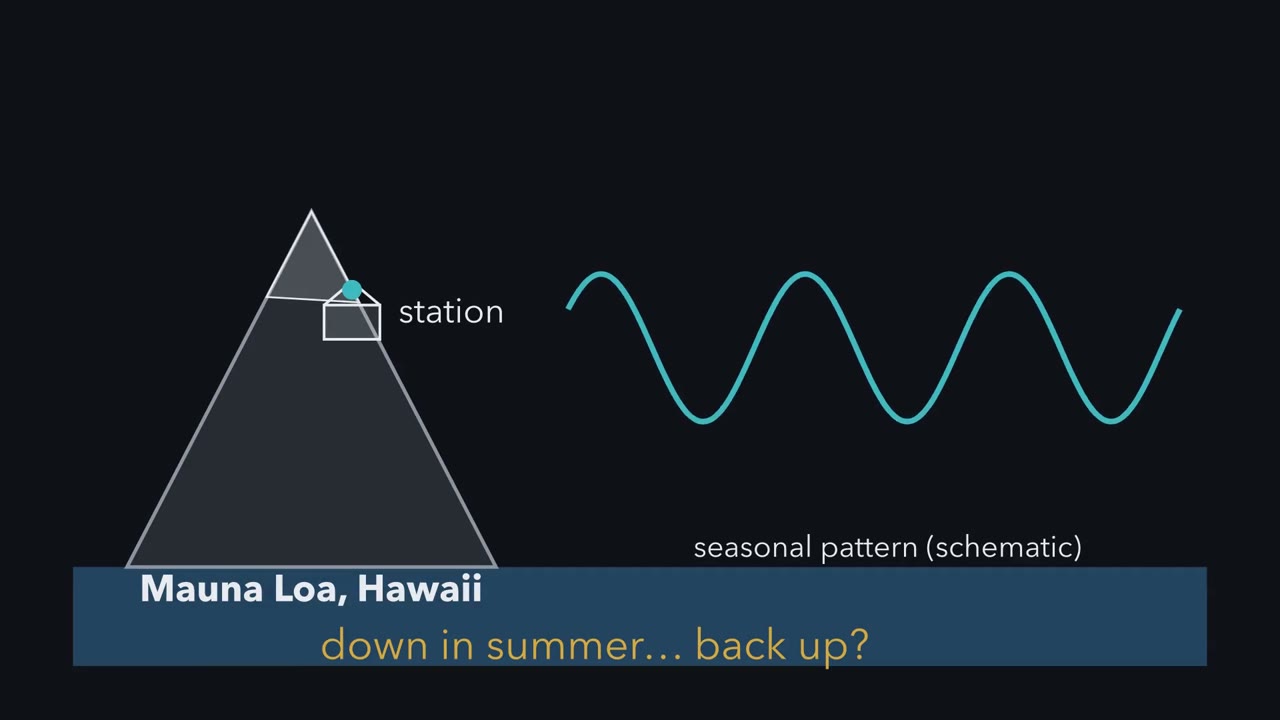
Why does the air over a Hawaiian volcano lose carbon dioxide every summer and win it back every fall and winter?
Continue in the lesson: The Carbon and Water Cycles →
3:03 · Free, with captions and a transcript. The lesson has the full text, the questions and the sources.
More films from this lesson
How this film was made. Narration: an AI narrator voice (Kokoro, af_heart) reading narration written from this lesson's text. Animation: AI-generated in code (Manim) by Claude, a schematic with no drawn molecular structures. Captions come from the narration script. See something wrong? Report it.