Films · Genetics and Molecular Biology
Reading a Tumor Family Tree
Read the transcript of “Reading a Tumor Family Tree”
Film transcript: Reading a Tumor Family Tree
The first film followed DNA changes through one expanding lineage. How can mixed DNA reads reveal which tumor lineage carries a change? Start with that same clay-colored family tree. An early clay marker appears near its trunk. Every later branch inherits it.
Later, one branch gains a second, square marker. Only that branch carries it, so it is a subclone. The trunk marker is clonal because every tumor branch carries it. The pattern records ancestry, even when the sample mixes all branches together. Now place a matched-normal sample beside the tumor. It comes from the same person, often from blood. A variant found only in tumor is usually somatic. A variant found in both samples is usually germline, most often inherited. The word usually matters. Here is a gold variant in both tumor and matched normal.
Predict: did it most likely enter this person's cells before the tumor lineage began, or after one tumor branch formed? Most likely, it was present before the tumor lineage began. So it is usually germline, whether inherited or newly formed in an egg or sperm. The matched normal gives the timing clue. Tumor data alone cannot reliably separate that history from a somatic change. Variant allele fraction, or VAF, is the fraction of reads carrying a variant. A clonal variant can still sit below one half.
Normal cells dilute the tumor reads. Copy gains, losses, and loss of heterozygosity also change the number of variant and nonvariant copies. Purity is the fraction of cells in the sample that are tumor cells. For a heterozygous clonal variant in a two-copy region, expected VAF is purity times one half. The shortcut also assumes normal cells lack the variant. It fails after copy changes or loss of the other allele, or when only a subclone carries it. So read the evidence in order.
Compare tumor with matched normal. Ask which lineages carry the variant. Then count mutant copies against all copies. Purity, copy number, and read depth limit the inference. The result is a family-tree estimate, not a perfect replay. A high or low fraction is not a verdict by itself. Read it with the matched normal and the sample's copy structure. Different branch histories can produce similar fractions, so the supporting clues matter. That uncertainty belongs in the interpretation. Together, those clues connect mixed sequencing reads back to the expanding cell lineages that produced them.
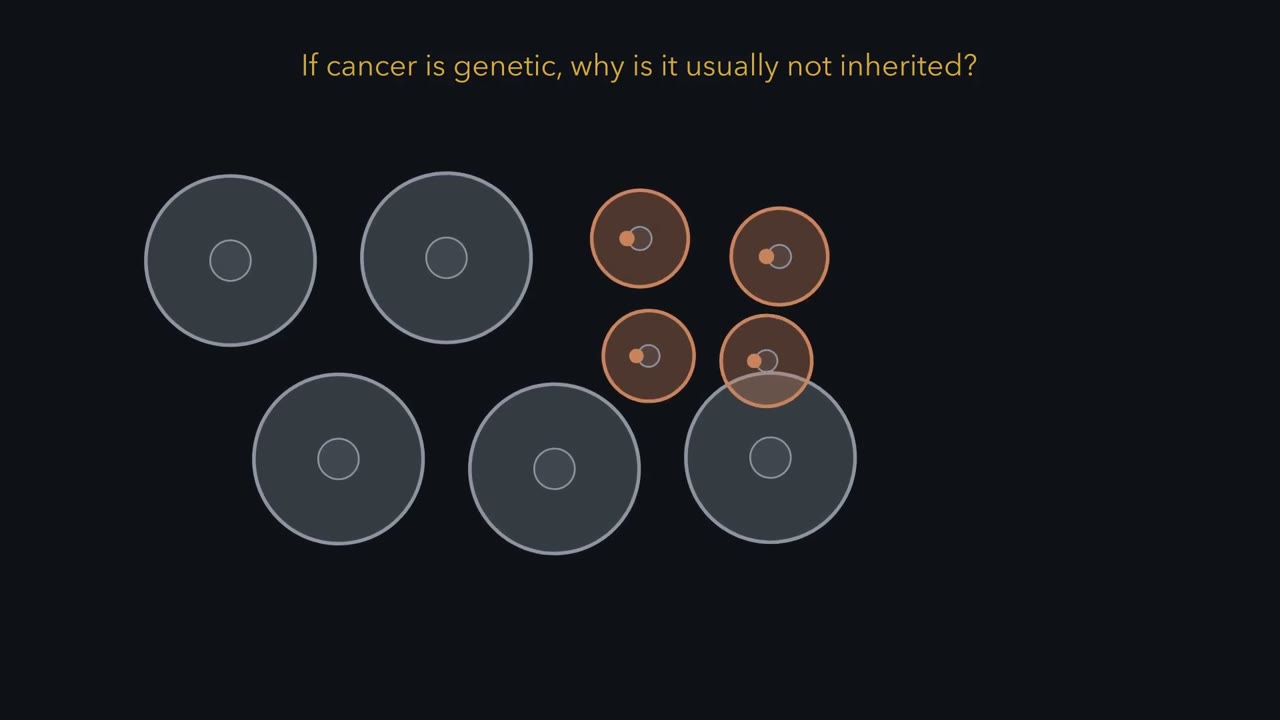
If cancer is a genetic disease, why are most of the DNA changes in a tumor not inherited?
Continue in the lesson: Cancer as a Genetic Disease →
3:21 · Free, with captions and a transcript. The lesson has the full text, the questions and the sources.
More films from this lesson
How this film was made. Narration: an AI narrator voice (Kokoro, af_heart) reading narration written from this lesson's text. Animation: AI-generated in code (Manim) by Claude, a schematic with no drawn molecular structures. Captions come from the narration script. See something wrong? Report it.