PKA: The Target Sets the Response
Read the transcript of “PKA: The Target Sets the Response”
Film transcript: PKA: The Target Sets the Response
Synthesis and breakdown set the cAMP level. Once that messenger activates PKA, why do heart and fat cells respond differently? The messenger is common, but the reachable machinery need not be. That is the puzzle. At low cAMP, PKA rests as paired regulatory and catalytic subunits. Each catalytic subunit is a complete kinase. Each regulatory partner keeps one catalytic site inactive. The regulatory pair acts as an off switch until messenger arrives. A kinase modifies a target protein by transferring phosphate from ATP. The target must enter a groove. A regulatory segment mimics a target and occupies that groove first. Blocking the groove prevents genuine targets from receiving phosphate.
cAMP binds the regulatory subunits and changes their shape. Their blocking segments release the grooves. In the classical model, catalytic subunits come away free. Evidence suggests anchored complexes can act nearby without fully coming apart. Either picture exposes catalytic activity to targets within reach.
Now place the same active PKA across both cells. Both cells receive the same messenger level and display the same kinase. One cell offers green target strips, while the other offers different strips. Must their responses match?
No. An active PKA can modify only compatible targets it reaches. Different cells make different target proteins, so identical messenger and kinase activity can produce different cellular actions. The response follows the proteins present, not a special kind of cAMP. In fat, reachable targets include hormone-sensitive lipase and perilipin, supporting fat breakdown. In heart, other targets alter calcium entry, cycling, contraction, and relaxation. Liver offers another set, including enzymes that control glycogen. The relay is shared; the target set differs. Reach also matters within one cell. An anchoring protein can hold PKA beside a selected substrate.
The address narrows which target can meet the active kinase. Nearby cyclase supplies cAMP, while nearby phosphodiesterase removes it. Experiments reveal local cAMP regions and receptor-specific PKA activity. Local production, local removal, binding, and restricted movement may all contribute. Their importance varies and remains debated. The local patterns are observed; the mechanism is not fully settled. Activation therefore opens the catalytic groove, but access gives the signal meaning. The text now tests that groove with competition and examines the evidence for local signalling. Those experiments separate what is established from what is proposed.
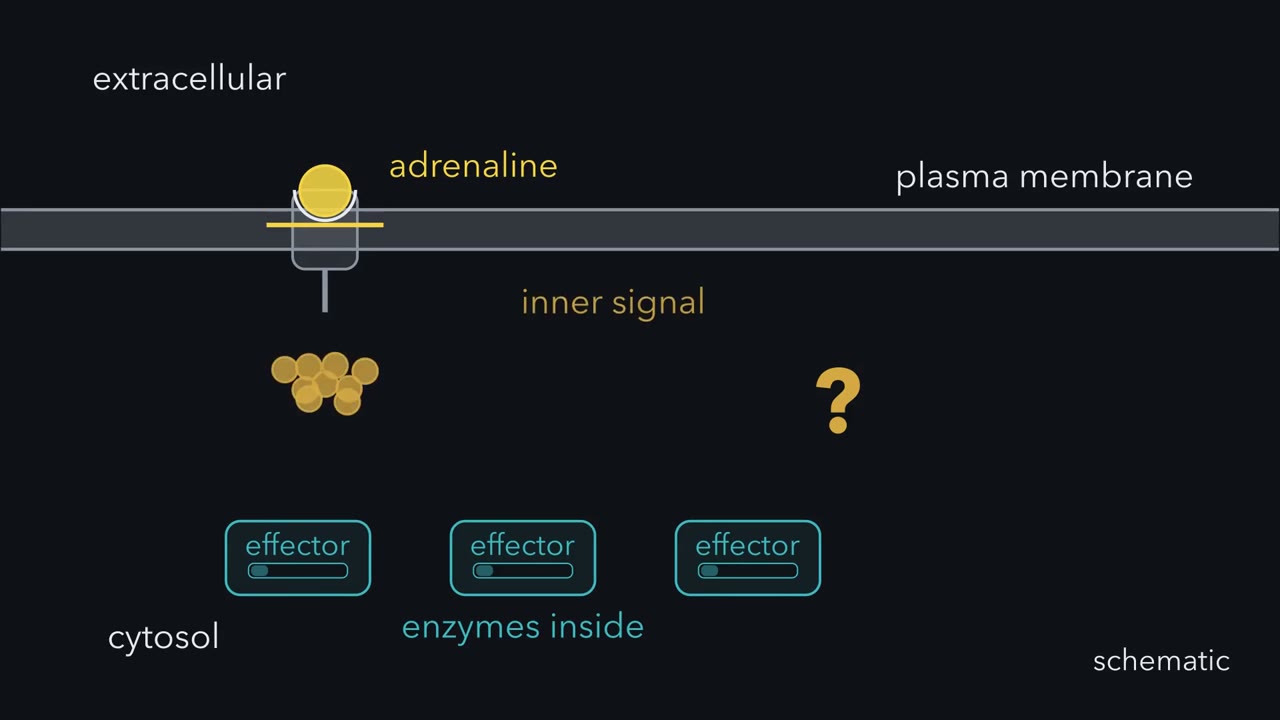
Adrenaline stays outside a liver cell, so how can enzymes inside respond?
Continue in the lesson: cAMP and Protein Kinase A →
3:46 · Free, with captions and a transcript. The lesson has the full text, the questions and the sources.
More films from this lesson
How this film was made. Narration: an AI narrator voice (Kokoro, af_heart) reading narration written from this lesson's text. Animation: AI-generated in code (Manim) by Claude, a schematic with no drawn molecular structures. Captions come from the narration script. See something wrong? Report it.