The Messenger Level: Made and Erased
Read the transcript of “The Messenger Level: Made and Erased”
Film transcript: The Messenger Level: Made and Erased
Adrenaline stays outside a liver cell. How can enzymes inside respond? Watch the outer signal stop at the membrane while an inner signal begins moving. The answer must connect both spaces without carrying adrenaline across.
The receptor changes shape and activates Gs on the inner face. Gs reaches adenylyl cyclase, in the membrane. The enzyme turns cytosolic ATP into cAMP. The membrane holds the first step beside the inner messenger is produced. cAMP is the second messenger here. Its level changes inside after the first messenger binds outside. Many copies can carry one receptor input toward intracellular effectors. Unlike adrenaline, these copies never need to cross the membrane from outside. The membrane step keeps making messenger while the receptor pathway remains active. Every gold token carries the same chemical information, so quantity becomes adjustable. More tokens raise the level.
Their location and lifetime also matter. A source would let cAMP keep accumulating. Phosphodiesterase provides the opposing process. It opens cAMP's ring and leaves inactive 5′-AMP, erasing the message. That product cannot switch on the kinase that reads cAMP. When removal is proportional to the amount present, it strengthens as cAMP accumulates. A higher level makes encounters with the red enzyme more frequent. The level settles when synthesis and breakdown match. This curve is computed from that first-order model. Now keep the blue source unchanged and strengthen the red removal process. Nothing else in the cell changes during this comparison.
Where will the cAMP level settle: above its old plateau, or below it? Below. At every cAMP level, stronger phosphodiesterase removes more. A lower concentration is enough for removal to match the unchanged source, so the computed plateau falls. The balance returns, but at a different level. Gs raises synthesis, while Gi lowers some forms of cyclase.
Phosphodiesterases set removal. These controls change the messenger before any downstream target is chosen. When adrenaline leaves, the receptor stops activating new Gs. Active Gs lingers until it splits its GTP, so cyclase drive fades. Synthesis falls back to its resting rate.
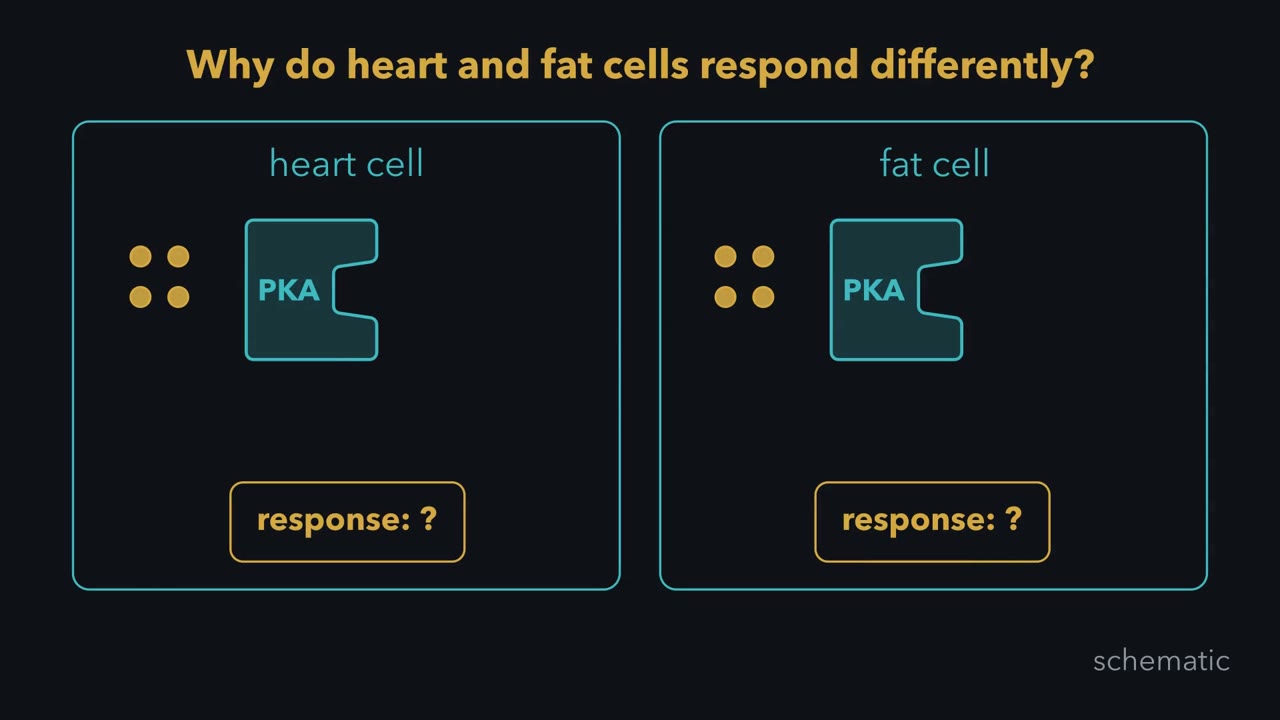
Phosphodiesterase then returns cAMP toward its resting level. Faster removal makes that return briefer. Phosphodiesterase then returns cyclic amp toward its resting level. The message therefore has an adjustable height and lifetime. Its amount is not the response itself. Several possible effectors wait in the same cytosol. The next question is how a cAMP reader turns that level into a specific action.
Adrenaline stays outside a liver cell, so how can enzymes inside respond?
Continue in the lesson: cAMP and Protein Kinase A →
3:37 · Free, with captions and a transcript. The lesson has the full text, the questions and the sources.
More films from this lesson
How this film was made. Narration: written from this lesson's text and read by an AI narrator voice (Kokoro, af_heart). Animation: AI-generated in code (Manim) by Claude, a schematic with no drawn molecular structures. Captions come from the narration script. See something wrong? Report it.