How One Ion Carries Different Messages
Read the transcript of “How One Ion Carries Different Messages”
Film transcript: How One Ion Carries Different Messages
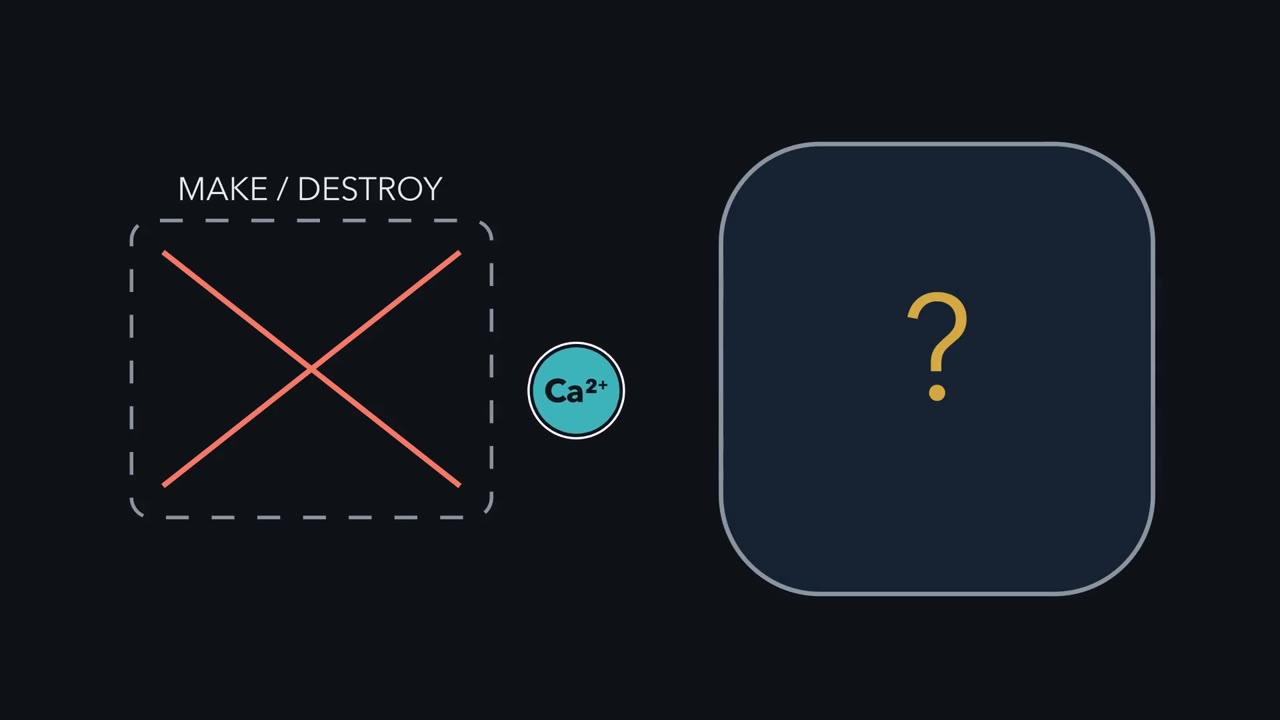
The first film showed how moving calcium creates a cytosolic rise. How can that same ion trigger different responses? A cell cannot label one calcium ion for contraction and another for secretion. Instead, it controls where the rise happens, and when and how often.
Open one gold channel. Calcium is highest near its pore before buffers capture and pumps remove it. The teal plume fades with distance. A sensor anchored beside the channel samples that local domain. An identical sensor across the cytosol meets much less free calcium. Predict before either sensor changes. Both sensors switch on only above the same calcium threshold. The channel opens briefly. Which sensor responds: the one beside the pore, the one across the cell, or both? Follow the fading plume.
Only the nearby sensor responds. Calcium beside the pore crosses the threshold; the lower level far away does not. The near sensor binds calcium, changes shape and exposes an orange output surface. Location has selected a reader without changing the calcium or the reader's binding properties. A local event can also recruit more release. Calcium from one site may help open a neighbouring release channel. Then the next site can recruit another. The moving front becomes a wave, and many sensors across the cell can respond. This spreading route is positive feedback. Now transform distance into time. One sensor sees isolated calcium spikes, each followed by full recovery.
Another sees closely spaced spikes. Both trains can contain similar individual rises, yet their intervals differ. A reader with a slowly fading active state can distinguish those intervals. With long gaps, the reader returns toward rest before the next spike.
Close spikes arrive while some activity remains. The responses can build. Calcium has not acquired a new identity. Timing matters because the reader keeps a biochemical memory that outlasts each brief rise. Cells give calcium meaning by controlling where and when free calcium rises. The size of a rise matters too; this film concentrates on place and timing.
Local domains favour nearby readers. Coordinated release can spread the response. Repeated spikes favour readers that retain activity between rises. Cells combine these patterns with different sensors; there is no universal decoder. The cell therefore writes information without changing the ion itself.
Channel position sets the starting place. Feedback can enlarge the territory. Opening and closing set the rhythm. Sensors read only the calcium pattern that reaches them, on the time scale their own chemistry can remember.
How can the same calcium ion trigger contraction, secretion or gene expression without making the cell respond everywhere at once?
Continue in the lesson: Calcium: The Messenger Kept at Arm's Length →
3:37 · Free, with captions and a transcript. The lesson has the full text, the questions and the sources.
More films from this lesson
How this film was made. Narration: an AI narrator voice (Kokoro, af_heart) reading narration written from this lesson's text. Animation: AI-generated in code (Manim) by Claude, a schematic with no drawn molecular structures. Captions come from the narration script. See something wrong? Report it.