Press play to start at .
Smaller Filter, Same Phosphate Out
From the film
- FGF23, made by bone, is phosphate's own brake: it lowers phosphate reabsorption in the proximal tubule and lowers calcitriol.
- At steady state, the kidneys must excrete the phosphate the gut absorbs, about 800 mg a day in round numbers.
- When filtration falls, the fraction of filtered phosphate excreted must rise; moderate kidney disease keeps phosphate normal largely this way.
- The fraction cannot pass 100 percent, so at very low filtration plasma phosphate must rise, even with high PTH.
Read the transcript of “Smaller Filter, Same Phosphate Out”
Film transcript: Smaller Filter, Same Phosphate Out
Tap a sentence to play from there.
- 0:00 The first film followed calcium through the kidney's filter: a huge daily flow, and a small share lost.
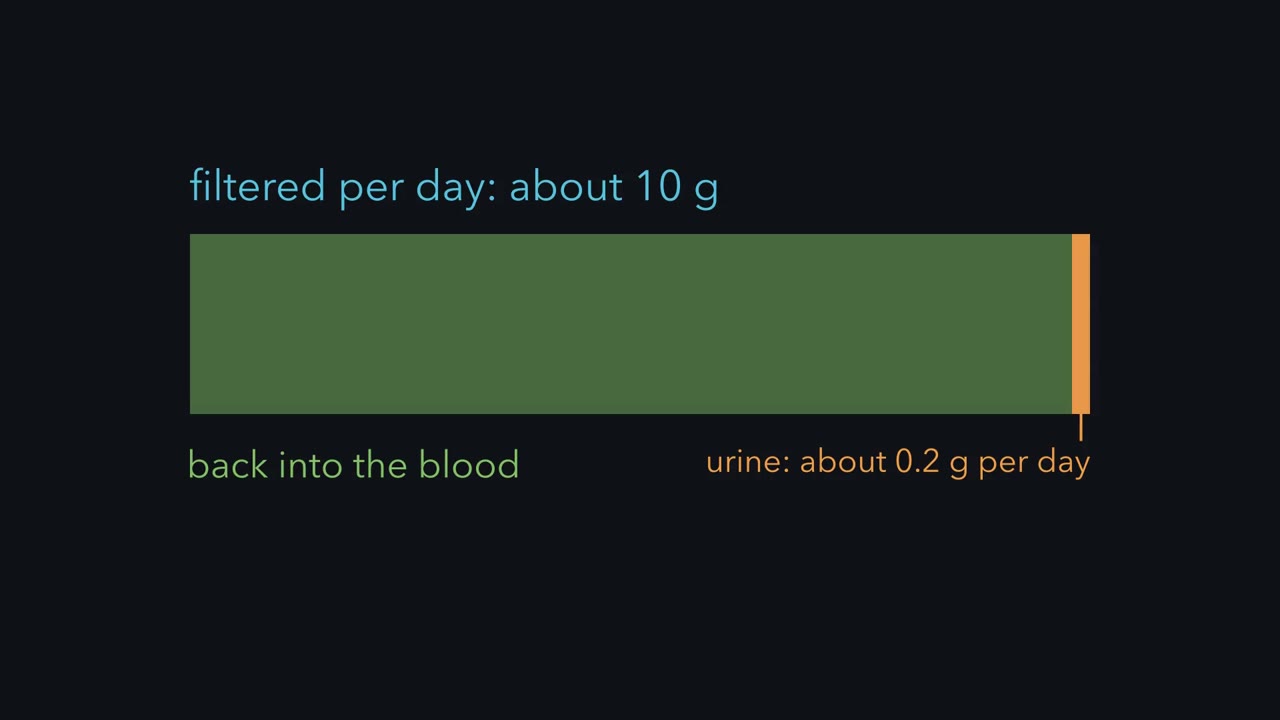
- 0:08 Phosphate passes the same filter.
- 0:11 Picture a healthy kidney and a badly failing one.
- 0:15 In round numbers, both excrete 800 mg of phosphate a day.
- 0:20 So why is blood phosphate high in the failing one?
- 0:26 First, phosphate's controls.
- 0:30 PTH throws phosphate out, but calcium sets PTH.
- 0:34 So bone makes phosphate its own brake, FGF23.
- 0:39 It acts on the kidney through a co-receptor, Klotho.
- 0:43 There it does two things.
- 0:46 Like PTH, it lowers phosphate reabsorption in the proximal tubule.
- 0:52 Unlike PTH, it lowers calcitriol, which cuts the phosphate absorbed from the gut.
- 0:58 Now the arithmetic, in round numbers.
- 1:02 Phosphate excreted equals filtration, times filterable plasma phosphate, times the fraction excreted.
- 1:10 A healthy filter passes 180 L a day.
- 1:14 15 percent of filtered phosphate leaves.
- 1:18 A plasma phosphate of about 3.3 mg/dL does the job.
- 1:24 Here is the rule. At steady state, the kidneys must excrete the phosphate the gut absorbs. When filtration falls, the fraction excreted must rise.
- 1:37 Where the fraction falls short, plasma phosphate rises instead.
- 1:41 Cut filtration to 60 L a day.
- 1:45 At 15 phosphate would need about 9.9.
- 1:49 If FGF23 and PTH push the fraction to 50 about 3.0 is enough.
- 1:57 So moderate kidney disease keeps phosphate normal largely by raising the fraction.
- 2:03 In one large cohort, FGF23 was high while phosphate and PTH were still normal.
- 2:10 That fits it rising first, without proving the order.
- 2:14 Now cut filtration to 15 L a day.
- 2:19 Suppose the kidney excreted every milligram it filtered.
- 2:22 Could plasma phosphate stay normal?
- 2:30 No. The fraction cannot pass 100 Even there, plasma phosphate must sit near 5.9.
- 2:40 At 50 it would need about 11.9.
- 2:44 So phosphate settles high, and climbs from there.
- 2:49 Calcitriol falls and PTH rises, yet phosphate stays up.
- 2:54 PTH's usual signature, calcium up and phosphate down, fails here.
- 2:59 A smaller filter can be covered by sending out a larger share.
- 3:05 When the share can grow no more, the blood level has to give.
Calcium balance: the same idea, other levels
A level is a place to start, not a rank. If this loses you, the rung below teaches the same idea, told more simply.
College, upper level · the level you chose
Calcium, Phosphate and Bone · this lesson
Calcium sensor sets PTH; PTH opens kidney, bone and gut doors, throws phosphate out.
Physiology · about 30 min · film 2:33 · 5 practice questions
Next door
- Calcium signaling: How a Cell Makes a Calcium Signal · 3:28 · Graduate school and beyond Cells keep calcium very low inside, so a small rise works as a message, and blood calcium must stay steady.
- Muscle contraction: Smooth muscle force is a balance · 2:42 Calcium is the switch that lets muscle pull, so too little or too much in blood upsets muscle work.
More films from this lesson
Continue in the lesson: Calcium, Phosphate and Bone →
Free, with captions and a transcript. The lesson has the full text, the questions and the sources.
How this film was made. Narration: an AI narrator voice (Kokoro, af_heart) reading narration written from this lesson's text. Animation: AI-generated in code (Manim) by Claude, a schematic with no drawn molecular structures. Captions come from the narration script. See something wrong? Report it.