Read the Branch Point
Read the transcript of “Read the Branch Point”
Film transcript: Read the Branch Point
The first film followed inherited evidence to a surprising pair. Once evidence is scored, how does a branching tree turn it into a claim about relatives? The answer is not the nearest tip. It is the path back to a shared branch point.
Begin with a trait table. Each row is an organism, and each column is one inherited feature. A present mark lights up in teal. When the same marks form a smaller group inside a larger group, the groups are nested. A tree can show that nesting. A useful marker is a shared derived characteristic. It first appeared in one ancestor and passed to that ancestor's descendants. Move its mark from the table onto the matching branch. Every tip beyond that mark belongs to the marked group in this tree. A branch point, also called a node, represents a common ancestral population. Start at two tips and trace both lines toward the root.
Stop at the first node shared by both paths. A pair sharing a later node is more closely related in this tree. Trace shared derived traits to branch points to find the closest relatives. Now spin the whale and hippo branches around their shared node. The tips trade places. Did the relationship change, or did only the drawing move? Follow both paths before you decide.
Only the drawing moved. Both paths still meet at the same node, so the relationship is unchanged. Tip order cannot decide relatedness. This tree also has no top or goal. Every living tip has continued changing since its ancestors split. Branch length needs a key. On a plain cladogram, a long line can be empty space for layout. It does not automatically mean more time or more change. Some trees add a scale for time or change. Read that scale before comparing lengths. A tree can only use the organisms and evidence included. New fossils, sequences, or traits can test its branches. Different evidence may disagree, so scientists compare several lines and treat the tree as a supported model.
Scientists can update that model when stronger evidence changes the supported branching order. The clean classroom table is a starting case, not every case. So do not read across the tips. Trace backward. Find the first node shared by both paths, then ask which shared derived trait marks that branch. Rotation changes the picture, and a scale can change what length means. The branching order carries the relationship.
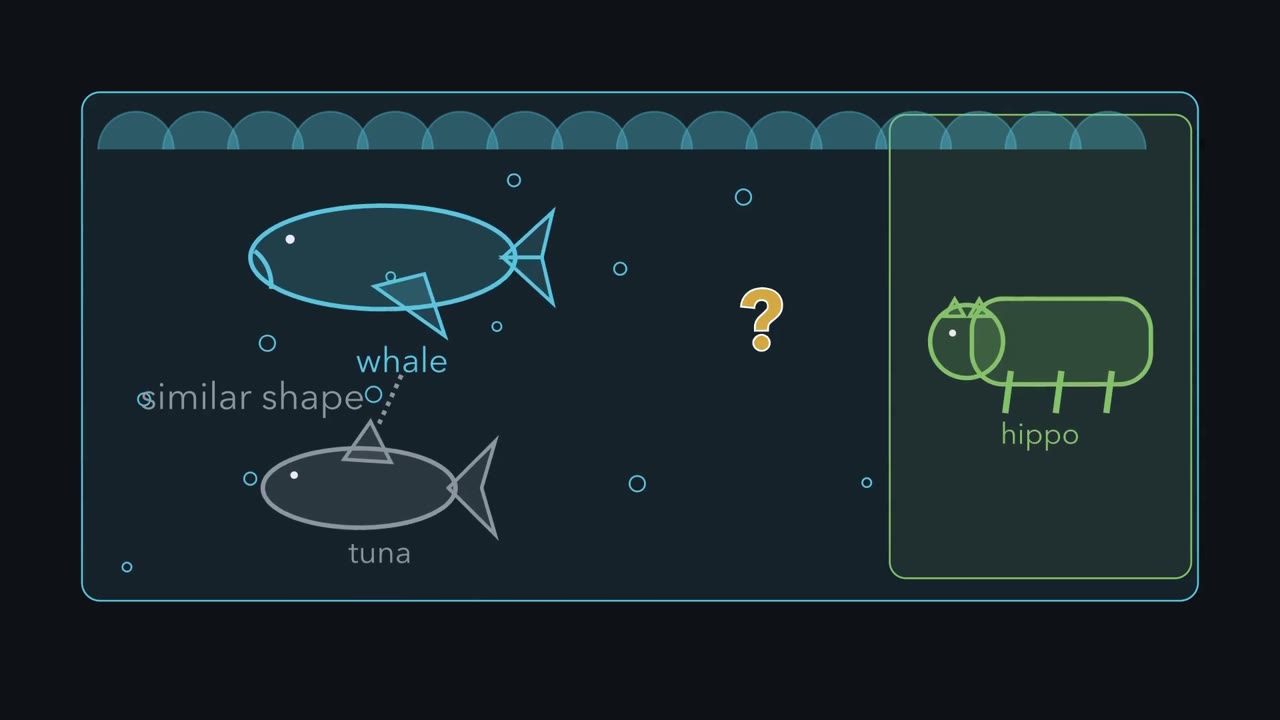
A whale lives in the sea and has a body shaped like a fish, so why do biologists say its closest living relatives are hippos?
Continue in the lesson: Building a Tree of Life →
3:16 · Free, with captions and a transcript. The lesson has the full text, the questions and the sources.
More films from this lesson
How this film was made. Narration: an AI narrator voice (Kokoro, af_heart) reading narration written from this lesson's text. Animation: AI-generated in code (Manim) by Claude, a schematic with no drawn molecular structures. Captions come from the narration script. See something wrong? Report it.