The Brake and Its Two Routes
Read the transcript of “The Brake and Its Two Routes”
Film transcript: The Brake and Its Two Routes
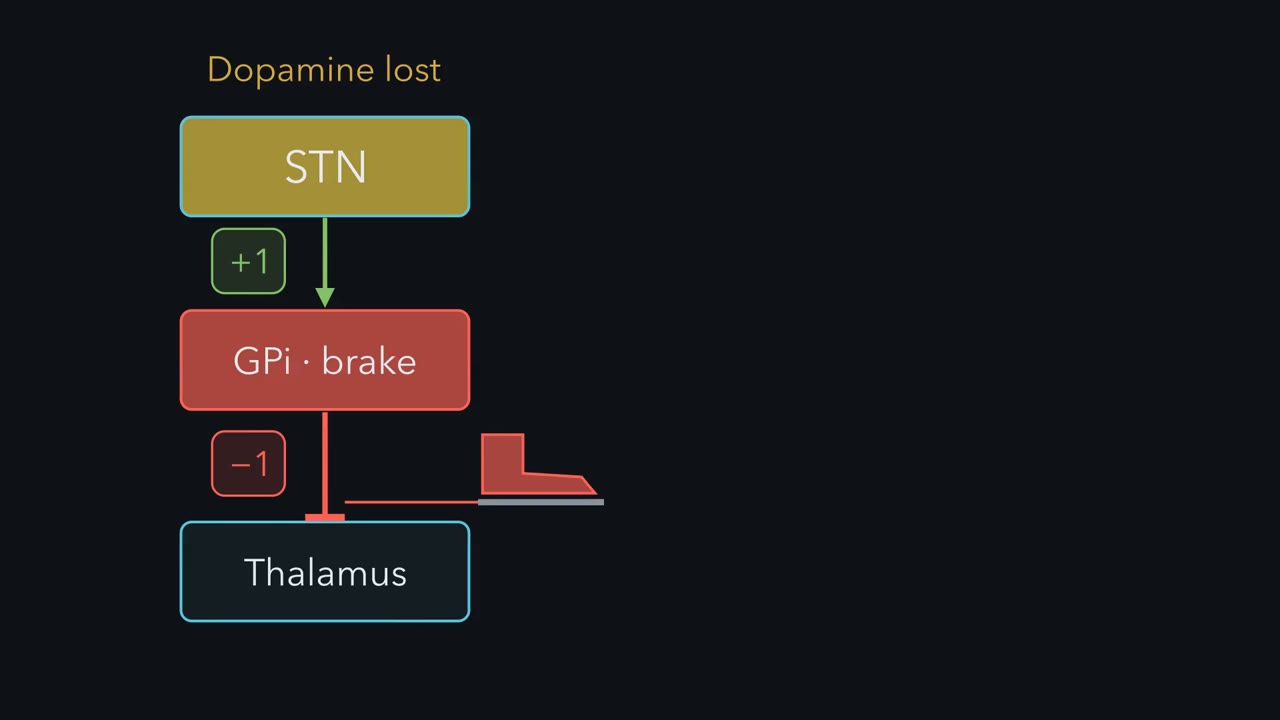
How can nuclei that never reach the spinal cord decide whether a movement goes ahead? Start with a picture: a column of boxes. The cortex is at the top, then an input stage. An output stage feeds the thalamus, which sends an arrow back to the cortex, closing a loop. Now the names. The input stage is the striatum. The output stage is the internal globus pallidus, GPi. Its output neurons are inhibitory and fire steadily, even at rest. So the thalamus is held down, like a foot on a brake. In the classic model, movement needs the brake lifted. Two routes run from the striatum to the brake. Striatal projection neurons are inhibitory too. In the direct route, striatal neurons with D1 receptors inhibit the brake.
The brake inhibits the thalamus. Two inhibitions, an even number. More striatal firing releases the thalamus, toward movement. The indirect route takes a detour. Striatal neurons with D2 receptors inhibit the external globus pallidus, GPe. GPe inhibits the subthalamic nucleus, STN. And the STN excites the brake. Walk it through. D2 neurons fire more, so GPe fires less, and the freed STN fires more. The brake, excited, fires more. The thalamus is held down harder. Three inhibitions, an odd number. This route pushes away from movement. Now add dopamine, from the substantia nigra pars compacta. It acts on the first box of each route. Treat each action as one more link.
In the classic model, dopamine excites the D1 neurons and inhibits the D2 neurons. Acting through each receptor, does dopamine push toward movement or away from it? Toward movement, both ways. Through D1, dopamine adds no flip. Through D2, its own inhibition adds one flip to the route's three. Four flips, an even number. The two actions agree. So losing dopamine pushes both routes toward less movement. The direct route weakens, the indirect strengthens. So the brake fires more for two reasons: less inhibition from the striatum, more excitation from the STN. The thalamus is held down harder, and movement is hard to start: the model's prediction of akinesia.
The model rests on a measurement. In 1960, post-mortem brains from people with Parkinson's disease showed striatal dopamine greatly reduced. Inhibit an inhibitor, and you release its target.
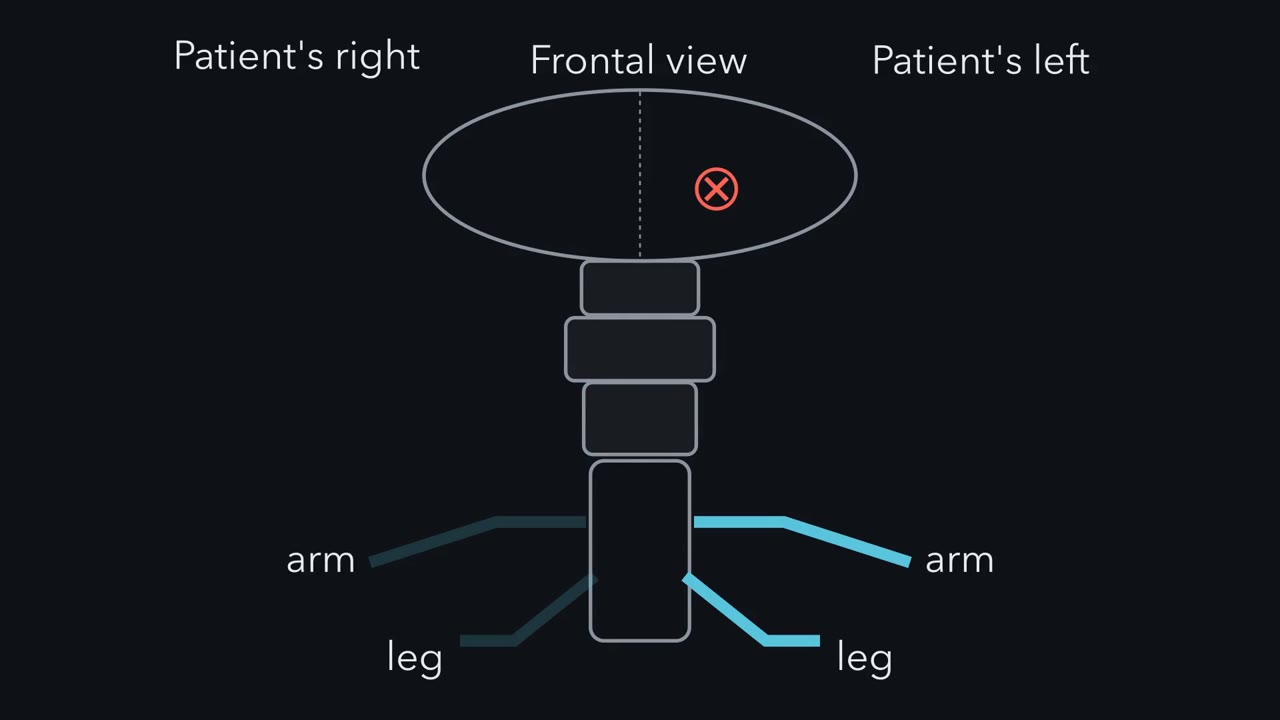
A stroke deep in the left hemisphere weakens the right side. A cut in the right half of the neck weakens the right side too. Why?
Continue in the lesson: Descending Control and the Basal Ganglia →
3:04 · Free, with captions and a transcript. The lesson has the full text, the questions and the sources.
More films from this lesson
How this film was made. Narration: an AI narrator voice (Kokoro, af_heart) reading narration written from this lesson's text. Animation: AI-generated in code (Manim) by Claude, a schematic with no drawn molecular structures. Captions come from the narration script. See something wrong? Report it.