Two Counts: Side and Sign
Read the transcript of “Two Counts: Side and Sign”
Film transcript: Two Counts: Side and Sign
A stroke deep in the left side of the brain weakens the right side of the body. Why the opposite side? A cut through the right half of the cord in the neck weakens the right side too. Lesions on opposite sides, weakness on the same side. Follow the tract down from the motor cortex, through the internal capsule and the brainstem. In the caudal medulla, most of its fibres cross the midline. That crossing is the pyramidal decussation. Damage above the crossing shows up on the opposite side of the body. In the cord, most fibres have already crossed. So damage there shows up on the same side. So here is the first count. Count the crossings between the damage and the muscle.
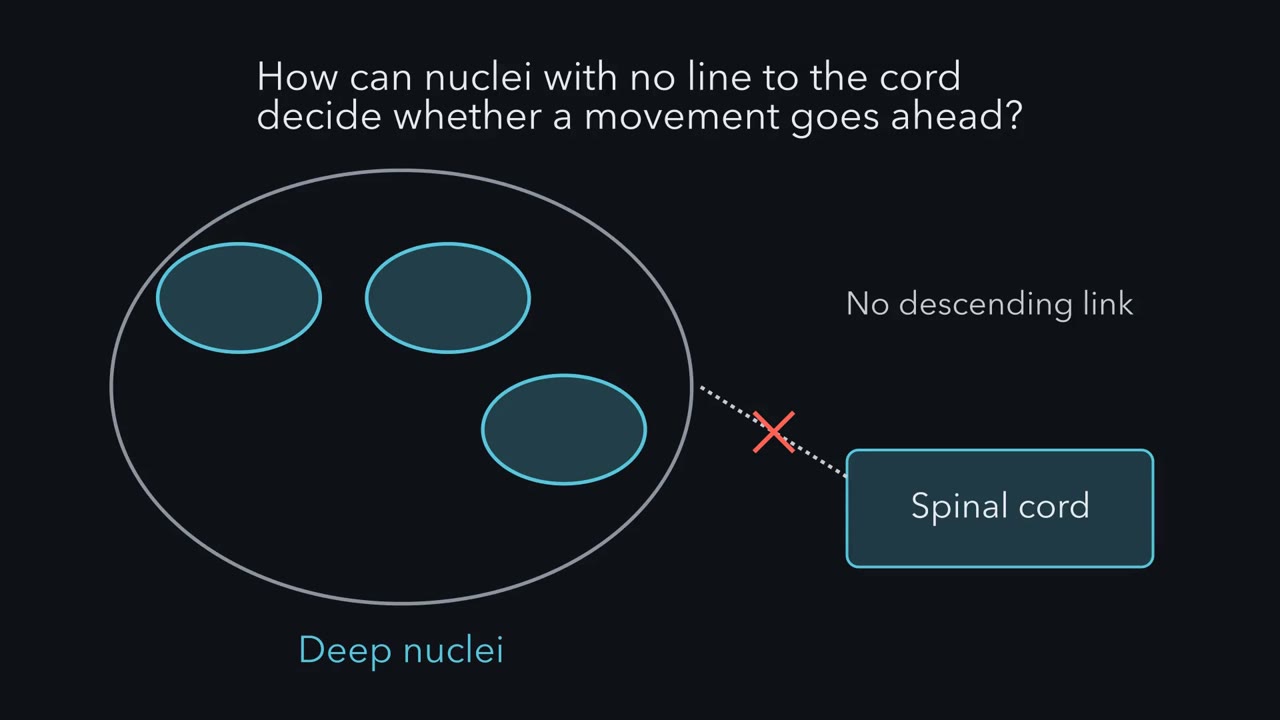
One crossing flips the side. Try one. A lesion sits in the right pyramid, just above the crossing. Which limbs are weak? The left limbs. One crossing lies below the lesion, so the side flips. A second puzzle. The basal ganglia never reach the spinal cord, yet in the classic model they decide whether a movement goes ahead. Their trick rests on inhibition. Picture three neurons in a row. The first inhibits the second, and the second inhibits the third. Now the first neuron starts firing faster. What does the third one do?
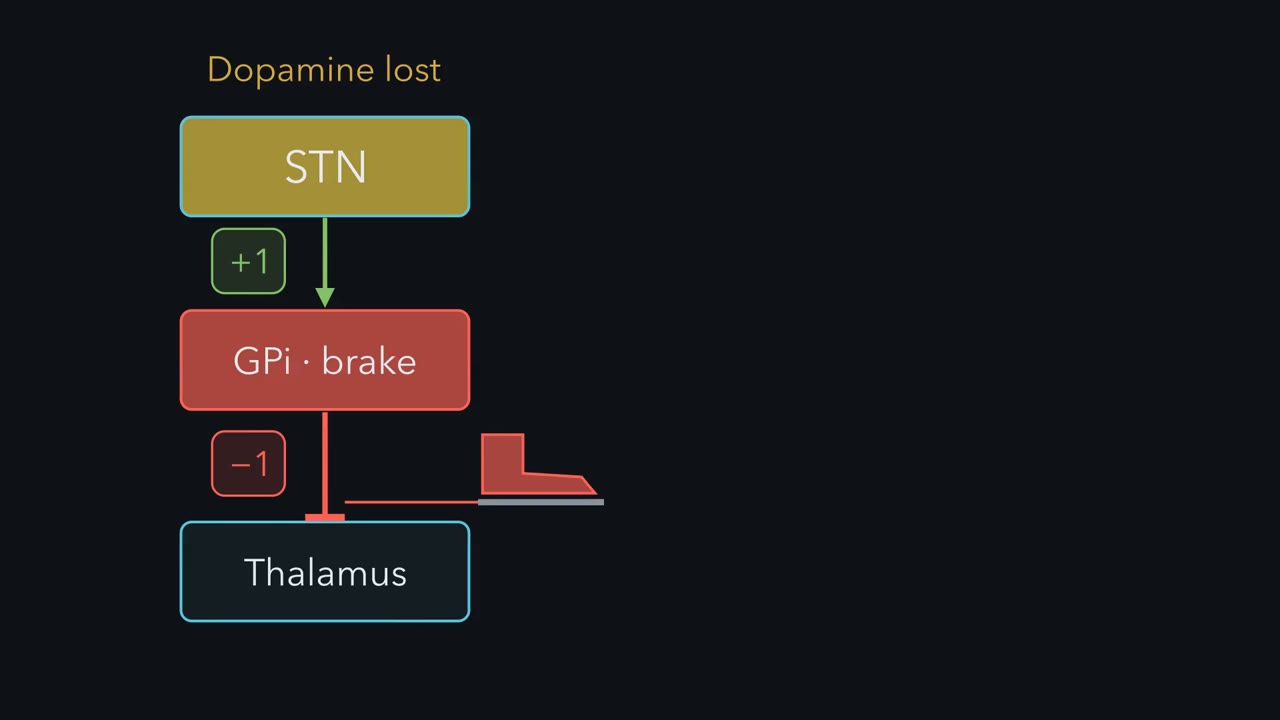
The third fires faster too. The first holds the second down, so the second lets go of the third. Inhibiting an inhibitor releases its target. That is disinhibition. That is the second count. Each inhibitory link flips the sign. An even number keeps the direction. An odd number reverses it. Put them together. For a motor pathway, follow the chain from the lesion or drug to the muscle. Crossings set the side. Inhibitions set the sign. Some limits. The counts give the direction of a change along one chosen path, not its size. The sign count assumes each link keeps a fixed sign, and each neuron can still change its firing. When routes pull in opposite directions, the net effect depends on how strong each route is. And input from both sides breaks the crossing count: after a one-sided cortical lesion, the forehead is usually weakened less than the lower face.
Follow the chain, and count what flips.
A stroke deep in the left hemisphere weakens the right side. A cut in the right half of the neck weakens the right side too. Why?
Continue in the lesson: Descending Control and the Basal Ganglia →
2:41 · Free, with captions and a transcript. The lesson has the full text, the questions and the sources.
More films from this lesson
How this film was made. Narration: an AI narrator voice (Kokoro, af_heart) reading narration written from this lesson's text. Animation: AI-generated in code (Manim) by Claude, a schematic with no drawn molecular structures. Captions come from the narration script. See something wrong? Report it.