Films · Genetics and Molecular Biology
When Genes Share a Phage
Read the transcript of “When Genes Share a Phage”
Film transcript: When Genes Share a Phage
The first film used ordered arrival to map a chromosome. How can a phage reveal which genes sit close together? Keep following gold donor DNA. The carrier has changed, so the readout must change too. Genes can cross a cell-blocking filter inside phage particles, protected from DNase. In generalized transduction, a phage sometimes packages host DNA instead of phage DNA. Any host region can be sampled. The coat reveals the route; the host fragment creates the mapping signal. P22 carries host fragments in Salmonella. P1 does this in E. coli. Each transducing particle delivers only a limited chromosome segment. The phage carries a short window, not the whole circular chromosome.
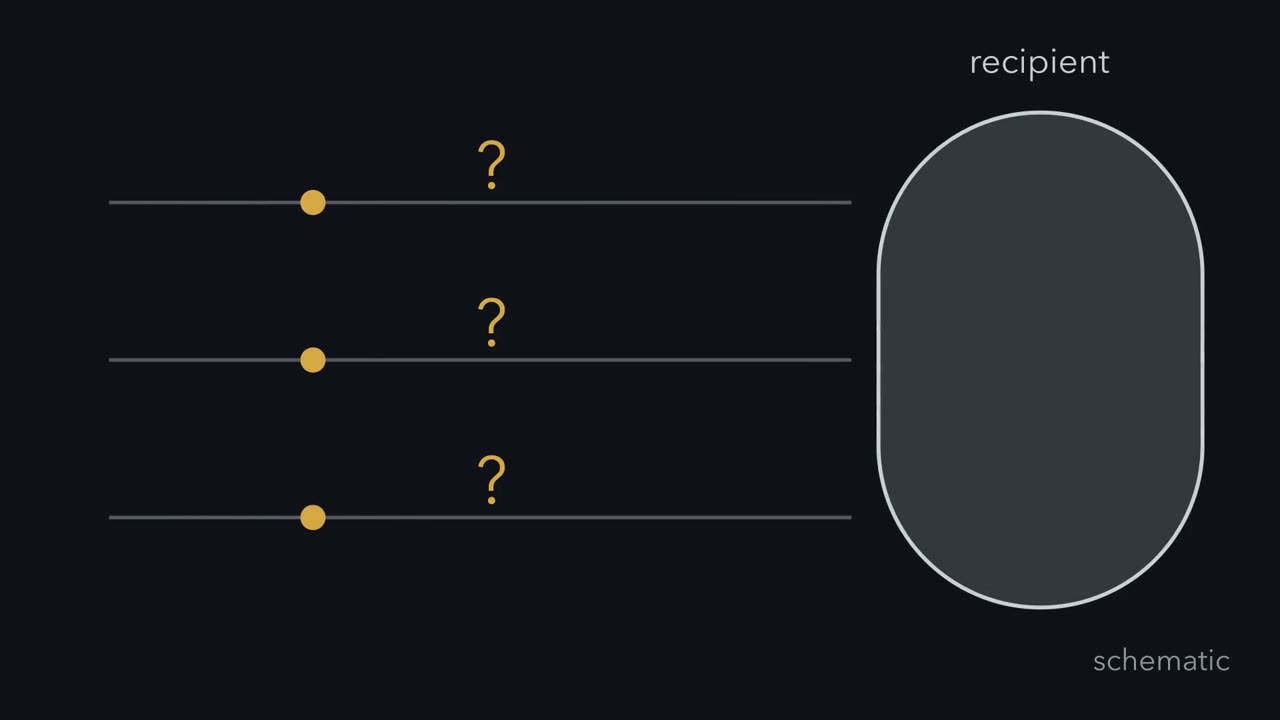
Specialized transduction follows another rule. Lambda inserts at one preferred site between gal and bio. Inaccurate removal can carry only neighbouring host genes. This is not random sampling across the chromosome; attachment-site position matters. Return to generalized transduction. Two genes can share one particle only when one host fragment covers both. Closer markers fit together in more possible windows. Move the window and count how often both markers remain inside. Two marker pairs produce different shared-carriage bars. One bar is high, and one is low. Which pair lies closer on the chromosome?
Compare only the bars; do not infer direction yet. The pair with the higher shared-carriage bar is closer. More fragment positions can include both markers, so more particles deliver them together. The bar summarizes many particles, not one specially chosen fragment. Researchers select recipients that gained one donor marker. Then they score the fraction that also gained another. That fraction is the cotransduction frequency.
Selection defines the denominator before the second marker is counted. Frequencies against one selected marker rank proximity, but cannot place genes left or right. Three-factor classes settle the order. The same proximity can sit on either side of the selected marker. Shared carriage is not the whole colony. The donor fragment must enter and be expressed. For stable inheritance, it must also recombine into the recipient chromosome. A colony combines transport, recombination, expression, and survival under selection. Interrupted mating maps long chromosome stretches by time. Cotransduction resolves a local interval by shared carriage. Each route creates its own map readout.
Neither readout gives physical base pairs directly in this lesson. For generalized transduction, shared carriage maps proximity. Closer genes travel together more often, within the phage's limited load. Compare markers under the same phage and experimental conditions.
Two E. coli strains that each cannot make several nutrients are mixed. A few cells can now make them all. Where did the genes come from?
Continue in the lesson: Bacterial and Phage Genetics: Conjugation, Transduction and Transformation →
3:46 · Free, with captions and a transcript. The lesson has the full text, the questions and the sources.
More films from this lesson
How this film was made. Narration: an AI narrator voice (Kokoro, af_heart) reading narration written from this lesson's text. Animation: AI-generated in code (Manim) by Claude, a schematic with no drawn molecular structures. Captions come from the narration script. See something wrong? Report it.