Films · Genetics and Molecular Biology
From DNA Route to Gene Order
Read the transcript of “From DNA Route to Gene Order”
Film transcript: From DNA Route to Gene Order
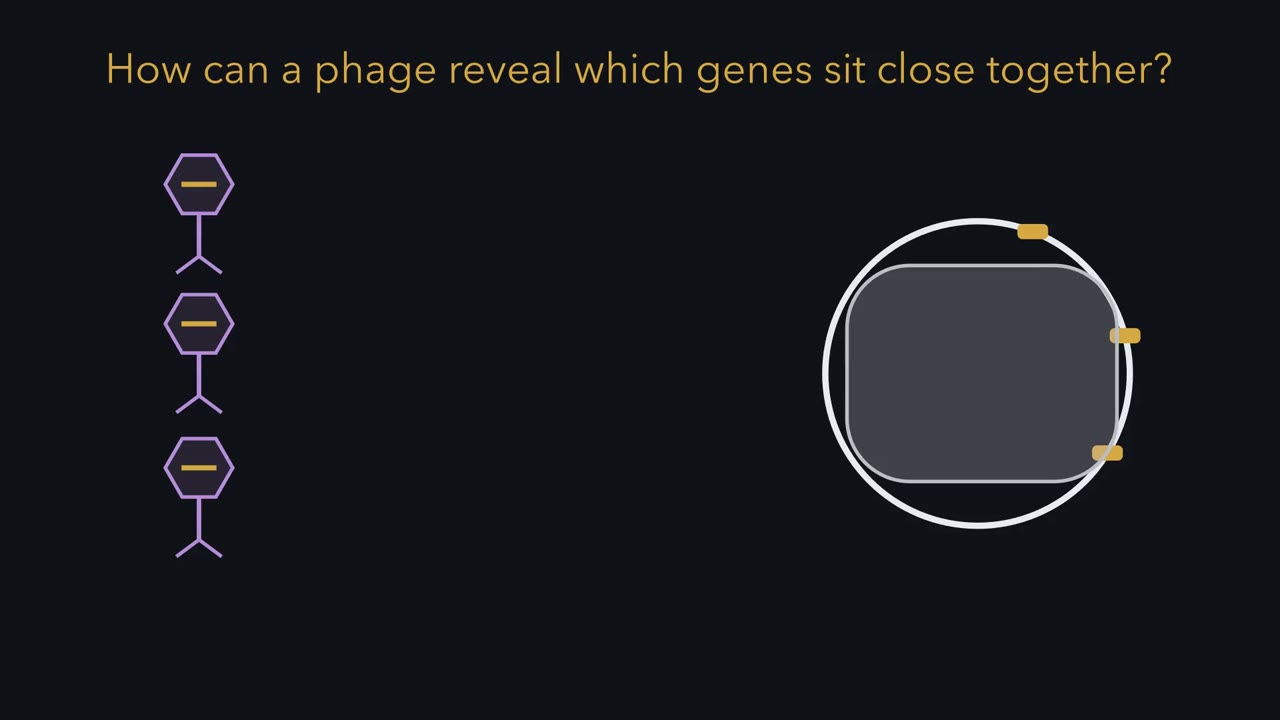
A bacterium gained a useful gene. What carried it there, and can that journey reveal a map? Watch the donor DNA, shown in gold. Bacteria do not make meiotic crosses, yet donor genes can become inherited. One path exposes free DNA for transformation. Another joins donor and recipient for conjugation. The third protects donor DNA inside a phage during transduction.
Competent cells take up the free DNA. A filter that stops cells blocks only the contact path. DNase destroys exposed DNA, but a phage coat protects its cargo. That two-step test turns three pictures into a decision. An unknown transfer survives the enzyme, but stops when cells are separated. Which carrier fits? Follow both clues before choosing. One result rules out free DNA. The other rules out a phage.
Conjugation fits. Its DNA is never exposed, so the enzyme misses it. Separating the cells removes the connection it needs. Both clues point to direct contact, not merely DNA moving through the medium. In E. coli, the F factor is a small DNA circle. Free F transfers itself from a donor to a recipient. One strand crosses from F+ plus to F−, minus, and each cell completes the circle. Chromosomal markers rarely follow. When F joins the donor chromosome, the cell is Hfr. Transfer now pulls chromosomal markers through the same origin in a fixed order. Because pairs usually separate early, recipients receive only part of the chromosome. The remaining F sequence would arrive last.
Break different pairs apart at different times, then score the recipients. Markers nearer the origin appear first. With steady transfer, the time gaps become map distances. Selective plates reveal which recipients inherited each marker. A marker's entry time is the earliest interruption that still yields it. A different Hfr origin can send the same chromosome the other way.
Absolute arrival times change, but matching gaps reveal one circular map. The origin sets the starting time, so absolute times cannot be compared directly across donors. Selection makes rare recipients visible, but a colony reports more than arrival. The donor piece must also be expressed and usually integrated. Incoming linear DNA cannot copy itself with the chromosome.
Recombination can replace the matching recipient segment. The route created the readout. For Hfr transfer, ordered arrival maps gene order. If transfer is roughly steady, time gaps also map distance. Keep the gaps, not the clock's starting values.
Two E. coli strains that each cannot make several nutrients are mixed. A few cells can now make them all. Where did the genes come from?
Continue in the lesson: Bacterial and Phage Genetics: Conjugation, Transduction and Transformation →
3:35 · Free, with captions and a transcript. The lesson has the full text, the questions and the sources.
More films from this lesson
How this film was made. Narration: written from this lesson's text and read by an AI narrator voice (Kokoro, af_heart). Animation: AI-generated in code (Manim) by Claude, a schematic with no drawn molecular structures. Captions come from the narration script. See something wrong? Report it.