New Neighbours
Read the transcript of “New Neighbours”
Film transcript: New Neighbours
A ball of cells has to become a body with an outside, a middle and a gut. How do surface cells get inside, and does it matter whom they meet? The first film showed cleavage cutting the egg into cells, each with its own slice.
Purple marked what a cell inherits. Cleavage makes new contacts as cells divide, but it does not rearrange the whole embryo. Gastrulation is the stage that does. Cells travel from the surface to the inside, and sort into three germ layers. Ectoderm, in blue, stays outside.
Mesoderm, in red, forms the middle. Endoderm, in yellow, lines the inside. Embryos get cells inside by several movements. In invagination, a sheet bends inward, like a finger pushed into a soft ball. In involution, a sheet rolls over an edge and spreads along the inside. In a frog, cells roll in over the lip of the blastopore, the opening where they enter. In ingression, single cells leave the sheet and move inward, one at a time. Embryos combine these movements to bring cells inside.
Moving inside does something else. Cells now sit next to cells they never touched before. Can a neighbour change what a cell becomes? Hilde Mangold tested this with newt embryos. She cut out a piece of the dorsal lip of the blastopore, the edge on the future back side. The donor came from a pale newt species. She grafted the piece onto the belly side of a darker embryo, from a related species. The host grew a second body axis.
If the graft built that second axis only from its own inherited material, what colour would the new axis be? It was not all pale. Dark host cells were part of it. The graft had recruited them. It told host cells what to become. Remember the crescent: colour showed where it went, not what it did. Here colour still only traced cells. The graft was the test, and colour showed host cells joined in. A signal from one group of cells that changes the fate of its neighbours is called induction. The grafted tissue is called the organizer. So a cell's fate has two sources. Purple: what it inherits from its slice of egg. Green: what its new neighbours tell it.
Most embryos studied closely use both.
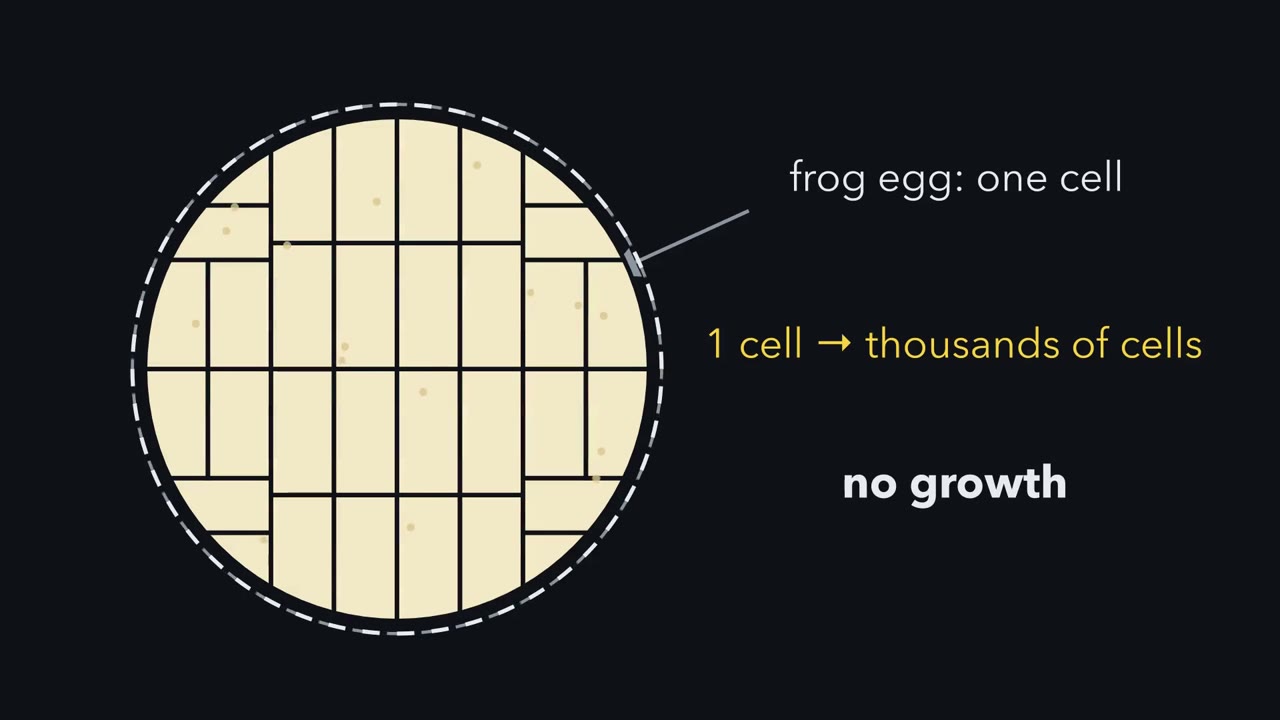
A frog egg divides into thousands of cells without growing at all. How does each cell come to its fate?
Continue in the lesson: Animal Development →
3:03 · Free, with captions and a transcript. The lesson has the full text, the questions and the sources.
More films from this lesson
How this film was made. Narration: an AI narrator voice (Kokoro, af_heart) reading narration written from this lesson's text. Animation: AI-generated in code (Manim) by Claude, a schematic with no drawn molecular structures. Captions come from the narration script. See something wrong? Report it.