One Segment, Constant Volume
Read the transcript of “One Segment, Constant Volume”
Film transcript: One Segment, Constant Volume
An earthworm has no bones. What does it push against to drive through soil? The first film showed that a body plan does not reveal ancestry. This film asks what a body plan is for. Zoom in on one segment of the earthworm. Its coelom holds fluid. Thin walls called septa largely separate it from the segments on either side. Two muscle layers wrap the body wall. Circular muscles run around it, like rings.
Longitudinal muscles run along the body. Fluid cannot be squeezed into a smaller volume. So fluid held in by a muscular wall gives muscles something to push against. This is a hydrostatic skeleton, like water in a balloon. Here we treat one segment as sealed. The coelom does a second job. Organs inside it, such as the gut, can grow and move with some independence from the body wall. Now the circular muscles contract, and the segment gets narrower. The fluid has nowhere to go. Does the segment get longer, shorter, or stay the same?
It gets longer. The volume must stay the same, so a narrower segment has to stretch. The septa move apart as the end faces shrink. Now the longitudinal muscles contract. The segment gets shorter, so at the same volume it must get fatter. Tiny bristles called setae poke out and grip the soil. Because septa partition the coelom, neighbours can take different shapes. In textbook accounts, each segment works largely on its own. One is long and thin, reaching forward. Its neighbour is short, fat and anchored. Pass these shapes down the body as a wave. Long, thin segments reach ahead. Short, fat segments hold the ground behind them. And the worm moves forward through the soil.
The same body plan has a second payoff. The gut runs through, from mouth to anus. Food moves one way, so successive regions can specialize in different jobs. A muscular pharynx takes food in. A crop stores it. A gizzard grinds it. A long intestine digests and absorbs it. So the earthworm needs no bones. Fluid held in by muscle is its skeleton. The volume stays the same. Narrow a segment, and it lengthens. Shorten it, and it widens.
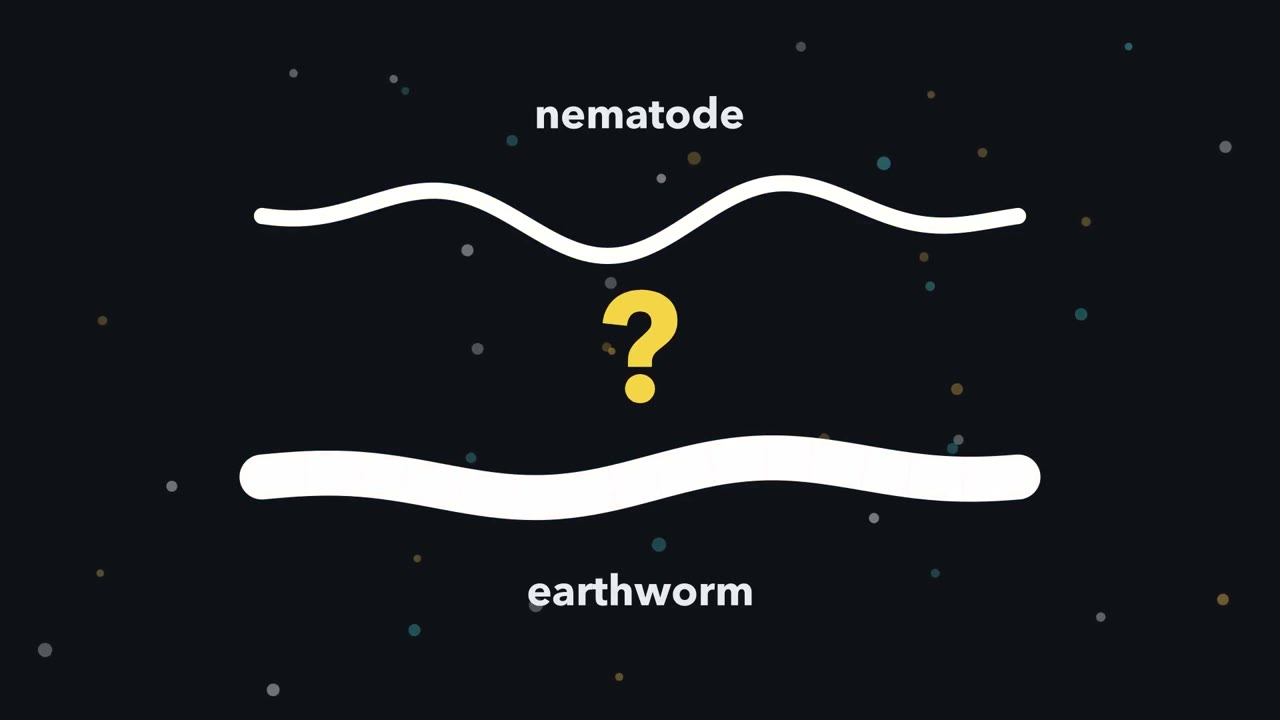
A nematode and an earthworm are both soft, tube-shaped worms with a gut from mouth to anus. Genes put the nematode with insects and other moulting animals, and the earthworm with snails and flatworms. What does a body plan tell you, and what does it not?
Continue in the lesson: Animal Body Plans: Similar Bodies, Different Branches →
3:03 · Free, with captions and a transcript. The lesson has the full text, the questions and the sources.
More films from this lesson
How this film was made. Narration: an AI narrator voice (Kokoro, af_heart) reading narration written from this lesson's text. Animation: AI-generated in code (Manim) by Claude, a schematic with no drawn molecular structures. Captions come from the narration script. See something wrong? Report it.