Similar Bodies, Different Branches
Read the transcript of “Similar Bodies, Different Branches”
Film transcript: Similar Bodies, Different Branches
A nematode and an earthworm look almost the same. Are they close relatives? Both are soft, tube-shaped worms. Each has a gut that runs from mouth to anus. Slice each worm across the middle. Add a third worm, a flat planarian. Now colour the tissue layers. The outer layer is blue. The middle layer, mesoderm, is orange. It makes muscle. The gut lining is yellow. The small white space in each centre is the gut lumen, where food goes. It is not the body cavity. The body cavity, if there is one, lies between gut and body wall. In the planarian, tissue fills that space. There is no body cavity. In the nematode, a fluid space is lined by mesoderm only on the outside.
That is a pseudocoelom. In the earthworm, the fluid space is lined by mesoderm on both sides. That is a true coelom. Three worms, three ways to fill the same space. Libbie Hyman's great survey of the invertebrates ordered animals this way. No cavity, then a partial lining, then a full one. It looks like a staircase, from simple to complex. Now compare genes from many animals instead. If the staircase were a family tree, where should the nematode land?
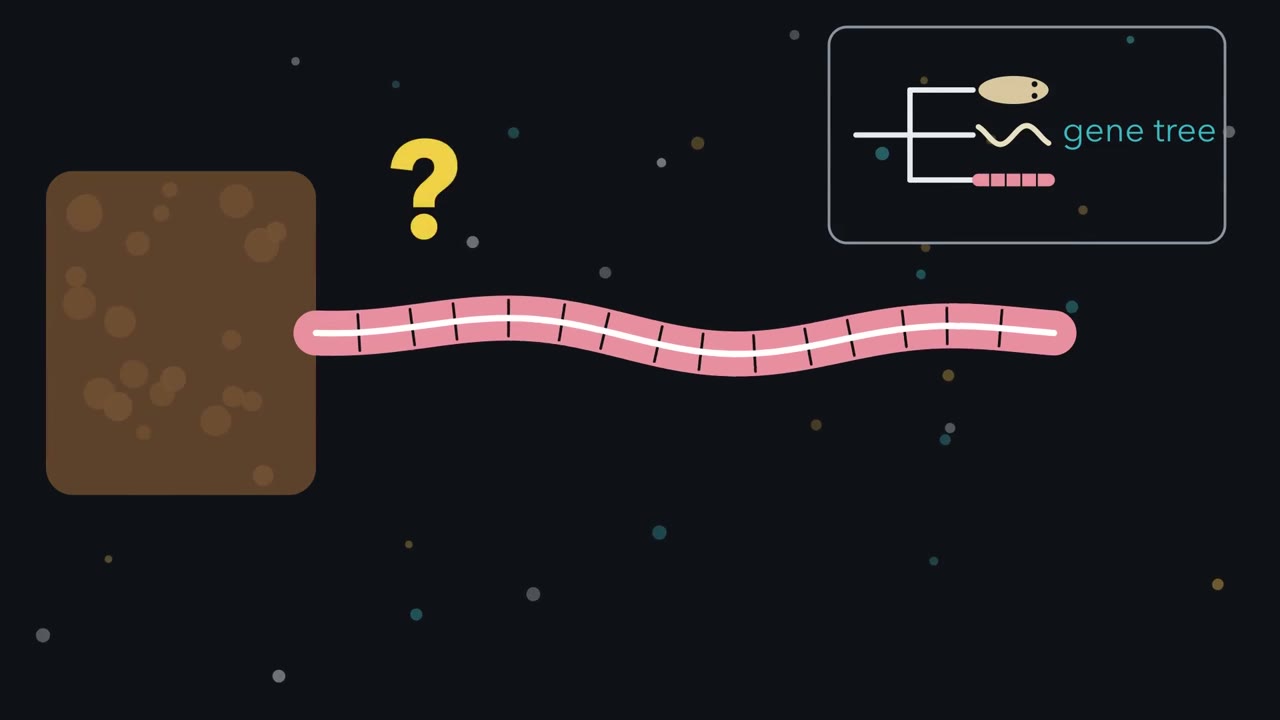
Between the flatworm and the earthworm, or somewhere else? Somewhere else. The genes put the nematode with the arthropods, such as insects. Both shed a tough outer cuticle as they grow. That moulting names the group, Ecdysozoa. The planarian moves too. It lands beside the earthworm and a snail, in a group called Spiralia. Its relatives have a coelom. So the flatworm is not an early, simple branch. Now mark each tip with its body cavity. The cavity marks are scattered across the tree. The moulting mark sits on one branch only. Animals that share a level of organization, like a body-cavity type, form a grade. A clade is something else. It is an ancestor and all of its descendants.
A shared, derived character can mark a clade. It is a new state that arose in a common ancestor. Moulting fits one origin on this tree. Cavity type changes several times. To test any character, lay it on a tree built from other evidence. Many genes are one such source. So keep two jobs apart. A body plan describes how an animal is built. Independent evidence tests whom it descends from.
A nematode and an earthworm are both soft, tube-shaped worms with a gut from mouth to anus. Genes put the nematode with insects and other moulting animals, and the earthworm with snails and flatworms. What does a body plan tell you, and what does it not?
Continue in the lesson: Animal Body Plans: Similar Bodies, Different Branches →
3:16 · Free, with captions and a transcript. The lesson has the full text, the questions and the sources.
More films from this lesson
How this film was made. Narration: written from this lesson's text and read by an AI narrator voice (Kokoro, af_heart). Animation: AI-generated in code (Manim) by Claude, a schematic with no drawn molecular structures. Captions come from the narration script. See something wrong? Report it.