Films · Developmental Neuroscience
Who Makes Them, and How Many Are Kept
Read the transcript of “Who Makes Them, and How Many Are Kept”
Film transcript: Who Makes Them, and How Many Are Kept
Adult rodents make new neurons. Which cell makes them, and how many are kept? They appear in two places. One is the subventricular zone, in the wall of the lateral ventricles. Its young neurons migrate forward in chains to the olfactory bulb. The other is the dentate gyrus of the hippocampus. There, the rate falls steeply with age.
Four kinds of cell sit in that wall. Ependymal cells line it, with astrocyte-like B cells beneath. Both divide rarely. Fast-dividing C cells multiply, and young neurons, the A cells, migrate away. In 1999, Fiona Doetsch and colleagues infused adult mice with a drug that kills cells copying DNA, then stopped. Pause and predict. Which cells survive? And which one rebuilds the zone?
The fast dividers and most neuroblasts died. The rare dividers survived. Then the astrocyte-like cells divided. Precursors came back, then neuroblasts, in the normal order. That makes them the leading candidate, not yet proof. Proof needs an inherited label showing the neurons descend from an astrocyte-like cell, in the same cells as neuron identity. This retrovirus writes its genes into the chromosome of a dividing cell, so every descendant inherits them. This virus enters only through one receptor. The mice were engineered to make it only in cells making GFAP. So in untreated mice, only astrocyte-like cells were infected. Later, the marker turned up in new olfactory bulb neurons.
The dentate gyrus follows the same plan, with radial, astrocyte-like stem cells. How many are kept? In mice, many newborn cells die early, mostly within the first days. Later, while they mature, survival also depends partly on their own activity. Young neurons lacking NMDA receptors survive less well than their neighbours. Other survival signals may help too. More new neurons can mean more division, or more young cells kept. Two time points help tell them apart. After one dose of BrdU, a one-day count is an index of division. At four weeks, label plus a neuron protein counts labelled cells that are neurons by then. Pause and predict. If running acted only on division, what would you see at each time point?
More labelled cells at one day, and more new neurons at four weeks, in the same proportion. In those mouse studies, running mainly raised division. Enriched housing mainly raised survival. Takeaway: the stem cell looks glial, and born is not the same as kept.
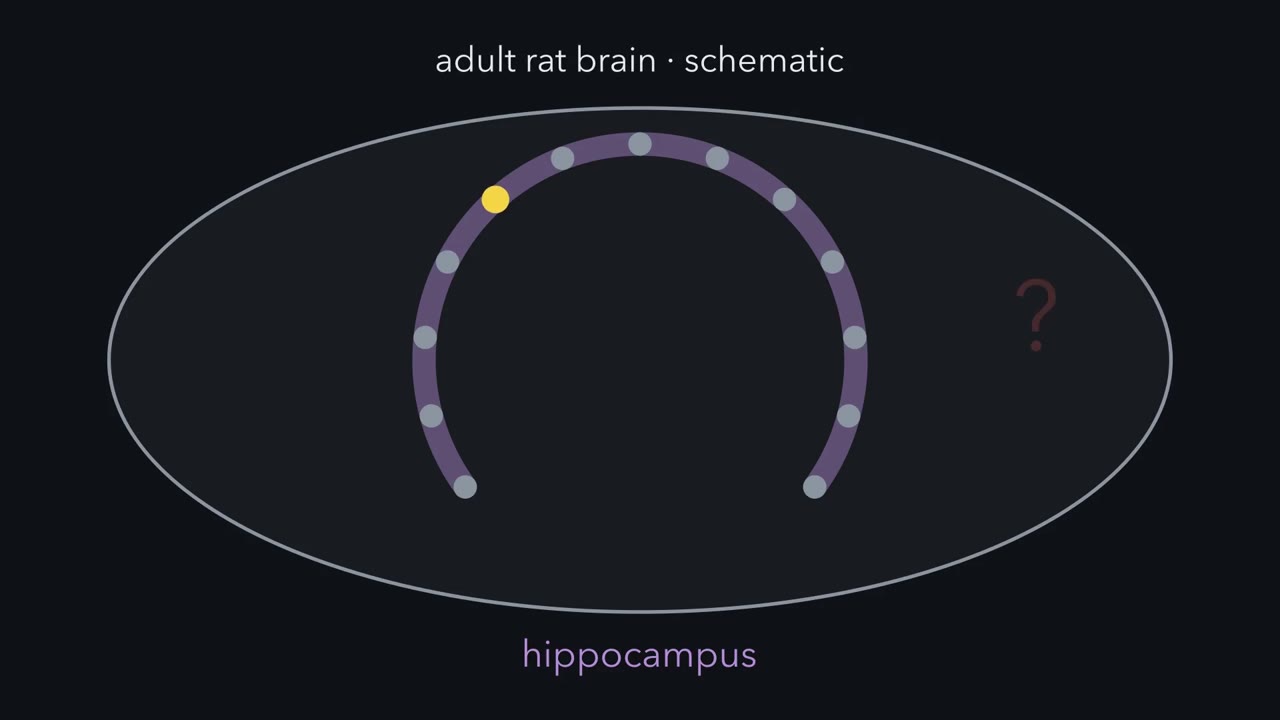
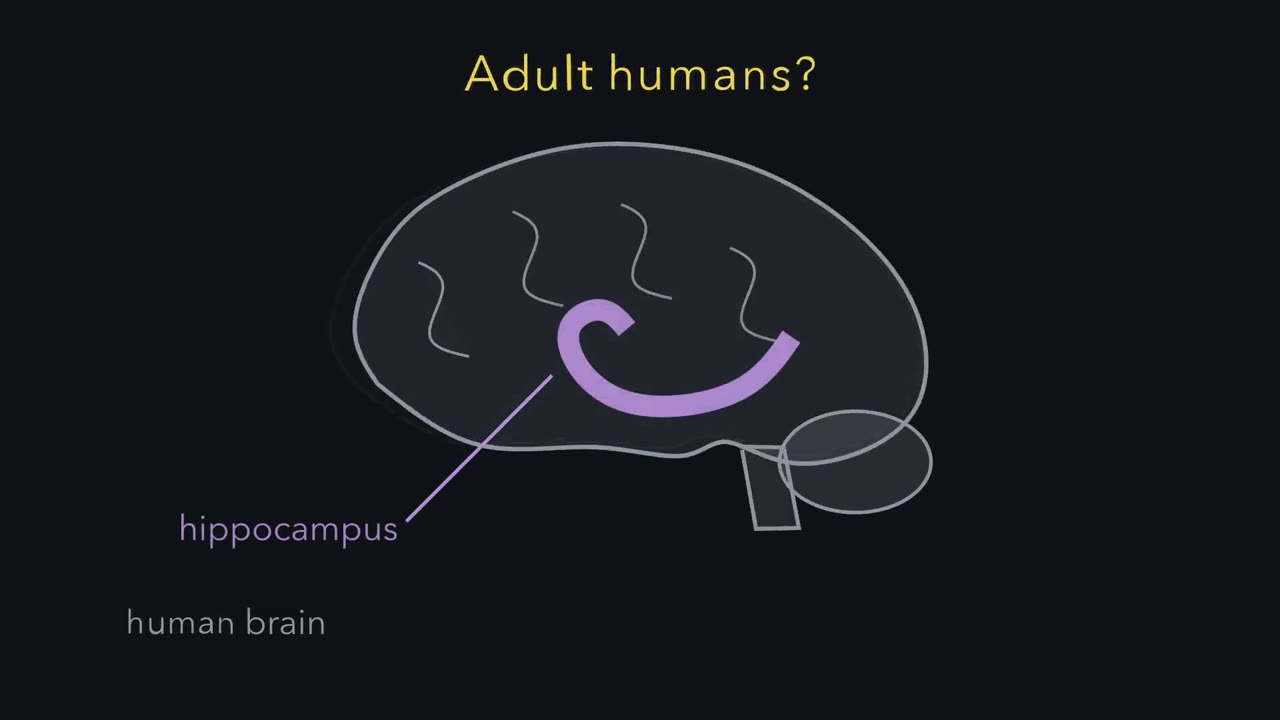
Inject an adult rat with a label that marks newly made DNA. A month later a labelled cell sits in its hippocampus. Is it a new neuron, how would you know, and do you make them too?
Continue in the lesson: Two Places the Adult Brain Still Makes Neurons →
3:29 · Free, with captions and a transcript. The lesson has the full text, the questions and the sources.
More films from this lesson
How this film was made. Narration: an AI narrator voice (Kokoro, af_heart) reading narration written from this lesson's text. Animation: AI-generated in code (Manim) by Claude, a schematic with no drawn molecular structures. Captions come from the narration script. See something wrong? Report it.